




Among the following L-serine is:
A)

B)

C)

D)

Answer
 Verified
577.8k+ views
Hint: Serine belongs to the category of ɑ-amino acids which is generally employed in the protein biosynthesis. It comprises of α-amino group (protonated \[-N{H_3}^ + \]), a carboxyl group (deprotonated\[-CO{O^ - }\]), and a side chain comprising of a hydroxyl methyl group, thus, classifying serine a polar amino acid. The L-stereoisomer of serine occurs naturally in proteins.
Complete step by step answer:
Almost every amino acid can exist in two forms of isomers owing to the capability to form two different enantiomers (i.e. stereoisomers) around the chiral (central) carbon atom. Conventionally, these are known as L- and D- forms, which mean left-handed and right-handed atomic configurations. While (+) and (-) notation indicate the substance’s optical activity. If it rotates the plane of polarised light in the clockwise direction, (+) notation is used otherwise (i.e. anti-clockwise) (-) notation is used. If we compare R and S nomenclature, R indicates clockwise direction and S indicates anti-clockwise direction. Always keep in mind that the curved arrow is drawn from the highest priority substituent towards the lowest priority substituent as shown below. The order of priority followed is : \[ - N{H_2}\;,{\text{ }} - {\text{ }}COOH,{\text{ }} - {\text{ }}C{H_2}\;OH,{\text{ }} - H\].
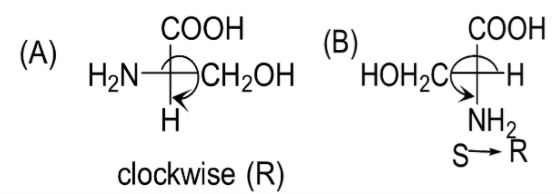
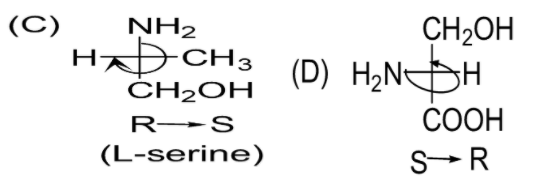
Therefore, the correct answer is Option C.
Note:
The names of the enantiomers of a compound must comprise the "handedness" of a molecule. The Cahn–Ingold–Prelog sequence rules,or simply called as CIP priority rules are considered to be a standard process in organic chemistry to completely name a stereoisomer of a molecule. The CIP rules assign a R or S descriptor to every stereocenter and also an E or Z descriptor to every double bond such that the configuration of the molecule can be uniquely specified by including the descriptors in its name.
Complete step by step answer:
Almost every amino acid can exist in two forms of isomers owing to the capability to form two different enantiomers (i.e. stereoisomers) around the chiral (central) carbon atom. Conventionally, these are known as L- and D- forms, which mean left-handed and right-handed atomic configurations. While (+) and (-) notation indicate the substance’s optical activity. If it rotates the plane of polarised light in the clockwise direction, (+) notation is used otherwise (i.e. anti-clockwise) (-) notation is used. If we compare R and S nomenclature, R indicates clockwise direction and S indicates anti-clockwise direction. Always keep in mind that the curved arrow is drawn from the highest priority substituent towards the lowest priority substituent as shown below. The order of priority followed is : \[ - N{H_2}\;,{\text{ }} - {\text{ }}COOH,{\text{ }} - {\text{ }}C{H_2}\;OH,{\text{ }} - H\].
Therefore, the correct answer is Option C.
Note:
The names of the enantiomers of a compound must comprise the "handedness" of a molecule. The Cahn–Ingold–Prelog sequence rules,or simply called as CIP priority rules are considered to be a standard process in organic chemistry to completely name a stereoisomer of a molecule. The CIP rules assign a R or S descriptor to every stereocenter and also an E or Z descriptor to every double bond such that the configuration of the molecule can be uniquely specified by including the descriptors in its name.
Recently Updated Pages
Master Class 11 Computer Science: Engaging Questions & Answers for Success

Master Class 11 Business Studies: Engaging Questions & Answers for Success
Master Class 11 Economics: Engaging Questions & Answers for Success
Master Class 11 English: Engaging Questions & Answers for Success
Master Class 11 Maths: Engaging Questions & Answers for Success
Master Class 11 Biology: Engaging Questions & Answers for Success
Trending doubts
One Metric ton is equal to kg A 10000 B 1000 C 100 class 11 physics CBSE
There are 720 permutations of the digits 1 2 3 4 5 class 11 maths CBSE
Discuss the various forms of bacteria class 11 biology CBSE
Draw a diagram of a plant cell and label at least eight class 11 biology CBSE
State the laws of reflection of light
10 examples of friction in our daily life