




Why are smooth muscles called involuntary in nature?
Answer
 Verified
510.9k+ views
Hint: Involuntary muscles are those that cannot be controlled by will or consciousness and are frequently associated with organs that contract and relax slowly and regularly. Because there are no striations when viewed under a microscope, involuntary muscles are also known as smooth muscles or non-striated muscles.
Complete answer:
Smooth muscles can be found in the oesophagus, stomach, intestine, blood vessels, iris of the eye, and dermis of the skin. They are involuntary because they cannot be directly controlled. The autonomic nervous system regulates the action of these muscles.
Smooth muscle is a type of muscle tissue that is used to apply pressure to vessels and organs by various systems. Smooth muscle is made up of smooth muscle cells arranged in sheets or strands. These cells have actin and myosin fibres that run through the cell and are supported by a protein framework.
Smooth muscle contracts in response to certain stimuli as ATP is released for use by myosin. The amount of ATP released is proportional to the intensity of the stimuli, allowing the smooth muscle to contract in a graded manner as opposed to the skeletal muscle's "on-or-off" contraction.
Smooth muscle, like all muscle tissue, can contract. The image above depicts how actin and myosin fibres shorten, causing the cell to shrink. However, there are some significant differences between smooth muscle and other types of muscle in terms of how they contract.
A signal from the somatic nervous system travels to the muscle and stimulates organelles in the muscle cell to release calcium. Calcium causes a protein to detach from actin, and myosin binds to the opening on actin very quickly. Because ATP is always available, myosin uses it to rapidly contract the cell. While smooth muscle does not contract or release as quickly as skeletal or cardiac muscle, it is far more useful in terms of providing consistent, elastic tension.
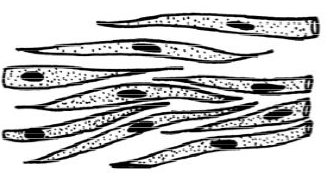
Thus, the smooth muscles are called involuntary in nature.
Note: Smooth muscle, because of its ability to contract and hold, is used for a variety of functions throughout the body. Smooth muscle is also responsible for contracting the irises, raising the small hairs on your arm, contracting the many sphincters in your body, and even moving fluids through organs by applying pressure to them, in addition to the functions listed above.
Complete answer:
Smooth muscles can be found in the oesophagus, stomach, intestine, blood vessels, iris of the eye, and dermis of the skin. They are involuntary because they cannot be directly controlled. The autonomic nervous system regulates the action of these muscles.
Smooth muscle is a type of muscle tissue that is used to apply pressure to vessels and organs by various systems. Smooth muscle is made up of smooth muscle cells arranged in sheets or strands. These cells have actin and myosin fibres that run through the cell and are supported by a protein framework.
Smooth muscle contracts in response to certain stimuli as ATP is released for use by myosin. The amount of ATP released is proportional to the intensity of the stimuli, allowing the smooth muscle to contract in a graded manner as opposed to the skeletal muscle's "on-or-off" contraction.
Smooth muscle, like all muscle tissue, can contract. The image above depicts how actin and myosin fibres shorten, causing the cell to shrink. However, there are some significant differences between smooth muscle and other types of muscle in terms of how they contract.
A signal from the somatic nervous system travels to the muscle and stimulates organelles in the muscle cell to release calcium. Calcium causes a protein to detach from actin, and myosin binds to the opening on actin very quickly. Because ATP is always available, myosin uses it to rapidly contract the cell. While smooth muscle does not contract or release as quickly as skeletal or cardiac muscle, it is far more useful in terms of providing consistent, elastic tension.
Thus, the smooth muscles are called involuntary in nature.
Note: Smooth muscle, because of its ability to contract and hold, is used for a variety of functions throughout the body. Smooth muscle is also responsible for contracting the irises, raising the small hairs on your arm, contracting the many sphincters in your body, and even moving fluids through organs by applying pressure to them, in addition to the functions listed above.
Recently Updated Pages
Master Class 10 Computer Science: Engaging Questions & Answers for Success

Master Class 10 General Knowledge: Engaging Questions & Answers for Success
Master Class 10 English: Engaging Questions & Answers for Success
Master Class 10 Social Science: Engaging Questions & Answers for Success
Master Class 10 Maths: Engaging Questions & Answers for Success
Master Class 10 Science: Engaging Questions & Answers for Success
Trending doubts
What is the median of the first 10 natural numbers class 10 maths CBSE
Which women's tennis player has 24 Grand Slam singles titles?
Who is the Brand Ambassador of Incredible India?
Why is there a time difference of about 5 hours between class 10 social science CBSE
Write a letter to the principal requesting him to grant class 10 english CBSE
A moving boat is observed from the top of a 150 m high class 10 maths CBSE