




What are the blocks, groups and periods for the following Electronic Configuration periodic table? Is $1{{s}^{2}}2{{s}^{2}}2{{p}^{6}}3{{s}^{1}}3{{p}^{3}}3d$
(a) p-block ,VI-A , 3rd period
(b) p-block ,VII-A , 3rd period
(c) p-block ,V-A , 3rd period
(d) p-block ,VI-A , 4rd period
Answer
 Verified
575.7k+ views
Hint: The shell in which the last electron enters tells us about the block to which the element belongs and the value of principal quantum number tells us about the period and for s-block elements the group number is equal to the number of the valence electrons and for p-block elements the group number =10+ number of electrons in the valence shell. Now answer the statement.
Complete step by step answer:
-In the modern periodic table, the physical and chemical properties of the elements are the periodic functions of their atomic weights and the long period table has been divided into the periods (horizontal rows) and groups (vertical columns). In terms of the electron configuration, a group consists of a series of elements which have the same outermost electronic configurations but they have different total numbers of electrons. In the periodic table, there are a total of 18 groups and 7 periods. The elements belonging to the groups 1and2 belong to s-block elements and have the general electronic configuration as $n{{s}^{1-2}}$ and the elements belonging to the groups 13and 18 belong to p-block elements and have the general electronic configuration as $n{{s}^{2}}n{{p}^{1-6}}$. From the statement, we can see that the outermost configuration is the same as the p- block elements and the last electron also enters the p-orbital. So, thus, the element is a p- block element. For p-block elements, to find the group the formula is applied is as: Group number= 10+ the total number of valence electrons
-As the number of electrons in the valence is 4. Then the Group number= 10+4=14 or V-A.
We can know about the period from the principal quantum number. The principal quantum number tells us about the period or the shell to which an electron belongs. The highest value of the principal quantum represents the period of the element. In the given electronic configuration, the highest value of principal quantum number is 3. So, it belongs to the third period. Hence, the element with the electronic configuration -$1{{s}^{2}}2{{s}^{2}}2{{p}^{6}}3{{s}^{1}}3{{p}^{3}}3d$ belongs to 3rd period, V-A group and is a p-block element.
So, option (c) is correct.
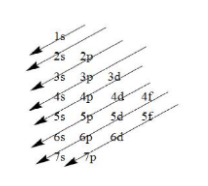
Note: When we write the electronic configuration of any element, the electrons are filled according to the Aufbau principle i.e. the electrons are first filled in the orbitals having lower energy followed by orbitals having higher energy as indicated by the arrows.
Complete step by step answer:
-In the modern periodic table, the physical and chemical properties of the elements are the periodic functions of their atomic weights and the long period table has been divided into the periods (horizontal rows) and groups (vertical columns). In terms of the electron configuration, a group consists of a series of elements which have the same outermost electronic configurations but they have different total numbers of electrons. In the periodic table, there are a total of 18 groups and 7 periods. The elements belonging to the groups 1and2 belong to s-block elements and have the general electronic configuration as $n{{s}^{1-2}}$ and the elements belonging to the groups 13and 18 belong to p-block elements and have the general electronic configuration as $n{{s}^{2}}n{{p}^{1-6}}$. From the statement, we can see that the outermost configuration is the same as the p- block elements and the last electron also enters the p-orbital. So, thus, the element is a p- block element. For p-block elements, to find the group the formula is applied is as: Group number= 10+ the total number of valence electrons
-As the number of electrons in the valence is 4. Then the Group number= 10+4=14 or V-A.
We can know about the period from the principal quantum number. The principal quantum number tells us about the period or the shell to which an electron belongs. The highest value of the principal quantum represents the period of the element. In the given electronic configuration, the highest value of principal quantum number is 3. So, it belongs to the third period. Hence, the element with the electronic configuration -$1{{s}^{2}}2{{s}^{2}}2{{p}^{6}}3{{s}^{1}}3{{p}^{3}}3d$ belongs to 3rd period, V-A group and is a p-block element.
So, option (c) is correct.
Note: When we write the electronic configuration of any element, the electrons are filled according to the Aufbau principle i.e. the electrons are first filled in the orbitals having lower energy followed by orbitals having higher energy as indicated by the arrows.
Recently Updated Pages
Master Class 11 Computer Science: Engaging Questions & Answers for Success

Master Class 11 Business Studies: Engaging Questions & Answers for Success
Master Class 11 Economics: Engaging Questions & Answers for Success
Master Class 11 English: Engaging Questions & Answers for Success
Master Class 11 Maths: Engaging Questions & Answers for Success
Master Class 11 Biology: Engaging Questions & Answers for Success
Trending doubts
One Metric ton is equal to kg A 10000 B 1000 C 100 class 11 physics CBSE
There are 720 permutations of the digits 1 2 3 4 5 class 11 maths CBSE
Discuss the various forms of bacteria class 11 biology CBSE
Draw a diagram of a plant cell and label at least eight class 11 biology CBSE
State the laws of reflection of light
Explain zero factorial class 11 maths CBSE