




What are the dimensions of the small intestine? What are reasons to explain why the small intestine is so long, compared to the large intestine?
Answer
 Verified
530.4k+ views
Hint: Small intestine is the tubular organ which carries food from stomach to the colon. It is an important organ of our digestive system as most of the digestion takes place here. It is also associated with the absorption of nutrients from the food.
Complete answer:
The small intestine is a tube-like coiled structure which is around 7 metres long and 2.5-3 cm in diameter. It is the largest part of the digestive system. It is larger than the large intestine so as to provide maximum surface area for digestion and absorption of food. It is made up of three parts duodenum, ileum and jejunum.
The length of the large intestine is around 5 feet but is broader than the small intestine in diameter. The small intestine is long as compared to large intestine because
i) The digestion of carbohydrates, lipids, fats and proteins takes place here whereas in the large intestine only absorption of salts and water takes place.
ii) The small intestine is lined with epithelial cells which have finger-like projections. These projections provide greater surface area for digestion and absorption of food whereas the large intestine is already digested.
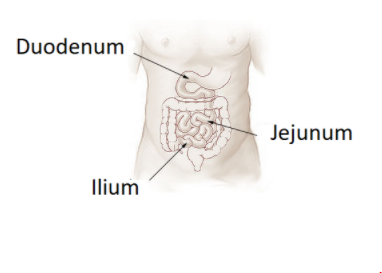
Note: The small intestine is around three times the length of our body. The food ingested stays in the small intestine for the maximum period of time. The maximum absorption of nutrients from the food takes place here. The absorbed nutrients are absorbed into the bloodstream and are circulated throughout the body.
Complete answer:
The small intestine is a tube-like coiled structure which is around 7 metres long and 2.5-3 cm in diameter. It is the largest part of the digestive system. It is larger than the large intestine so as to provide maximum surface area for digestion and absorption of food. It is made up of three parts duodenum, ileum and jejunum.
The length of the large intestine is around 5 feet but is broader than the small intestine in diameter. The small intestine is long as compared to large intestine because
i) The digestion of carbohydrates, lipids, fats and proteins takes place here whereas in the large intestine only absorption of salts and water takes place.
ii) The small intestine is lined with epithelial cells which have finger-like projections. These projections provide greater surface area for digestion and absorption of food whereas the large intestine is already digested.
Note: The small intestine is around three times the length of our body. The food ingested stays in the small intestine for the maximum period of time. The maximum absorption of nutrients from the food takes place here. The absorbed nutrients are absorbed into the bloodstream and are circulated throughout the body.
Recently Updated Pages
Master Class 11 Computer Science: Engaging Questions & Answers for Success

Master Class 11 Business Studies: Engaging Questions & Answers for Success
Master Class 11 Economics: Engaging Questions & Answers for Success
Master Class 11 English: Engaging Questions & Answers for Success
Master Class 11 Maths: Engaging Questions & Answers for Success
Master Class 11 Biology: Engaging Questions & Answers for Success
Trending doubts
One Metric ton is equal to kg A 10000 B 1000 C 100 class 11 physics CBSE
There are 720 permutations of the digits 1 2 3 4 5 class 11 maths CBSE
Discuss the various forms of bacteria class 11 biology CBSE
Draw a diagram of a plant cell and label at least eight class 11 biology CBSE
State the laws of reflection of light
10 examples of friction in our daily life