




Area of the quadrilateral formed by the tangents and the normal at the ends of the latus rectum of the parabola ${{y}^{2}}=4x+16$ is
[a] 8
[b] 4
[c] 10
[d] 28
Answer
 Verified
588.6k+ views
Hint: Observe that the area of the quadrilateral is symmetric about the x-axis. Hence if we find the area of the triangle ACD, then the area of the quadrilateral will be twice the area found. Use the fact that the coordinates of endpoints of the latus rectum of the parabola ${{y}^{2}}=4ax$ are $\left( a,2a \right)$ and $\left( a,-2a \right)$. Use the fact that the equation of tangent to the conic $a{{x}^{2}}+2hxy+b{{y}^{2}}+2gx+2fy+c=0$ at point $\left( {{x}_{1}},{{y}_{1}} \right)$ is given by $ax{{x}_{1}}+h\left( x{{y}_{1}}+y{{x}_{1}} \right)+by{{y}_{1}}+g\left( x+{{x}_{1}} \right)+f\left( y+{{y}_{1}} \right)+c=0$. Hence determine the equation of the tangent AC and hence determine the coordinates of the point C. Using the fact that if two lines are perpendicular to each other and have slopes ${{m}_{1}}$ and ${{m}_{2}}$, then ${{m}_{1}}{{m}_{2}}=-1$. Hence determine the slope of the line AD and hence determine the equation of AD. Hence determine coordinates of point D. Hence find the area of the triangle ACD and hence find the area of the quadrilateral ACBD.
Complete step by step answer:
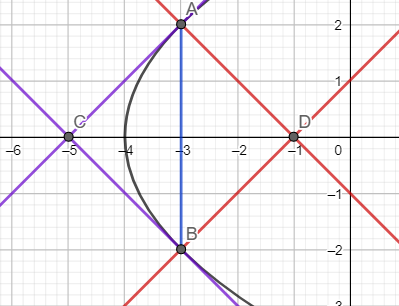
Equation of the parabola is ${{y}^{2}}=4x+16$
Taking 4 common from the terms on RHS, we get
${{y}^{2}}=4\left( x+4 \right)$
Let $Y=y$ and $X=x+4$
Hence, according to X-Y coordinate system the equation of the parabola is ${{Y}^{2}}=4X$
Now, we know that the coordinates of the end points of the latus rectum of the parabola ${{y}^{2}}=4ax$ are given by $\left( a,2a \right)$ and $\left( a,-2a \right)$
Hence, the coordinates of one end of the latus rectum is
$\begin{align}
& X=1,Y=2 \\
& \Rightarrow x=-3,y=2 \\
\end{align}$
Hence, we have
$A\equiv \left( -3,2 \right)$
We know that equation of the tangent to the conic $a{{x}^{2}}+2hxy+b{{y}^{2}}+2gx+2fy+c=0$ at point $\left( {{x}_{1}},{{y}_{1}} \right)$ is given by $ax{{x}_{1}}+h\left( x{{y}_{1}}+y{{x}_{1}} \right)+by{{y}_{1}}+g\left( x+{{x}_{1}} \right)+f\left( y+{{y}_{1}} \right)+c=0$.
Hence, we have equation of AC is
$y\left( 2 \right)=2\left( x-3 \right)+16$
Dividing both sides by 2, we get
$\begin{align}
& y=x-3+8 \\
& \Rightarrow y=x+5 \\
\end{align}$
Since point C lies on x-axis, we have for point C, y = 0
Substituting value of y in equation of AC, we get
$x+5=0\Rightarrow x=-5$
Hence, we have
$C\equiv \left( -5,0 \right)$
Also, we have slope of AC is 1
Hence, we have slope of AD is -1
We know that if slope of the line passing through $\left( {{x}_{1}},{{y}_{1}} \right)$ is m, then the equation of the line is given by
$y-{{y}_{1}}=m\left( x-{{x}_{1}} \right)$
Hence, we have
Equation of AD is
$\begin{align}
& y-2=-1\left( x+3 \right) \\
& \Rightarrow y+x+1=0 \\
\end{align}$
Since point D lies on x-axis, we have for point D y =0
Substituting the value of y in equation of AD, we get
$x+1=0\Rightarrow x=-1$
Hence, we have
$D\equiv \left( -1,0 \right)$
Hence, we have
$CD=-1-\left( -5 \right)=4$
Also, we know that the length of the latus rectum of the parabola ${{y}^{2}}=4ax$ is 4a.
Hence, we have
$AB=4$
Hence the height of the triangle ACD is $\dfrac{1}{2}AB=2$
We know that area of a triangle with base b and height h is given by $A=\dfrac{1}{2}bh$
Hence, we have
$ar\left( \Delta ACD \right)=\dfrac{1}{2}\times 2\times 4=4$
Hence, we have
$ar\left( ACBD \right)=4+4=8$
So, the correct answer is “Option A”.
Note: [1] Alternative Solution:
We know that the area of the quadrilateral formed by the tangents and the normal at the endpoints of the latus rectum of the parabola ${{y}^{2}}=4ax$ is given by $A=8a$
Complete step by step answer:
Equation of the parabola is ${{y}^{2}}=4x+16$
Taking 4 common from the terms on RHS, we get
${{y}^{2}}=4\left( x+4 \right)$
Let $Y=y$ and $X=x+4$
Hence, according to X-Y coordinate system the equation of the parabola is ${{Y}^{2}}=4X$
Now, we know that the coordinates of the end points of the latus rectum of the parabola ${{y}^{2}}=4ax$ are given by $\left( a,2a \right)$ and $\left( a,-2a \right)$
Hence, the coordinates of one end of the latus rectum is
$\begin{align}
& X=1,Y=2 \\
& \Rightarrow x=-3,y=2 \\
\end{align}$
Hence, we have
$A\equiv \left( -3,2 \right)$
We know that equation of the tangent to the conic $a{{x}^{2}}+2hxy+b{{y}^{2}}+2gx+2fy+c=0$ at point $\left( {{x}_{1}},{{y}_{1}} \right)$ is given by $ax{{x}_{1}}+h\left( x{{y}_{1}}+y{{x}_{1}} \right)+by{{y}_{1}}+g\left( x+{{x}_{1}} \right)+f\left( y+{{y}_{1}} \right)+c=0$.
Hence, we have equation of AC is
$y\left( 2 \right)=2\left( x-3 \right)+16$
Dividing both sides by 2, we get
$\begin{align}
& y=x-3+8 \\
& \Rightarrow y=x+5 \\
\end{align}$
Since point C lies on x-axis, we have for point C, y = 0
Substituting value of y in equation of AC, we get
$x+5=0\Rightarrow x=-5$
Hence, we have
$C\equiv \left( -5,0 \right)$
Also, we have slope of AC is 1
Hence, we have slope of AD is -1
We know that if slope of the line passing through $\left( {{x}_{1}},{{y}_{1}} \right)$ is m, then the equation of the line is given by
$y-{{y}_{1}}=m\left( x-{{x}_{1}} \right)$
Hence, we have
Equation of AD is
$\begin{align}
& y-2=-1\left( x+3 \right) \\
& \Rightarrow y+x+1=0 \\
\end{align}$
Since point D lies on x-axis, we have for point D y =0
Substituting the value of y in equation of AD, we get
$x+1=0\Rightarrow x=-1$
Hence, we have
$D\equiv \left( -1,0 \right)$
Hence, we have
$CD=-1-\left( -5 \right)=4$
Also, we know that the length of the latus rectum of the parabola ${{y}^{2}}=4ax$ is 4a.
Hence, we have
$AB=4$
Hence the height of the triangle ACD is $\dfrac{1}{2}AB=2$
We know that area of a triangle with base b and height h is given by $A=\dfrac{1}{2}bh$
Hence, we have
$ar\left( \Delta ACD \right)=\dfrac{1}{2}\times 2\times 4=4$
Hence, we have
$ar\left( ACBD \right)=4+4=8$
So, the correct answer is “Option A”.
Note: [1] Alternative Solution:
We know that the area of the quadrilateral formed by the tangents and the normal at the endpoints of the latus rectum of the parabola ${{y}^{2}}=4ax$ is given by $A=8a$
Recently Updated Pages
Master Class 11 Computer Science: Engaging Questions & Answers for Success

Master Class 11 Business Studies: Engaging Questions & Answers for Success
Master Class 11 Economics: Engaging Questions & Answers for Success
Master Class 11 English: Engaging Questions & Answers for Success
Master Class 11 Maths: Engaging Questions & Answers for Success
Master Class 11 Biology: Engaging Questions & Answers for Success
Trending doubts
One Metric ton is equal to kg A 10000 B 1000 C 100 class 11 physics CBSE
There are 720 permutations of the digits 1 2 3 4 5 class 11 maths CBSE
Discuss the various forms of bacteria class 11 biology CBSE
Draw a diagram of a plant cell and label at least eight class 11 biology CBSE
State the laws of reflection of light
Explain zero factorial class 11 maths CBSE