




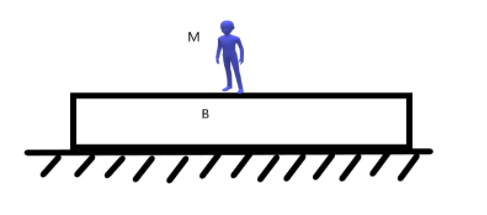
As shown in figure, M is a mass 60kg standing on a block of mass 40kg kept on ground. The coefficient of friction between the feet of the man and the block is 0.3 and that between B and the ground is 0.1. If the man accelerates with an acceleration $2m/{s^2}$ in the forward direction, then:
A. If is not possible
B. B will move backward with an acceleration $0.5m/{s^2} $
C. B will not move.
D. B will move forward with an acceleration$0.5m/{s^2} $
Answer
 Verified
598.8k+ views
- Hint: Friction is resistance to motion of one object moving relatively to another. It is not said as a fundamental force, like gravity or electromagnetism. To understand friction the best example from our daily life is; friction is what holds your shoe to ground. Moreover in ice the friction is very little that is the reason it is hard to walk on ice.
Complete step-by-step solution -
Let us begin this problem with an assumption that the block will remain stationary.
The force on the man is:
$F = m {a_{man}} = (60kg) (2m/{s^2}) = 120N$ Towards left.
Now, the force required for the block to remain stationary is 120N towards the left on block from ground.
But since normal force on block from ground is:
$N = (40 + 60kg) (10m/{s^2}) = 1000N$,
Maximum friction on it is:
$f = (100N) (0.1) = 100N$ Towards left (since the block has the tendency to move towards right).
Hence, block will move towards left and forces on it will be:
$120 - 100N = 20N$
Therefore, acceleration of the block is
${a_{block}} = 20N/40kg = 0.5m/{s^2}$ Towards left, that is backwards.
Therefore option (B) B will move backward with an acceleration $0.5m/{s^2} $ is a correct answer.
Note: The term acceleration means; Acceleration is a vector quantity and it is described as the rate at which an object changes its velocity. An object is accelerating if it is changing its velocity. Therefore, acceleration is a change in speed.
Complete step-by-step solution -
Let us begin this problem with an assumption that the block will remain stationary.
The force on the man is:
$F = m {a_{man}} = (60kg) (2m/{s^2}) = 120N$ Towards left.
Now, the force required for the block to remain stationary is 120N towards the left on block from ground.
But since normal force on block from ground is:
$N = (40 + 60kg) (10m/{s^2}) = 1000N$,
Maximum friction on it is:
$f = (100N) (0.1) = 100N$ Towards left (since the block has the tendency to move towards right).
Hence, block will move towards left and forces on it will be:
$120 - 100N = 20N$
Therefore, acceleration of the block is
${a_{block}} = 20N/40kg = 0.5m/{s^2}$ Towards left, that is backwards.
Therefore option (B) B will move backward with an acceleration $0.5m/{s^2} $ is a correct answer.
Note: The term acceleration means; Acceleration is a vector quantity and it is described as the rate at which an object changes its velocity. An object is accelerating if it is changing its velocity. Therefore, acceleration is a change in speed.
Recently Updated Pages
Master Class 11 Computer Science: Engaging Questions & Answers for Success

Master Class 11 Business Studies: Engaging Questions & Answers for Success
Master Class 11 Economics: Engaging Questions & Answers for Success
Master Class 11 English: Engaging Questions & Answers for Success
Master Class 11 Maths: Engaging Questions & Answers for Success
Master Class 11 Biology: Engaging Questions & Answers for Success
Trending doubts
One Metric ton is equal to kg A 10000 B 1000 C 100 class 11 physics CBSE
There are 720 permutations of the digits 1 2 3 4 5 class 11 maths CBSE
Discuss the various forms of bacteria class 11 biology CBSE
Draw a diagram of a plant cell and label at least eight class 11 biology CBSE
State the laws of reflection of light
Explain zero factorial class 11 maths CBSE