



Assertion: The displacement time graph of a body moving with uniform velocity is a straight line.
Reason: The displacement is proportional to time in a body moving with uniform velocity and starting at the origin.
(A) Both Assertion and Reason are true and the Reason is the correct explanation of the Assertion.
(B) Both Assertion and Reason are true, but Reason is not the correct explanation of the Assertion.
(C) Assertion is true, but the Reason is false.
(D) Assertion is false, but the Reason is true.
Answer
 Verified
478.5k+ views
Hint: The term "displacement" refers to a shift in an object's direction. It's a vector quantity with a magnitude and a direction. It's shown as an arrow pointing from the starting point to the destination. For instance, if an object moves from position A to position B, its position shifts. Displacement is the term for a move in an object's direction.
Complete answer:
The rate of change of an object's direction with respect to a frame of reference and time is known as its velocity.
Uniform velocity is defined as a state in which a body travels the same distance in the same amount of time. v is the average velocity of a body over time t in equation ( d=v t ), and if both its magnitude and direction do not change over time, the body is said to be at uniform velocity.
Consider a distance-time graph in which the body moves in a consistent manner. When a body travels the same distance in the same amount of time, it is assumed to be in uniform motion. Consider a one-second interval: if a body covers 10 metres in the first second, it can cover 10 metres per second after that, indicating that the body is moving in a uniform manner. Let's make a graph to reflect uniform motion.
Since the equal distance is filled in equal units of time, the distance time graph will be a straight line, much as in uniform motion.
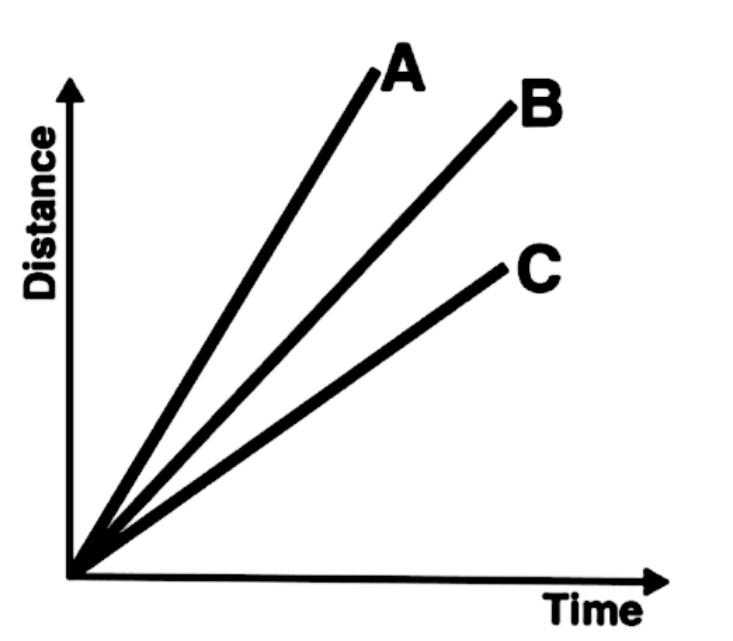
The slopes of A, B, and C may vary. It's how the slope of a distance-time curve measures the body's speed; the steeper the slope, the faster the body will be. We can deduce from the graph above that body A has the fastest speed and body C has the slowest speed.
Hence option A is correct.
Note:
Consider if the distance changes exponentially, meaning that the velocity changes at a steady rate or that the acceleration is constant. However, in a uniformly accelerated motion, where velocity varies at a constant rate with respect to time, the graph will be a straight line, with the slope representing the sum of acceleration.
Complete answer:
The rate of change of an object's direction with respect to a frame of reference and time is known as its velocity.
Uniform velocity is defined as a state in which a body travels the same distance in the same amount of time. v is the average velocity of a body over time t in equation ( d=v t ), and if both its magnitude and direction do not change over time, the body is said to be at uniform velocity.
Consider a distance-time graph in which the body moves in a consistent manner. When a body travels the same distance in the same amount of time, it is assumed to be in uniform motion. Consider a one-second interval: if a body covers 10 metres in the first second, it can cover 10 metres per second after that, indicating that the body is moving in a uniform manner. Let's make a graph to reflect uniform motion.
Since the equal distance is filled in equal units of time, the distance time graph will be a straight line, much as in uniform motion.
The slopes of A, B, and C may vary. It's how the slope of a distance-time curve measures the body's speed; the steeper the slope, the faster the body will be. We can deduce from the graph above that body A has the fastest speed and body C has the slowest speed.
Hence option A is correct.
Note:
Consider if the distance changes exponentially, meaning that the velocity changes at a steady rate or that the acceleration is constant. However, in a uniformly accelerated motion, where velocity varies at a constant rate with respect to time, the graph will be a straight line, with the slope representing the sum of acceleration.
Recently Updated Pages
Master Class 11 Computer Science: Engaging Questions & Answers for Success

Master Class 11 Business Studies: Engaging Questions & Answers for Success
Master Class 11 Economics: Engaging Questions & Answers for Success
Master Class 11 English: Engaging Questions & Answers for Success
Master Class 11 Maths: Engaging Questions & Answers for Success
Master Class 11 Biology: Engaging Questions & Answers for Success
Trending doubts
One Metric ton is equal to kg A 10000 B 1000 C 100 class 11 physics CBSE
There are 720 permutations of the digits 1 2 3 4 5 class 11 maths CBSE
Discuss the various forms of bacteria class 11 biology CBSE
Draw a diagram of a plant cell and label at least eight class 11 biology CBSE
State the laws of reflection of light
Explain zero factorial class 11 maths CBSE