




What is the basic unit of the nervous system?
Answer
 Verified
514.8k+ views
Hint: The nervous system or also called the neural system is a complex network of neurons that are specialized to carry messages. The complexity of the nervous system will increase as we move towards higher animals. In humans, the neural system integrates the activities of organs based on the stimuli, which the neurons can detect and transmit.
Complete answer:
The nervous system comprises of two main parts which are;
i) Central nervous system – It is made up of the brain and spinal cord.
ii) Peripheral nervous system – It is made up of nerves that branch off from the spinal cord and extended to all parts of the body. It includes two types of nerve fibres which are afferent nerve fibres and efferent nerve fibres.
The basic unit of the nervous system is a nerve cell or a neuron. The human brain comprises about a hundred billion neurons. A neuron has a cell body, which includes the cell nucleus, and special extensions called axons.
The different parts of a neuron are;
- Dendrites stretch out from the cell body of a neuron, and it is the shortest fibre in the cell body.
- Axon is the longest thread on the cell body of a neuron and has an insulating and protective sheath of myelin around it.
- Cell body comprises cytoplasm and nucleus.
- Synapse is a microscopic gap between a pair of adjacent neurons over which nerve impulses pass when moving from one neuron to the other.
The diagram below represents the structure of a neuron.
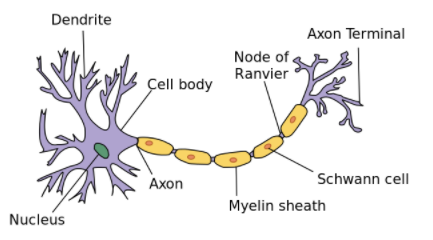
Note: Cranial nerves start from the brain as these nerves carry impulses from the central nervous system. Certain cranial nerves belong to the group of mixed nerves whereas others fall under sensory nerves. Spinal nerves originate from the spinal cord. All the spinal nerves transport impulses to and from the central nervous system and these are part of mixed nerves.
Complete answer:
The nervous system comprises of two main parts which are;
i) Central nervous system – It is made up of the brain and spinal cord.
ii) Peripheral nervous system – It is made up of nerves that branch off from the spinal cord and extended to all parts of the body. It includes two types of nerve fibres which are afferent nerve fibres and efferent nerve fibres.
The basic unit of the nervous system is a nerve cell or a neuron. The human brain comprises about a hundred billion neurons. A neuron has a cell body, which includes the cell nucleus, and special extensions called axons.
The different parts of a neuron are;
- Dendrites stretch out from the cell body of a neuron, and it is the shortest fibre in the cell body.
- Axon is the longest thread on the cell body of a neuron and has an insulating and protective sheath of myelin around it.
- Cell body comprises cytoplasm and nucleus.
- Synapse is a microscopic gap between a pair of adjacent neurons over which nerve impulses pass when moving from one neuron to the other.
The diagram below represents the structure of a neuron.
Note: Cranial nerves start from the brain as these nerves carry impulses from the central nervous system. Certain cranial nerves belong to the group of mixed nerves whereas others fall under sensory nerves. Spinal nerves originate from the spinal cord. All the spinal nerves transport impulses to and from the central nervous system and these are part of mixed nerves.
Recently Updated Pages
Master Class 11 Computer Science: Engaging Questions & Answers for Success

Master Class 11 Business Studies: Engaging Questions & Answers for Success
Master Class 11 Economics: Engaging Questions & Answers for Success
Master Class 11 English: Engaging Questions & Answers for Success
Master Class 11 Maths: Engaging Questions & Answers for Success
Master Class 11 Biology: Engaging Questions & Answers for Success
Trending doubts
One Metric ton is equal to kg A 10000 B 1000 C 100 class 11 physics CBSE
There are 720 permutations of the digits 1 2 3 4 5 class 11 maths CBSE
Discuss the various forms of bacteria class 11 biology CBSE
Draw a diagram of a plant cell and label at least eight class 11 biology CBSE
State the laws of reflection of light
Explain zero factorial class 11 maths CBSE