




How many bond pairs and lone pairs are there in $CO_3^{2 - }$.
Answer
 Verified
569.7k+ views
Hint: We know that lone pairs are electron pairs which does not take part in bonding whereas bond pairs are electron pairs which take part in bonding. To identify the number of lone pair and bond pairs in a compound we have to draw the Lewis structure of that compound.
Complete Step by step answer: Let us draw the Lewis structure of $CO_3^{2 - }$, to get more idea about the lone pair and bond pair
We know that carbon has 4 electrons and oxygen has 6 valence electrons. There is an extra 2 electrons due to the 2- charge. Therefore, the total valence electrons are $4 + 6 \times 3 + 2 = 24$ electrons. Since carbon is the least electronegative it goes in the centre and the oxygens around them. Now, we can plot the valence electrons on the atoms.
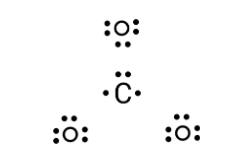
To this we have to add 2 extra electrons which are added to oxygen. And then we can share a double bond with the neutral oxygen and a single bond with oxygen having negative charge.
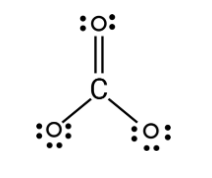
Here, we can see that carbon share its two electrons to form double bond with one oxygen
Hence the bond pair is 2. And for the two remaining oxygen there is single bond hence
bond pair. Therefore, the total bond pair becomes 4.
Now we can easily count the lone pair in oxygens, 2+3+3=8 lone pairs.
Note: We use formal charge on atoms or ions, to identify the electron count. Formal charge is the difference between the number of valence electrons of that atom in the free state and the number of electrons assigned to that atom in the Lewis structure.
Complete Step by step answer: Let us draw the Lewis structure of $CO_3^{2 - }$, to get more idea about the lone pair and bond pair
We know that carbon has 4 electrons and oxygen has 6 valence electrons. There is an extra 2 electrons due to the 2- charge. Therefore, the total valence electrons are $4 + 6 \times 3 + 2 = 24$ electrons. Since carbon is the least electronegative it goes in the centre and the oxygens around them. Now, we can plot the valence electrons on the atoms.
To this we have to add 2 extra electrons which are added to oxygen. And then we can share a double bond with the neutral oxygen and a single bond with oxygen having negative charge.
Here, we can see that carbon share its two electrons to form double bond with one oxygen
Hence the bond pair is 2. And for the two remaining oxygen there is single bond hence
bond pair. Therefore, the total bond pair becomes 4.
Now we can easily count the lone pair in oxygens, 2+3+3=8 lone pairs.
Note: We use formal charge on atoms or ions, to identify the electron count. Formal charge is the difference between the number of valence electrons of that atom in the free state and the number of electrons assigned to that atom in the Lewis structure.
Recently Updated Pages
Master Class 11 Computer Science: Engaging Questions & Answers for Success

Master Class 11 Business Studies: Engaging Questions & Answers for Success
Master Class 11 Economics: Engaging Questions & Answers for Success
Master Class 11 English: Engaging Questions & Answers for Success
Master Class 11 Maths: Engaging Questions & Answers for Success
Master Class 11 Biology: Engaging Questions & Answers for Success
Trending doubts
One Metric ton is equal to kg A 10000 B 1000 C 100 class 11 physics CBSE
There are 720 permutations of the digits 1 2 3 4 5 class 11 maths CBSE
Discuss the various forms of bacteria class 11 biology CBSE
Draw a diagram of a plant cell and label at least eight class 11 biology CBSE
State the laws of reflection of light
10 examples of friction in our daily life