




Can $ Cl $ act as a Lewis base?
Answer
 Verified
510.3k+ views
Hint: A species which has a tendency to accept an electron pair i.e., either electron deficient (positively charged) species or the atom with vacant d-orbitals is known as Lewis acid whereas a species which has a tendency to donate an electron pair i.e., either electron rich (negatively charged) species or the atom with lone pair of electrons is known as Lewis base.
Complete answer:
Chlorine is a chemical element which belongs to the halogen family and has atomic number $ 17 $ . Its electronic configuration can be represented as follows:
$ Cl = 1{s^2}2{s^2}2{p^6}3{s^2}3{p^5} $
As the valence shell of chlorine consists of seven electrons, so it generally exists as a chloride ion by gaining an electron pair while combining with other elements. Hence, it is considered as an electron rich species because it consists of three lone pairs of electrons along with a negative charge. It is represented as follows:
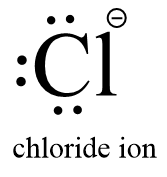
Due to the presence of a negative charge, it has a tendency to donate electrons and thus act as a Lewis base. Due to its high electronegativity, it is a poor electron donor and hence, it is a weak Lewis base.
Note:
It is important to note that the Lewis acids i.e., positively charged species are also known as electrophiles which means electron loving substances whereas the Lewis bases i.e., negatively charged species are also known as nucleophiles which means nucleus or proton loving species. Although there is a minute difference between base and a nucleophile i.e., stronger bases have the property to form stronger bonds between atoms while stronger nucleophiles have tendency to trigger the speed of reaction.
Complete answer:
Chlorine is a chemical element which belongs to the halogen family and has atomic number $ 17 $ . Its electronic configuration can be represented as follows:
$ Cl = 1{s^2}2{s^2}2{p^6}3{s^2}3{p^5} $
As the valence shell of chlorine consists of seven electrons, so it generally exists as a chloride ion by gaining an electron pair while combining with other elements. Hence, it is considered as an electron rich species because it consists of three lone pairs of electrons along with a negative charge. It is represented as follows:
Due to the presence of a negative charge, it has a tendency to donate electrons and thus act as a Lewis base. Due to its high electronegativity, it is a poor electron donor and hence, it is a weak Lewis base.
Note:
It is important to note that the Lewis acids i.e., positively charged species are also known as electrophiles which means electron loving substances whereas the Lewis bases i.e., negatively charged species are also known as nucleophiles which means nucleus or proton loving species. Although there is a minute difference between base and a nucleophile i.e., stronger bases have the property to form stronger bonds between atoms while stronger nucleophiles have tendency to trigger the speed of reaction.
Recently Updated Pages
Master Class 11 Computer Science: Engaging Questions & Answers for Success

Master Class 11 Business Studies: Engaging Questions & Answers for Success
Master Class 11 Economics: Engaging Questions & Answers for Success
Master Class 11 English: Engaging Questions & Answers for Success
Master Class 11 Maths: Engaging Questions & Answers for Success
Master Class 11 Biology: Engaging Questions & Answers for Success
Trending doubts
One Metric ton is equal to kg A 10000 B 1000 C 100 class 11 physics CBSE
There are 720 permutations of the digits 1 2 3 4 5 class 11 maths CBSE
Discuss the various forms of bacteria class 11 biology CBSE
Draw a diagram of a plant cell and label at least eight class 11 biology CBSE
State the laws of reflection of light
Explain zero factorial class 11 maths CBSE