




Choose the function of pseudopodia of Amoeba other than locomotion.
A) Regeneration
B) Excretion
C) Reproduction
D) Engulfment of food material
Answer
 Verified
577.8k+ views
Hint: In a eukaryotic cell, the pseudopodia are the project of cytoplasm. These are temporary (means they are not fixed to the structure) an arm-like projection. The single-celled organisms are characterised to form arm-like protrusion.
Complete answer:
Amoeba is a unicellular organism. They have the ability to alter their body shape by extending and retracting the pseudopods. They are often called amoeboids. They do not have a cell wall, which allows them for free movement. Pseudopods also called false feet are projections that can appear and disappear from the organism’s body. It is a bulge of cytoplasm formed by the coordinate action of actin microfilaments pushing out the plasma membrane that surrounds the cell.
The Function of pseudopods –
These help in the movement of the organisms and act as a tool to capture the prey. The organisms push the cytoplasm towards one end of the cell, which forms a projected or pseudopods off the cells. Now, pseudopods hold the critter in place, and the remaining of the cells can follow which leads to the moving of the organisms.
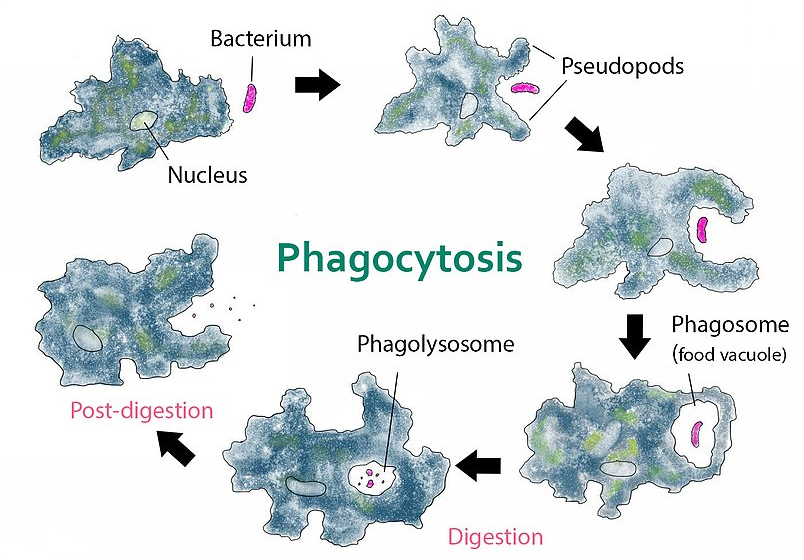
Pseudopods are also used for feeding. The organisms extend their pseudopods by engulfing their prey. Finally, they digested the prey by secreting the digestive enzymes.
The given figure has shown the digestion process in amoeba by using pseudopods.
Hence the correct answer is option D.
Note: A pseudopods are of many shapes and sizes. They can be stubby finger-like structures. Some of them are long and thin, while some can cross over each other and look-like a branching network. The pseudopods can be classified as filopodia, axopodia, reticulopodia, lobopodia, and lamellipodia. The most common type is lobopodia. In amoeba may form more than one type at once.
Complete answer:
Amoeba is a unicellular organism. They have the ability to alter their body shape by extending and retracting the pseudopods. They are often called amoeboids. They do not have a cell wall, which allows them for free movement. Pseudopods also called false feet are projections that can appear and disappear from the organism’s body. It is a bulge of cytoplasm formed by the coordinate action of actin microfilaments pushing out the plasma membrane that surrounds the cell.
The Function of pseudopods –
These help in the movement of the organisms and act as a tool to capture the prey. The organisms push the cytoplasm towards one end of the cell, which forms a projected or pseudopods off the cells. Now, pseudopods hold the critter in place, and the remaining of the cells can follow which leads to the moving of the organisms.
Pseudopods are also used for feeding. The organisms extend their pseudopods by engulfing their prey. Finally, they digested the prey by secreting the digestive enzymes.
The given figure has shown the digestion process in amoeba by using pseudopods.
Hence the correct answer is option D.
Note: A pseudopods are of many shapes and sizes. They can be stubby finger-like structures. Some of them are long and thin, while some can cross over each other and look-like a branching network. The pseudopods can be classified as filopodia, axopodia, reticulopodia, lobopodia, and lamellipodia. The most common type is lobopodia. In amoeba may form more than one type at once.
Recently Updated Pages
Master Class 10 Computer Science: Engaging Questions & Answers for Success

Master Class 10 General Knowledge: Engaging Questions & Answers for Success
Master Class 10 English: Engaging Questions & Answers for Success
Master Class 10 Social Science: Engaging Questions & Answers for Success
Master Class 10 Maths: Engaging Questions & Answers for Success
Master Class 10 Science: Engaging Questions & Answers for Success
Trending doubts
What is the median of the first 10 natural numbers class 10 maths CBSE
Which women's tennis player has 24 Grand Slam singles titles?
Who is the Brand Ambassador of Incredible India?
Why is there a time difference of about 5 hours between class 10 social science CBSE
Write a letter to the principal requesting him to grant class 10 english CBSE
A moving boat is observed from the top of a 150 m high class 10 maths CBSE