




Clinically jaundice manifests when the blood bilirubin level rises above
(a) 1mg/100ml
(b) 1mg/10ml
(c) 1.5mg/100ml
(d) 2mg/100ml
Answer
 Verified
571.2k+ views
Hint: Bilirubin is a brown-yellow pigment that is responsible for the color of solid waste products of vertebrates. It is a constituent of bile secreted by liver cells. Their elevated levels in blood cause a medical condition termed jaundice.
Complete answer:
The liver performs a multitude of functions such as it carries out the metabolism of proteins, fats, and carbohydrates in order to produce bile which is further secreted in the small intestine to aid in the digestion of fats. The major constituent of bile is water, in which bile pigments like bilirubin and biliverdin are dissolved. Other constituents include bile acids, cholesterol, phospholipids, and electrolytes. Break down of red blood cells in the liver leads to the production of bilirubin. Normally, the level of total bilirubin in an adult is 1.2mg/dl. For those who are below 18, normal blood bilirubin levels are 1mg/dl. The problem arises when the level of blood bilirubin exceeds 2mg/dl or 2mg/100ml. This elevation causes jaundice due to the buildup of bilirubin. The skin appears yellow with the whiteness of eyes.
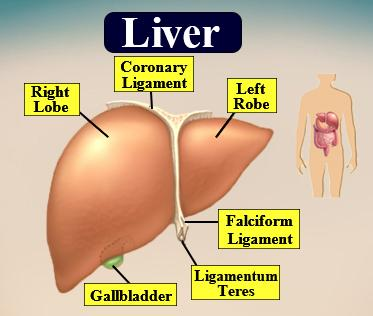
Additional Information: -The liver is split into two lobes -the left and right lobe. These two lobes are separated by Falciform ligament.
-It also stores vitamins, minerals, and glycogen, and is responsible to synthesize plasma proteins namely albumin and clotting factors. It also detoxifies the blood and purifies it.
-Bilirubin is of two types - conjugated bilirubin and unconjugated bilirubin. When blood passes through the liver, old RBCs are selected and degraded. Their degradation produces bilirubin which becomes conjugated with a water-soluble molecule. This makes it to be easily excreted by the body via urine.
-Unconjugated bilirubin is toxic as it is not attached to a water-soluble group and hence remains suspended in blood.
So, the correct answer is '2 mg / 100 ml'
Note: -A maximum of 10 % of the blood of the body can be held in the liver and it can pump 1.5 liters per minute.
-The ornithine cycle in the liver, also known as the urea cycle converts the highly toxic ammonia to urea for excretion.
Complete answer:
The liver performs a multitude of functions such as it carries out the metabolism of proteins, fats, and carbohydrates in order to produce bile which is further secreted in the small intestine to aid in the digestion of fats. The major constituent of bile is water, in which bile pigments like bilirubin and biliverdin are dissolved. Other constituents include bile acids, cholesterol, phospholipids, and electrolytes. Break down of red blood cells in the liver leads to the production of bilirubin. Normally, the level of total bilirubin in an adult is 1.2mg/dl. For those who are below 18, normal blood bilirubin levels are 1mg/dl. The problem arises when the level of blood bilirubin exceeds 2mg/dl or 2mg/100ml. This elevation causes jaundice due to the buildup of bilirubin. The skin appears yellow with the whiteness of eyes.
Additional Information: -The liver is split into two lobes -the left and right lobe. These two lobes are separated by Falciform ligament.
-It also stores vitamins, minerals, and glycogen, and is responsible to synthesize plasma proteins namely albumin and clotting factors. It also detoxifies the blood and purifies it.
-Bilirubin is of two types - conjugated bilirubin and unconjugated bilirubin. When blood passes through the liver, old RBCs are selected and degraded. Their degradation produces bilirubin which becomes conjugated with a water-soluble molecule. This makes it to be easily excreted by the body via urine.
-Unconjugated bilirubin is toxic as it is not attached to a water-soluble group and hence remains suspended in blood.
So, the correct answer is '2 mg / 100 ml'
Note: -A maximum of 10 % of the blood of the body can be held in the liver and it can pump 1.5 liters per minute.
-The ornithine cycle in the liver, also known as the urea cycle converts the highly toxic ammonia to urea for excretion.
Recently Updated Pages
Master Class 11 Computer Science: Engaging Questions & Answers for Success

Master Class 11 Business Studies: Engaging Questions & Answers for Success
Master Class 11 Economics: Engaging Questions & Answers for Success
Master Class 11 English: Engaging Questions & Answers for Success
Master Class 11 Maths: Engaging Questions & Answers for Success
Master Class 11 Biology: Engaging Questions & Answers for Success
Trending doubts
One Metric ton is equal to kg A 10000 B 1000 C 100 class 11 physics CBSE
There are 720 permutations of the digits 1 2 3 4 5 class 11 maths CBSE
Discuss the various forms of bacteria class 11 biology CBSE
Draw a diagram of a plant cell and label at least eight class 11 biology CBSE
State the laws of reflection of light
Explain zero factorial class 11 maths CBSE