




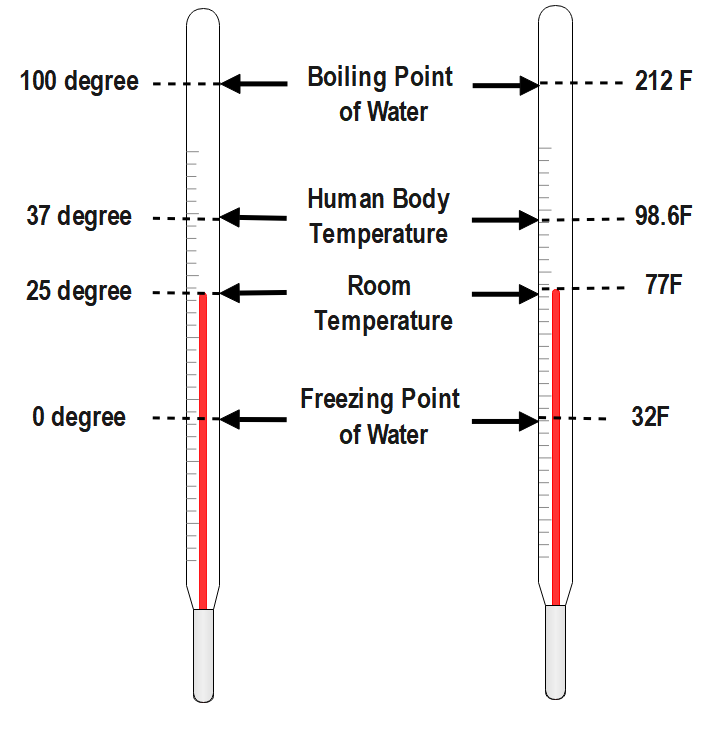
Consider the following figure,
The correct relationship between Fahrenheit and Celsius scale is:
(A) $ {}^ \circ F = {}^ \circ C\, + 273.15 $
(B) $ {}^ \circ F = \dfrac{2}{3}{}^ \circ C\, + 16 $
(C) $ {}^ \circ F = \dfrac{9}{5}{}^ \circ C\, + 32 $
(D) $ {}^ \circ F = \dfrac{1}{3}{}^ \circ C\, + 32 $
Answer
 Verified
529.2k+ views
Hint :The two scales are used to measure temperature but mostly we use Celsius scale. It can be represented as $ T{}^ \circ C $ where T is the numeric value of temperature. There are actually three scales to measure temperature, Celsius Fahrenheit and Kelvin. The temperature of one scale can be converted to another scale unit by a mathematical relation.
Complete Step By Step Answer:
The relation between C and F shows that Celsius and Fahrenheit are directly proportional to each other. It implies that as temperature increases in the Celsius scale there will also increase in the Fahrenheit. Both Celsius and Fahrenheit scales have their respective thermometer for measurements.
The mathematical relation between these two scales can be shown as,
$ {}^ \circ F = \dfrac{9}{5}{}^ \circ C\, + 32 $
It means if we multiply the Celsius scale temperature with $ \dfrac{9}{5} $ and then add $ 32 $ with it we get the temperature in Fahrenheit. Let’s take an example in which we convert the boiling point of water from Celsius to Fahrenheit. Boiling point of water is given as $ {100^ \circ }C $ on putting this value in the above mathematical relation we get,
$ {}^ \circ F = \dfrac{9}{5} \times 100\, + 32\, = \,\left( {9 \times 20} \right) + 32 $
$ {}^ \circ F\, = \,180 + 32 = \,212 $
It means this relation is correct as we get the same temperature which is shown in the Fahrenheit scale.
Option C is correct.
Note :
You can change the temperature from degree Celsius to Kelvin by just adding $ 273.15 $ with the degree Celsius temperature. We generally used to measure the temperature during any experiment in degree Celsius but for putting the value in formula we have to change it in the Kelvin scale.
Complete Step By Step Answer:
The relation between C and F shows that Celsius and Fahrenheit are directly proportional to each other. It implies that as temperature increases in the Celsius scale there will also increase in the Fahrenheit. Both Celsius and Fahrenheit scales have their respective thermometer for measurements.
The mathematical relation between these two scales can be shown as,
$ {}^ \circ F = \dfrac{9}{5}{}^ \circ C\, + 32 $
It means if we multiply the Celsius scale temperature with $ \dfrac{9}{5} $ and then add $ 32 $ with it we get the temperature in Fahrenheit. Let’s take an example in which we convert the boiling point of water from Celsius to Fahrenheit. Boiling point of water is given as $ {100^ \circ }C $ on putting this value in the above mathematical relation we get,
$ {}^ \circ F = \dfrac{9}{5} \times 100\, + 32\, = \,\left( {9 \times 20} \right) + 32 $
$ {}^ \circ F\, = \,180 + 32 = \,212 $
It means this relation is correct as we get the same temperature which is shown in the Fahrenheit scale.
Option C is correct.
Note :
You can change the temperature from degree Celsius to Kelvin by just adding $ 273.15 $ with the degree Celsius temperature. We generally used to measure the temperature during any experiment in degree Celsius but for putting the value in formula we have to change it in the Kelvin scale.
Recently Updated Pages
Master Class 11 Computer Science: Engaging Questions & Answers for Success

Master Class 11 Business Studies: Engaging Questions & Answers for Success
Master Class 11 Economics: Engaging Questions & Answers for Success
Master Class 11 English: Engaging Questions & Answers for Success
Master Class 11 Maths: Engaging Questions & Answers for Success
Master Class 11 Biology: Engaging Questions & Answers for Success
Trending doubts
One Metric ton is equal to kg A 10000 B 1000 C 100 class 11 physics CBSE
There are 720 permutations of the digits 1 2 3 4 5 class 11 maths CBSE
Discuss the various forms of bacteria class 11 biology CBSE
Draw a diagram of a plant cell and label at least eight class 11 biology CBSE
State the laws of reflection of light
Explain zero factorial class 11 maths CBSE