




Construct a quadrilateral ABCD, when $AB = 4cm$, $BC = 5cm$, $CD = 6.5cm$, $\angle ABC = 105^\circ $ and $\angle DCB = 80^\circ $. What is the length of AD?
A) $2.9cm$
B) $3.5cm$
C) $5.5cm$
D) $4.5cm$
Answer
 Verified
566.4k+ views
Hint: In this question, we are given three out of four sides of a quadrilateral and two angles. First, we have to construct the quadrilateral as per the given specifications and then, we have to find the measure of the fourth side. At first, draw a rough figure of the quadrilateral which could guide us. Then, start withdrawing the base of the quadrilateral. Draw the two angles and extend their arms as per the given measurement. Join the end points to get the side AD. Measure AD using a scale and choose the correct option.
Complete step-by-step solution:
We will start by drawing a rough diagram. Our quadrilateral ABCD will look like this.
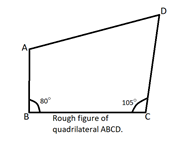
Using this as a demo figure, let us draw the required figure step by step.
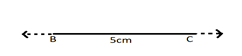
Step 1: Draw the base. Always try to take that side as the base whose vertices have been used as the vertex of those angles whose measure is given in the question. In this question, such a side is BC as one angle is on the vertex B and the other is on the vertex C and BC as one of their arms. So, we will take BC as the base of the quadrilateral.
Using scale, draw $BC = 5cm$. (I cannot use a scale here, so I will draw it with approximation. I have cut $BC = 5cm$ out of a line.)
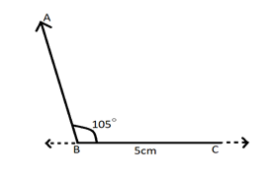
Step 2: Next step is to draw $\angle ABC = 105^\circ $. Use a protractor to draw the required angle. It will look like this:
Step 3: Now, we will make $\angle DCB = 80^\circ $ using protractor in the similar way we did above.
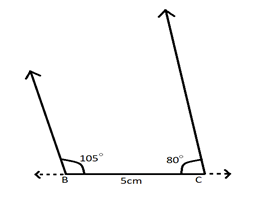
Step 4: In this step, we will cut the arms of the angles as per the given measurements. $AB = 4cm$ and $CD = 6.5cm$ .
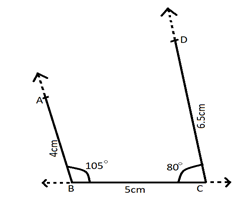
Step 5: Now, simply join the points A and D to get the side AD. Then, measure it using a scale and choose the correct option out of the given options.
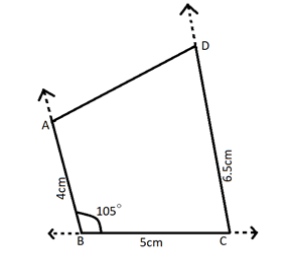
On measuring the side, we get $AD = 5.5cm$. Our final diagram is as follows:
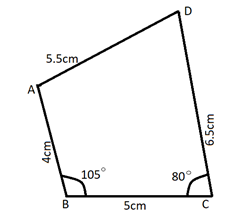
Hence, our final answer is option C) $5.5cm$.
Note: 1) Always use a scale and protractor to construct the figure as otherwise, the measurement of the side to be found will not be exact and you will lose marks.
2) It is important to write steps in those questions where we have to construct the figures. These steps involve marks. Make sure to write them even if they are not asked
Complete step-by-step solution:
We will start by drawing a rough diagram. Our quadrilateral ABCD will look like this.
Using this as a demo figure, let us draw the required figure step by step.
Step 1: Draw the base. Always try to take that side as the base whose vertices have been used as the vertex of those angles whose measure is given in the question. In this question, such a side is BC as one angle is on the vertex B and the other is on the vertex C and BC as one of their arms. So, we will take BC as the base of the quadrilateral.
Using scale, draw $BC = 5cm$. (I cannot use a scale here, so I will draw it with approximation. I have cut $BC = 5cm$ out of a line.)
Step 2: Next step is to draw $\angle ABC = 105^\circ $. Use a protractor to draw the required angle. It will look like this:
Step 3: Now, we will make $\angle DCB = 80^\circ $ using protractor in the similar way we did above.
Step 4: In this step, we will cut the arms of the angles as per the given measurements. $AB = 4cm$ and $CD = 6.5cm$ .
Step 5: Now, simply join the points A and D to get the side AD. Then, measure it using a scale and choose the correct option out of the given options.
On measuring the side, we get $AD = 5.5cm$. Our final diagram is as follows:
Hence, our final answer is option C) $5.5cm$.
Note: 1) Always use a scale and protractor to construct the figure as otherwise, the measurement of the side to be found will not be exact and you will lose marks.
2) It is important to write steps in those questions where we have to construct the figures. These steps involve marks. Make sure to write them even if they are not asked
Recently Updated Pages
Master Class 10 Computer Science: Engaging Questions & Answers for Success

Master Class 10 General Knowledge: Engaging Questions & Answers for Success
Master Class 10 English: Engaging Questions & Answers for Success
Master Class 10 Social Science: Engaging Questions & Answers for Success
Master Class 10 Maths: Engaging Questions & Answers for Success
Master Class 10 Science: Engaging Questions & Answers for Success
Trending doubts
What is the median of the first 10 natural numbers class 10 maths CBSE
Which women's tennis player has 24 Grand Slam singles titles?
Who is the Brand Ambassador of Incredible India?
Why is there a time difference of about 5 hours between class 10 social science CBSE
Write a letter to the principal requesting him to grant class 10 english CBSE
A moving boat is observed from the top of a 150 m high class 10 maths CBSE