




What is the correct IUPAC name of the compound?
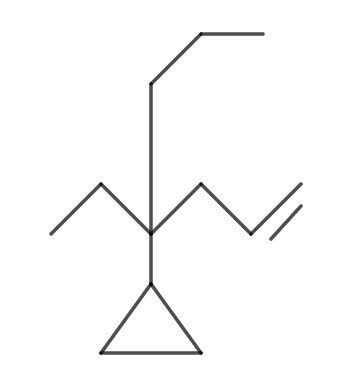
(A) 4-cyclopropyl-4-propyl-1-hexene
(B) 4-ethyl-4-cyclopropyl-1-heptene
(C) 4-cyclopropyl-4-ethyl-1-heptene
(D) Both a and c.
Answer
 Verified
502.8k+ views
Hint: to answer this question we have to know certain rules. IUPAC nomenclature is a method of naming organic chemical compounds as recommended by the International Union of Pure and Applied Chemistry.
Complete answer:
Let us look at few rules for IUPAC naming:
First we need to find and name the longest chain which is continuous and number it.
We need to identify the groups attached to it.
We will number the chains such that the functional group gets a lower number.
If 2 compounds are attached at the same numbered carbon we will alphabetically arrange to name them.
Now let us look at this question: in this question we will first start by finding the longest chain and numbering it. Remember that we have to number the longest chain such that the alkene group gets the lowest number. Look at the following image to know how numbering should be done:
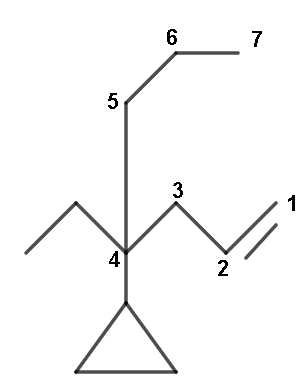
After numbering the compound we will check at what all numbers a side compound has been attached.
Here in this question, look at number 4, two compounds have been attached to it, they are cyclopropyl (cyclopropyl because it is 3 carbon compound and cyclic) and ethyl( 2 carbon compound) respectively.
Now we will start naming the compound. As there are 7 carbons in the longest chain it will be heptane. But observe that it is an alkene hence the suffix will be heptene.
Hence the nomenclature will be :
4-cyclopropyl-4-ethyl-heptene. ( here we have applied rule 4 that is we have alphabetically arranged the compound).
Hence the correct answer to this question is option B.
Note:
During naming of compounds remember that if the same carbon has 2 compounds the one that is alphabetically first will be written first. Hence don’t get confused between option c and d in this question.
Complete answer:
Let us look at few rules for IUPAC naming:
First we need to find and name the longest chain which is continuous and number it.
We need to identify the groups attached to it.
We will number the chains such that the functional group gets a lower number.
If 2 compounds are attached at the same numbered carbon we will alphabetically arrange to name them.
Now let us look at this question: in this question we will first start by finding the longest chain and numbering it. Remember that we have to number the longest chain such that the alkene group gets the lowest number. Look at the following image to know how numbering should be done:
After numbering the compound we will check at what all numbers a side compound has been attached.
Here in this question, look at number 4, two compounds have been attached to it, they are cyclopropyl (cyclopropyl because it is 3 carbon compound and cyclic) and ethyl( 2 carbon compound) respectively.
Now we will start naming the compound. As there are 7 carbons in the longest chain it will be heptane. But observe that it is an alkene hence the suffix will be heptene.
Hence the nomenclature will be :
4-cyclopropyl-4-ethyl-heptene. ( here we have applied rule 4 that is we have alphabetically arranged the compound).
Hence the correct answer to this question is option B.
Note:
During naming of compounds remember that if the same carbon has 2 compounds the one that is alphabetically first will be written first. Hence don’t get confused between option c and d in this question.
Recently Updated Pages
Master Class 11 Computer Science: Engaging Questions & Answers for Success

Master Class 11 Business Studies: Engaging Questions & Answers for Success
Master Class 11 Economics: Engaging Questions & Answers for Success
Master Class 11 English: Engaging Questions & Answers for Success
Master Class 11 Maths: Engaging Questions & Answers for Success
Master Class 11 Biology: Engaging Questions & Answers for Success
Trending doubts
One Metric ton is equal to kg A 10000 B 1000 C 100 class 11 physics CBSE
There are 720 permutations of the digits 1 2 3 4 5 class 11 maths CBSE
Discuss the various forms of bacteria class 11 biology CBSE
Draw a diagram of a plant cell and label at least eight class 11 biology CBSE
State the laws of reflection of light
Explain zero factorial class 11 maths CBSE