




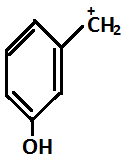
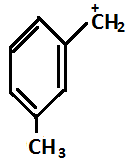
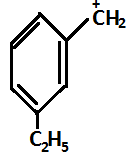
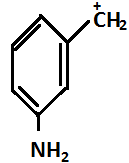
Correct order for stability for carbocation is:-
(A)
(B)
(C)
(D)
Answer
 Verified
546.3k+ views
Hint: To solve this question, we should know about the inductive effect, its types, how it affects the stability of an organic compound, the role of electron withdrawing groups and electron releasing groups present in the chain of the carbon atoms.
Complete step by step answer:
Let us understand from the basics.
Firstly, we will know what is the inductive effect and its types.
When the electrical charge is transmitted throughout the chain of atoms, the effect produced is called as an inductive effect. It is a permanent effect. There is an interesting fact to know about inductive effects. It is distance dependent. The relation is as follows:
Inductive effect $ \alpha $ $ \dfrac{1}{{dis\tan ce}} $
It is of two types-
+I effect: it is also called $ {e^ - } $ donating effect or $ {e^ - } $ repelling effect. It enhances the stability. The order for some groups is as follows:
$ { - ^ - }C{H_2} > { - ^ - }NH > - {O^ - } $ >Carboxylic group > $ {3^\circ } $ -alkyl group > $ {2^\circ } $ -alkyl group> $ {1^\circ } $ -alkyl group > -H
–I effect: it is also called $ {e^ - } $ withdrawing effect or $ {e^ - } $ attracting effect. The order for some groups is as follows:
$ { - ^ + }N{R_3} > { - ^ + }N{H_3} > - N{O_2} > - S{O_2}R > - C \equiv N > - CHO > - COOH > - F > - Cl > - Br > - I > - OR > - OH....... > - CH = C{H_2} > - H $
So in the given question, (P) and(S) show –I effect and (R) and (Q) show +I effect.
On the basis of the above mentioned order, the decreasing order for stability is R>Q>P>S.
Note:
-I effect decreases $ {e^ - } $ density on a molecule, making it $ {e^ - } $ deficient and highly acidic. Also, we should remember the series and difference between both the effects because otherwise the solution may have manual error.
Complete step by step answer:
Let us understand from the basics.
Firstly, we will know what is the inductive effect and its types.
When the electrical charge is transmitted throughout the chain of atoms, the effect produced is called as an inductive effect. It is a permanent effect. There is an interesting fact to know about inductive effects. It is distance dependent. The relation is as follows:
Inductive effect $ \alpha $ $ \dfrac{1}{{dis\tan ce}} $
It is of two types-
+I effect: it is also called $ {e^ - } $ donating effect or $ {e^ - } $ repelling effect. It enhances the stability. The order for some groups is as follows:
$ { - ^ - }C{H_2} > { - ^ - }NH > - {O^ - } $ >Carboxylic group > $ {3^\circ } $ -alkyl group > $ {2^\circ } $ -alkyl group> $ {1^\circ } $ -alkyl group > -H
–I effect: it is also called $ {e^ - } $ withdrawing effect or $ {e^ - } $ attracting effect. The order for some groups is as follows:
$ { - ^ + }N{R_3} > { - ^ + }N{H_3} > - N{O_2} > - S{O_2}R > - C \equiv N > - CHO > - COOH > - F > - Cl > - Br > - I > - OR > - OH....... > - CH = C{H_2} > - H $
So in the given question, (P) and(S) show –I effect and (R) and (Q) show +I effect.
On the basis of the above mentioned order, the decreasing order for stability is R>Q>P>S.
Note:
-I effect decreases $ {e^ - } $ density on a molecule, making it $ {e^ - } $ deficient and highly acidic. Also, we should remember the series and difference between both the effects because otherwise the solution may have manual error.
Recently Updated Pages
Master Class 11 Computer Science: Engaging Questions & Answers for Success

Master Class 11 Business Studies: Engaging Questions & Answers for Success
Master Class 11 Economics: Engaging Questions & Answers for Success
Master Class 11 English: Engaging Questions & Answers for Success
Master Class 11 Maths: Engaging Questions & Answers for Success
Master Class 11 Biology: Engaging Questions & Answers for Success
Trending doubts
One Metric ton is equal to kg A 10000 B 1000 C 100 class 11 physics CBSE
There are 720 permutations of the digits 1 2 3 4 5 class 11 maths CBSE
Discuss the various forms of bacteria class 11 biology CBSE
Draw a diagram of a plant cell and label at least eight class 11 biology CBSE
State the laws of reflection of light
Explain zero factorial class 11 maths CBSE