




Derive the lens maker's formula.
Answer
 Verified
567.3k+ views
Hint: Consider a double convex lens and a point object is located on the principal axis and the ray incident on the first spherical surface and it gets refracted.
Complete step by step answer:
Lens maker’s formula relates the focal length of a lens to the refractive index of the lens material and the radii of curvature of its two surfaces. For second refraction, the image of first reflection becomes the object of second refraction.
The figure below represents the refraction through a double convex lens:
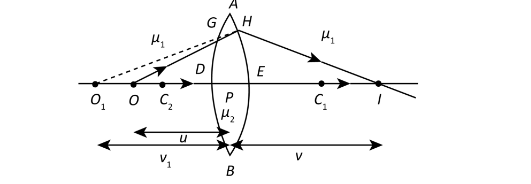
Here, ${C_1}$ and ${C_2}$ are the centres of curvature of two spherical surfaces of the convex
lens. $O$ represents an object and ${O_1}$ is the image due to first refraction. The refractive
The index of the medium is ${\mu _1}$ and the refraction index of the lens is ${\mu _2}$.
Let us consider the radii of the curvature be ${R_1}$ and ${R_2}$.
Using the formula for refraction at a curved surface, for the first time refraction at $ADB$,
image distance is ${v_1}$, we have,
$\dfrac{{{\mu _2}}}{{{v_1}}} - \dfrac{{{\mu _1}}}{u} = \dfrac{{{\mu _2} - {\mu _1}}}{{{R_1}}}$... (I)
The final image $I$, which is an image due to second refraction as well.
Now we know for the second refraction, ${v_1}$ becomes the object distance.
$\dfrac{{{\mu _1}}}{v} - \dfrac{{{\mu _2}}}{{{v_1}}} = \dfrac{{{\mu _1} - {\mu _2}}}{{{R_2}}}$... (II)
Now we add equation (I) and (II), we have,
$
\dfrac{{{\mu _1}}}{v} - \dfrac{{{\mu _1}}}{u} = \dfrac{{{\mu _2} - {\mu _1}}}{{{R_1}}} +
\dfrac{{{\mu _1} - {\mu _2}}}{{{R_1}}}\\
{\mu _1}\left( {\dfrac{1}{v} - \dfrac{1}{u}} \right) = \left( {{\mu _2} - {\mu _1}} \right)\left(
{\dfrac{1}{{{R_1}}} - \dfrac{1}{{{R_2}}}} \right)\\
\left( {\dfrac{1}{v} - \dfrac{1}{u}} \right) = \left( {\dfrac{{{\mu _2}}}{{{\mu _1}}} - 1} \right)\left(
{\dfrac{1}{{{R_1}}} - \dfrac{1}{{{R_2}}}} \right)
$
If the object is placed at infinity $\left( {u = \infty } \right)$, the image will be formed at the
focus, $v = f$. Thus, the above equation becomes,
$\dfrac{1}{f} = \left( {\dfrac{{{\mu _2}}}{{{\mu _1}}} - 1} \right)\left( {\dfrac{1}{{{R_1}}} -
\dfrac{1}{{{R_2}}}} \right)$
This is known as Lens maker’s formula.
Note: The assumptions made in the derivation of the formula:
1. The object is a point object located on the principal axis.
2. The aperture of the lens is small.
3. All the rays make very small angles with the normal to the lens faces.
4. The lens is thin.
Complete step by step answer:
Lens maker’s formula relates the focal length of a lens to the refractive index of the lens material and the radii of curvature of its two surfaces. For second refraction, the image of first reflection becomes the object of second refraction.
The figure below represents the refraction through a double convex lens:
Here, ${C_1}$ and ${C_2}$ are the centres of curvature of two spherical surfaces of the convex
lens. $O$ represents an object and ${O_1}$ is the image due to first refraction. The refractive
The index of the medium is ${\mu _1}$ and the refraction index of the lens is ${\mu _2}$.
Let us consider the radii of the curvature be ${R_1}$ and ${R_2}$.
Using the formula for refraction at a curved surface, for the first time refraction at $ADB$,
image distance is ${v_1}$, we have,
$\dfrac{{{\mu _2}}}{{{v_1}}} - \dfrac{{{\mu _1}}}{u} = \dfrac{{{\mu _2} - {\mu _1}}}{{{R_1}}}$... (I)
The final image $I$, which is an image due to second refraction as well.
Now we know for the second refraction, ${v_1}$ becomes the object distance.
$\dfrac{{{\mu _1}}}{v} - \dfrac{{{\mu _2}}}{{{v_1}}} = \dfrac{{{\mu _1} - {\mu _2}}}{{{R_2}}}$... (II)
Now we add equation (I) and (II), we have,
$
\dfrac{{{\mu _1}}}{v} - \dfrac{{{\mu _1}}}{u} = \dfrac{{{\mu _2} - {\mu _1}}}{{{R_1}}} +
\dfrac{{{\mu _1} - {\mu _2}}}{{{R_1}}}\\
{\mu _1}\left( {\dfrac{1}{v} - \dfrac{1}{u}} \right) = \left( {{\mu _2} - {\mu _1}} \right)\left(
{\dfrac{1}{{{R_1}}} - \dfrac{1}{{{R_2}}}} \right)\\
\left( {\dfrac{1}{v} - \dfrac{1}{u}} \right) = \left( {\dfrac{{{\mu _2}}}{{{\mu _1}}} - 1} \right)\left(
{\dfrac{1}{{{R_1}}} - \dfrac{1}{{{R_2}}}} \right)
$
If the object is placed at infinity $\left( {u = \infty } \right)$, the image will be formed at the
focus, $v = f$. Thus, the above equation becomes,
$\dfrac{1}{f} = \left( {\dfrac{{{\mu _2}}}{{{\mu _1}}} - 1} \right)\left( {\dfrac{1}{{{R_1}}} -
\dfrac{1}{{{R_2}}}} \right)$
This is known as Lens maker’s formula.
Note: The assumptions made in the derivation of the formula:
1. The object is a point object located on the principal axis.
2. The aperture of the lens is small.
3. All the rays make very small angles with the normal to the lens faces.
4. The lens is thin.
Recently Updated Pages
Master Class 11 Computer Science: Engaging Questions & Answers for Success

Master Class 11 Business Studies: Engaging Questions & Answers for Success
Master Class 11 Economics: Engaging Questions & Answers for Success
Master Class 11 English: Engaging Questions & Answers for Success
Master Class 11 Maths: Engaging Questions & Answers for Success
Master Class 11 Biology: Engaging Questions & Answers for Success
Trending doubts
One Metric ton is equal to kg A 10000 B 1000 C 100 class 11 physics CBSE
There are 720 permutations of the digits 1 2 3 4 5 class 11 maths CBSE
Discuss the various forms of bacteria class 11 biology CBSE
Draw a diagram of a plant cell and label at least eight class 11 biology CBSE
State the laws of reflection of light
Explain zero factorial class 11 maths CBSE