




Derive the third equation of the motion-
Answer
 Verified
508.2k+ views
Hint: The third equation of motion is the relationship between final velocity ‘v’, initial velocity ‘u’ , acceleration ‘and distance travelled ‘s’. We will start by considering that a body is moving with uniform acceleration. We will plot the v-t (velocity-time) graph for the body and using the graph we will reach the equation.
Complete step-by-step solution:
Let us first know a few terms:
1) initial velocity is the velocity with which the body first starts moving.
2) final velocity- velocity the body attains after completing its motion.
Let us start by considering a body, moving on a plane with uniform acceleration ’a’. let ‘u’ be its initial velocity ’v’ be its final velocity, ‘t’ be time travelled and ‘s’ be distance travelled. And ‘a’ is the acceleration .
We will plot a( v-t) graph to derive this equation:
Look at the following graph,
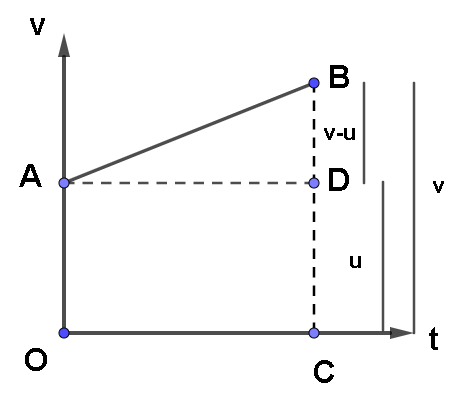
Here: OA=CD=u
BC=v
AND, OC=AD=t
As total height is v, then the height BD=BC-BD.
That is BD=v-u
We know that the slope of the v-t graph gives acceleration.
Hence, \[a = \dfrac{{BD}}{{AD}}\]
\[a = \dfrac{{BC - CD}}{{OC}}\]
\[a = \dfrac{{v - u}}{t}\]
\[t = \dfrac{{v - u}}{a} - - - - - - - - - - - \left( 1 \right)\]
Distance travelled by the body in time t= area enclosed by v-t graph.
We see that there is a trapezium formed with height ‘t’ and sum of parallel sides as ‘u’ and ‘v’ .
Hence the distance travelled by the body =area of the trapezium in the graph.
X=area of trapezium
\[x = \dfrac{1}{2} \times OC \times \left( {OA + BC} \right)\]
\[x = \dfrac{1}{2} \times t \times \left( {u + v} \right)\]
Now substituting value of t from equation 1, we get
\[x = \dfrac{1}{2} \times \left( {\dfrac{{v - u}}{a}} \right) \times \left( {u + v} \right)\]
\[x = \dfrac{1}{{2a}} \times \left( {v - u} \right) \times \left( {u + v} \right)\]
\[x = \dfrac{1}{{2a}} \times \left( {{v^2} - {u^2}} \right)\]
Or, \[x2a = \left( {{v^2} - {u^2}} \right)\]
Substituting x=s we get :
\[2as = \left( {{v^2} - {u^2}} \right)\]
\[\therefore {v^2} = {u^2} + 2as\]
Hence derived.
Note: The slope under the (v-t) graph gives acceleration.
The area under the curve of a (v-t) graph gives the displacement.
Remember to write BD=v-u , otherwise the whole derivation could go wrong.
Also all the equations of motion can be applied only when the acceleration is constant.
Complete step-by-step solution:
Let us first know a few terms:
1) initial velocity is the velocity with which the body first starts moving.
2) final velocity- velocity the body attains after completing its motion.
Let us start by considering a body, moving on a plane with uniform acceleration ’a’. let ‘u’ be its initial velocity ’v’ be its final velocity, ‘t’ be time travelled and ‘s’ be distance travelled. And ‘a’ is the acceleration .
We will plot a( v-t) graph to derive this equation:
Look at the following graph,
Here: OA=CD=u
BC=v
AND, OC=AD=t
As total height is v, then the height BD=BC-BD.
That is BD=v-u
We know that the slope of the v-t graph gives acceleration.
Hence, \[a = \dfrac{{BD}}{{AD}}\]
\[a = \dfrac{{BC - CD}}{{OC}}\]
\[a = \dfrac{{v - u}}{t}\]
\[t = \dfrac{{v - u}}{a} - - - - - - - - - - - \left( 1 \right)\]
Distance travelled by the body in time t= area enclosed by v-t graph.
We see that there is a trapezium formed with height ‘t’ and sum of parallel sides as ‘u’ and ‘v’ .
Hence the distance travelled by the body =area of the trapezium in the graph.
X=area of trapezium
\[x = \dfrac{1}{2} \times OC \times \left( {OA + BC} \right)\]
\[x = \dfrac{1}{2} \times t \times \left( {u + v} \right)\]
Now substituting value of t from equation 1, we get
\[x = \dfrac{1}{2} \times \left( {\dfrac{{v - u}}{a}} \right) \times \left( {u + v} \right)\]
\[x = \dfrac{1}{{2a}} \times \left( {v - u} \right) \times \left( {u + v} \right)\]
\[x = \dfrac{1}{{2a}} \times \left( {{v^2} - {u^2}} \right)\]
Or, \[x2a = \left( {{v^2} - {u^2}} \right)\]
Substituting x=s we get :
\[2as = \left( {{v^2} - {u^2}} \right)\]
\[\therefore {v^2} = {u^2} + 2as\]
Hence derived.
Note: The slope under the (v-t) graph gives acceleration.
The area under the curve of a (v-t) graph gives the displacement.
Remember to write BD=v-u , otherwise the whole derivation could go wrong.
Also all the equations of motion can be applied only when the acceleration is constant.
Recently Updated Pages
Master Class 11 Computer Science: Engaging Questions & Answers for Success

Master Class 11 Business Studies: Engaging Questions & Answers for Success
Master Class 11 Economics: Engaging Questions & Answers for Success
Master Class 11 English: Engaging Questions & Answers for Success
Master Class 11 Maths: Engaging Questions & Answers for Success
Master Class 11 Biology: Engaging Questions & Answers for Success
Trending doubts
One Metric ton is equal to kg A 10000 B 1000 C 100 class 11 physics CBSE
There are 720 permutations of the digits 1 2 3 4 5 class 11 maths CBSE
Discuss the various forms of bacteria class 11 biology CBSE
Draw a diagram of a plant cell and label at least eight class 11 biology CBSE
State the laws of reflection of light
Explain zero factorial class 11 maths CBSE