




How many different types of tissues are found in the human body?
(a) 4
(b)14
(c)12
(d)40
Answer
 Verified
570.6k+ views
Hint: Groups of cells form tissue and different tissues have different functions such as absorption, secretion, storage, support, and conduction, etc. Tissue categorized on basis of its location and function.
Complete answer:
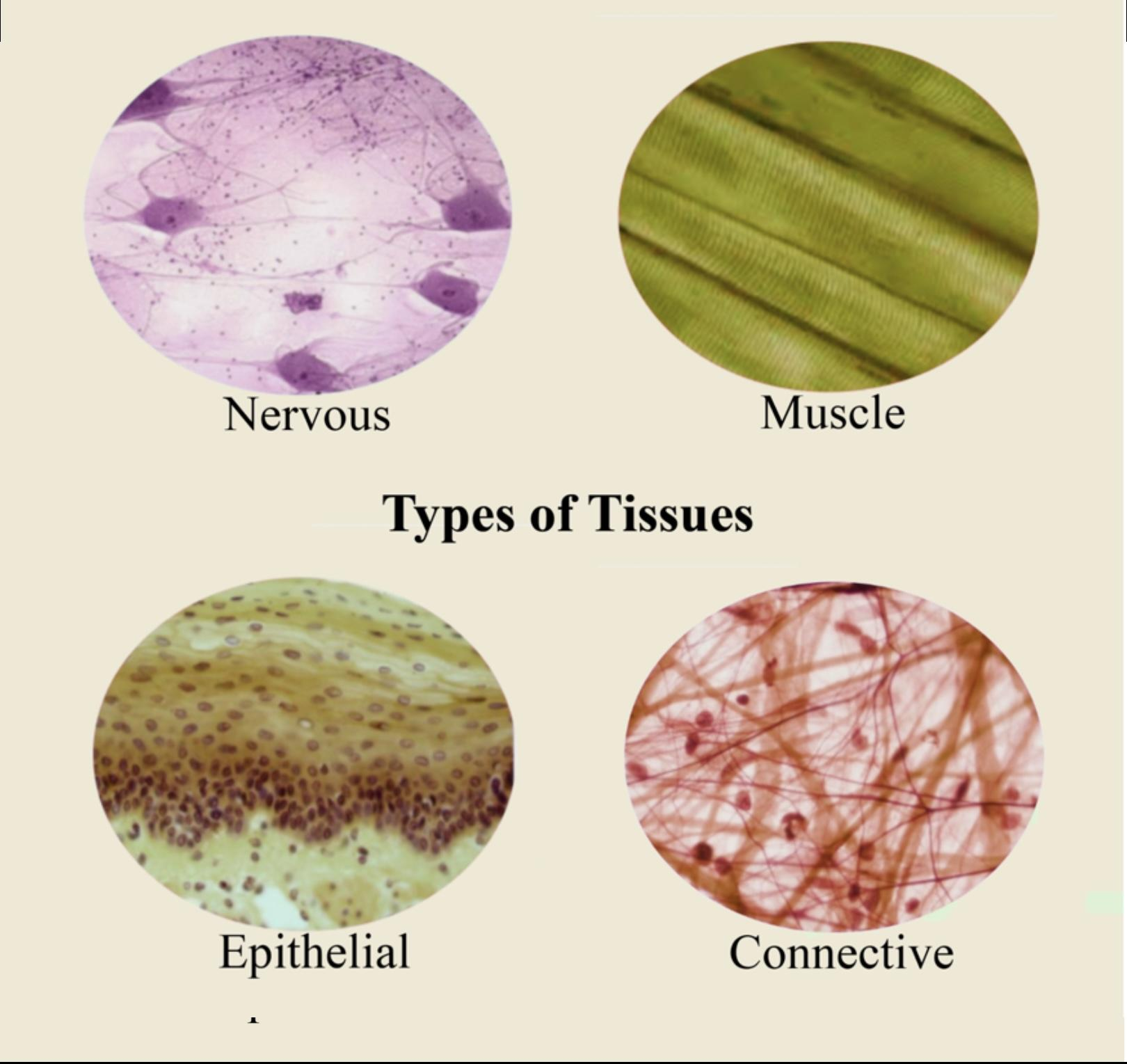
In the human body, there are mainly four different types of tissue present such as epithelial tissue, connective tissue, muscular tissue, and nervous tissue. This tissue is classified on the basis of its shape and function.
Additional Information: Epithelial tissue- Epithelial tissue is present inside or outside the body surface, it also forms the protecting sheet on the organ surface. Epithelial tissue arises from ectoderm, mesoderm, and endoderm. Its main function is absorption and secretion.
Epithelial tissue is of two types: simple epithelium and compound epithelium.
Simple epithelium is single-layered and is of five types- squamous, cuboidal, columnar, ciliated, and pseudostratified. The compound epithelium is of two types- stratified and transitional.
Connective tissue- It forms by mesoderm layer. It provides support and helps in storage.
Connective tissue is of different types like connective tissue cells, connective tissue fiber, connective tissue proper.
Connective tissue also forms skeletal tissues like bone and cartilage and also fluid tissue like blood.
Muscular tissues- It develops from the mesoderm. It is divided into three types: striated muscle fiber, non-striated muscle fiber, and cardiac muscle. According to its location, it functions as voluntary and involuntary.
Nervous tissue- Nervous tissue derives from the ectoderm layer and it conducts impulse from the brain to various parts of the body and vice versa. The main function of nervous tissue is excitability and conductivity.
So, the correct answer is ‘4’.
Note: Epithelial tissue also forms glands on the basis of chemical secretion. The origin of tissue is the germ layer but the origin of the gland is the epithelial tissue that’s why the gland is considered as a part of the tissue and these glands on basis of its secretion divided into the exocrine gland, endocrine gland, and heterocrine gland.
Complete answer:
In the human body, there are mainly four different types of tissue present such as epithelial tissue, connective tissue, muscular tissue, and nervous tissue. This tissue is classified on the basis of its shape and function.
Additional Information: Epithelial tissue- Epithelial tissue is present inside or outside the body surface, it also forms the protecting sheet on the organ surface. Epithelial tissue arises from ectoderm, mesoderm, and endoderm. Its main function is absorption and secretion.
Epithelial tissue is of two types: simple epithelium and compound epithelium.
Simple epithelium is single-layered and is of five types- squamous, cuboidal, columnar, ciliated, and pseudostratified. The compound epithelium is of two types- stratified and transitional.
Connective tissue- It forms by mesoderm layer. It provides support and helps in storage.
Connective tissue is of different types like connective tissue cells, connective tissue fiber, connective tissue proper.
Connective tissue also forms skeletal tissues like bone and cartilage and also fluid tissue like blood.
Muscular tissues- It develops from the mesoderm. It is divided into three types: striated muscle fiber, non-striated muscle fiber, and cardiac muscle. According to its location, it functions as voluntary and involuntary.
Nervous tissue- Nervous tissue derives from the ectoderm layer and it conducts impulse from the brain to various parts of the body and vice versa. The main function of nervous tissue is excitability and conductivity.
So, the correct answer is ‘4’.
Note: Epithelial tissue also forms glands on the basis of chemical secretion. The origin of tissue is the germ layer but the origin of the gland is the epithelial tissue that’s why the gland is considered as a part of the tissue and these glands on basis of its secretion divided into the exocrine gland, endocrine gland, and heterocrine gland.
Recently Updated Pages
Master Class 11 Computer Science: Engaging Questions & Answers for Success

Master Class 11 Business Studies: Engaging Questions & Answers for Success
Master Class 11 Economics: Engaging Questions & Answers for Success
Master Class 11 English: Engaging Questions & Answers for Success
Master Class 11 Maths: Engaging Questions & Answers for Success
Master Class 11 Biology: Engaging Questions & Answers for Success
Trending doubts
One Metric ton is equal to kg A 10000 B 1000 C 100 class 11 physics CBSE
There are 720 permutations of the digits 1 2 3 4 5 class 11 maths CBSE
Discuss the various forms of bacteria class 11 biology CBSE
Draw a diagram of a plant cell and label at least eight class 11 biology CBSE
State the laws of reflection of light
Explain zero factorial class 11 maths CBSE