




How do emulsifying agents stabilize the emulsion?
Answer
 Verified
581.4k+ views
Hint: Basically, emulsions are the mixture of two or more types of liquids. They are said to be stabilized by some agents that form films at the surface of the droplets or those which impart them a kind of mechanical stability. Moreover, emulsifying agents are the substances that are added to emulsions for stabilization purposes.
Complete step by step answer:
Emulsions are defined as the colloid consisting of two or more non-homogeneous types of liquid wherein one of the liquids contains the dispersion of the different form of liquids. They basically consist of dispersion of two liquids that are immiscible with each other. Now, one of the liquids will act as the dispersion medium and the other will act as the dispersed phase.
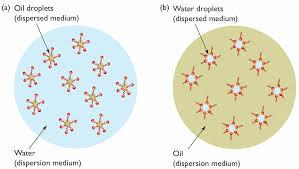
Moreover, the term emulsion is also applied to a group of mixed systems known as solutions or gels or suspensions. There are two types of emulsions i.e. oil in water and water in oil. Now, emulsifiers or emulsifying agents are the substances which are added to emulsions for stabilization purposes. They are soluble in both water and oil. They further form a layer between the dispersed phase and the dispersion medium and thereby preventing the dispersed phase particles to come together to form larger particles and separate out. They stabilize an emulsion by reducing the interfacial tension between two liquids that form an emulsion. For example, soap, the soap molecules form a protective film around each oil droplet. This further reduces the interfacial tension and stabilizes the emulsion.
Note: Emulsions are very much famous in various fields of science. They are usually used in cosmetics, pharmaceuticals and personal hygiene. They are utilized in the tanning and dyeing industries and are used in the manufacturing process of plastics and synthetic rubber.
Complete step by step answer:
Emulsions are defined as the colloid consisting of two or more non-homogeneous types of liquid wherein one of the liquids contains the dispersion of the different form of liquids. They basically consist of dispersion of two liquids that are immiscible with each other. Now, one of the liquids will act as the dispersion medium and the other will act as the dispersed phase.
Moreover, the term emulsion is also applied to a group of mixed systems known as solutions or gels or suspensions. There are two types of emulsions i.e. oil in water and water in oil. Now, emulsifiers or emulsifying agents are the substances which are added to emulsions for stabilization purposes. They are soluble in both water and oil. They further form a layer between the dispersed phase and the dispersion medium and thereby preventing the dispersed phase particles to come together to form larger particles and separate out. They stabilize an emulsion by reducing the interfacial tension between two liquids that form an emulsion. For example, soap, the soap molecules form a protective film around each oil droplet. This further reduces the interfacial tension and stabilizes the emulsion.
Note: Emulsions are very much famous in various fields of science. They are usually used in cosmetics, pharmaceuticals and personal hygiene. They are utilized in the tanning and dyeing industries and are used in the manufacturing process of plastics and synthetic rubber.
Recently Updated Pages
Master Class 11 Computer Science: Engaging Questions & Answers for Success

Master Class 11 Business Studies: Engaging Questions & Answers for Success
Master Class 11 Economics: Engaging Questions & Answers for Success
Master Class 11 English: Engaging Questions & Answers for Success
Master Class 11 Maths: Engaging Questions & Answers for Success
Master Class 11 Biology: Engaging Questions & Answers for Success
Trending doubts
One Metric ton is equal to kg A 10000 B 1000 C 100 class 11 physics CBSE
There are 720 permutations of the digits 1 2 3 4 5 class 11 maths CBSE
Discuss the various forms of bacteria class 11 biology CBSE
Draw a diagram of a plant cell and label at least eight class 11 biology CBSE
State the laws of reflection of light
Explain zero factorial class 11 maths CBSE