



Explain why a rectangle is a convex quadrilateral.
Answer
 Verified
621.3k+ views
Hint: A convex quadrilateral is a quadrilateral which has all interior angles less than 180 degrees and all the diagonals lie within the quadrilateral.
Complete step-by-step answer:
First, we look at a case where a quadrilateral is not convex. This would help in differentiating between a convex and non-convex quadrilateral.
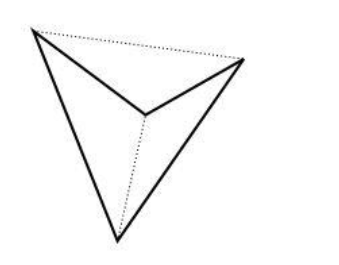
The above quadrilateral is non-convex. This is because it violates the definition since, one of the internal angles in this figure would be greater than 180 degrees. Further, if we draw various diagonals of the quadrilateral, one of the diagonals would lie outside the quadrilateral. (diagonals are marked in dashed lines) Thus this would be an example of convex quadrilateral.
Now, we will see why the rectangle is in fact a convex quadrilateral figure. In the case of a rectangle, we see (in the below figure) that all the interior angles are 90 degrees (thus less than 180 degrees).
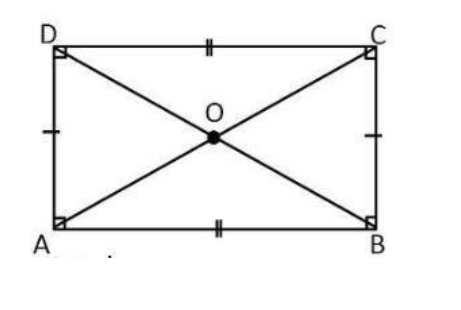
Further, all the diagonals are perpendicular bisectors and lie inside the quadrilateral (as shown above). Thus since, both the conditions of the definition are met for the case of a rectangle, we can conclude that it is a convex quadrilateral.
Note: In general, to check whether any polygon (for any figure with any number of sides) is convex or not non-convex, all we have to do is draw all the diagonals inside the polygon. Next, if this criterion is met, we check for every interior angle inside the polygon. If all the angles are less than 180 degrees, then the polygon is convex.
Complete step-by-step answer:
First, we look at a case where a quadrilateral is not convex. This would help in differentiating between a convex and non-convex quadrilateral.
The above quadrilateral is non-convex. This is because it violates the definition since, one of the internal angles in this figure would be greater than 180 degrees. Further, if we draw various diagonals of the quadrilateral, one of the diagonals would lie outside the quadrilateral. (diagonals are marked in dashed lines) Thus this would be an example of convex quadrilateral.
Now, we will see why the rectangle is in fact a convex quadrilateral figure. In the case of a rectangle, we see (in the below figure) that all the interior angles are 90 degrees (thus less than 180 degrees).
Further, all the diagonals are perpendicular bisectors and lie inside the quadrilateral (as shown above). Thus since, both the conditions of the definition are met for the case of a rectangle, we can conclude that it is a convex quadrilateral.
Note: In general, to check whether any polygon (for any figure with any number of sides) is convex or not non-convex, all we have to do is draw all the diagonals inside the polygon. Next, if this criterion is met, we check for every interior angle inside the polygon. If all the angles are less than 180 degrees, then the polygon is convex.
Recently Updated Pages
Master Class 8 Social Science: Engaging Questions & Answers for Success

Master Class 8 English: Engaging Questions & Answers for Success
Class 8 Question and Answer - Your Ultimate Solutions Guide
Master Class 8 Maths: Engaging Questions & Answers for Success
Master Class 8 Science: Engaging Questions & Answers for Success
Master Class 9 General Knowledge: Engaging Questions & Answers for Success
Trending doubts
What is BLO What is the full form of BLO class 8 social science CBSE
Citizens of India can vote at the age of A 18 years class 8 social science CBSE
Full form of STD, ISD and PCO
Advantages and disadvantages of science
Right to vote is a AFundamental Right BFundamental class 8 social science CBSE
What are the 12 elements of nature class 8 chemistry CBSE