




Fermentation is done by-
A. All micro organism
B. All fungi
C. All bacteria
D. Some fungi and some bacteria
Answer
 Verified
506.1k+ views
Hint: “Fermentation is an anaerobic process that releases energy from glucose even when oxygen is not present”.
Fermentation happens in yeast cells and bacteria, as well as in mammalian muscles. It is an anaerobic mechanism that breaks down glucose.
Cellular respiration refers to the breathing that takes place at the cellular level in our bodies. It can happen when there isn't enough oxygen or when there isn't enough.
Types of fermentation:
1. Lactic acid fermentation
2. Alcohol fermentation
3. Acetic acid fermentation
Complete answer:
Option A: Because viruses are acellular organisms, they do not follow respiration.
So, option A is not correct.
Option B: Sugar is transformed to acids, gases, or alcohol during fermentation, which is an anaerobic respiration process. It's found in yeast, bacteria, and oxygen-depleted muscle cells, as well as in lactic acid fermentation. The food processing industry uses this phenomenon to make a wide range of edibles and beverages. Because viruses are acellular organisms, they do not follow respiration
So, option B is not correct.
Option C: Lactic acid bacteria, principally Enterococcus, Lactobacillus, Lactococcus, Leuconostoc, Pediococcus, Weissella, and other species, are commonly prevalent in many fermented foods and beverages.
So, option C is not correct.
Option D: Fermentation is an anaerobic respiration process in which sugar is converted to acids, gases, or alcohol. It can be found in yeast and bacteria, as well as oxygen-depleted muscle cells, as in lactic acid fermentation. This phenomenon is used by the food processing industry to create a variety of edible items and beverages. Viruses do not follow respiration because they are acellular organisms. Protista are unicellular eukaryotic creatures that breathe.
So, option D is correct
Hence, Option D is the correct answer.
Note:
Fermentation is a biological process that takes place in an anaerobic environment. The initial step in fermentation is the same as it is in cellular respiration: the creation of pyruvic acid by glycolysis, which produces two ATP molecules. Pyruvate is then converted to lactic acid, ethanol, or other compounds in the next phase. \[NA{D^ + }\] is generated here, and it is re-used in the glycolysis process.
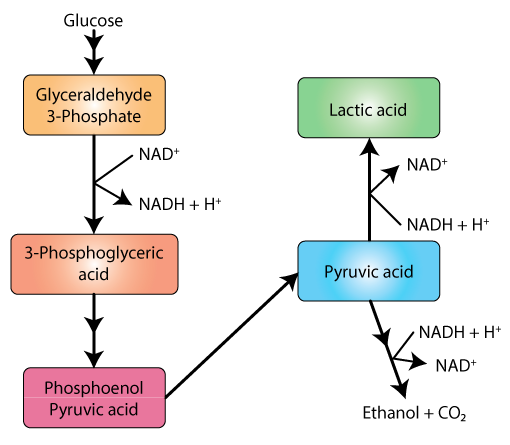
Fermentation happens in yeast cells and bacteria, as well as in mammalian muscles. It is an anaerobic mechanism that breaks down glucose.
Cellular respiration refers to the breathing that takes place at the cellular level in our bodies. It can happen when there isn't enough oxygen or when there isn't enough.
Types of fermentation:
1. Lactic acid fermentation
2. Alcohol fermentation
3. Acetic acid fermentation
Complete answer:
Option A: Because viruses are acellular organisms, they do not follow respiration.
So, option A is not correct.
Option B: Sugar is transformed to acids, gases, or alcohol during fermentation, which is an anaerobic respiration process. It's found in yeast, bacteria, and oxygen-depleted muscle cells, as well as in lactic acid fermentation. The food processing industry uses this phenomenon to make a wide range of edibles and beverages. Because viruses are acellular organisms, they do not follow respiration
So, option B is not correct.
Option C: Lactic acid bacteria, principally Enterococcus, Lactobacillus, Lactococcus, Leuconostoc, Pediococcus, Weissella, and other species, are commonly prevalent in many fermented foods and beverages.
So, option C is not correct.
Option D: Fermentation is an anaerobic respiration process in which sugar is converted to acids, gases, or alcohol. It can be found in yeast and bacteria, as well as oxygen-depleted muscle cells, as in lactic acid fermentation. This phenomenon is used by the food processing industry to create a variety of edible items and beverages. Viruses do not follow respiration because they are acellular organisms. Protista are unicellular eukaryotic creatures that breathe.
So, option D is correct
Hence, Option D is the correct answer.
Note:
Fermentation is a biological process that takes place in an anaerobic environment. The initial step in fermentation is the same as it is in cellular respiration: the creation of pyruvic acid by glycolysis, which produces two ATP molecules. Pyruvate is then converted to lactic acid, ethanol, or other compounds in the next phase. \[NA{D^ + }\] is generated here, and it is re-used in the glycolysis process.
Recently Updated Pages
Master Class 11 Computer Science: Engaging Questions & Answers for Success

Master Class 11 Business Studies: Engaging Questions & Answers for Success
Master Class 11 Economics: Engaging Questions & Answers for Success
Master Class 11 English: Engaging Questions & Answers for Success
Master Class 11 Maths: Engaging Questions & Answers for Success
Master Class 11 Biology: Engaging Questions & Answers for Success
Trending doubts
One Metric ton is equal to kg A 10000 B 1000 C 100 class 11 physics CBSE
There are 720 permutations of the digits 1 2 3 4 5 class 11 maths CBSE
Discuss the various forms of bacteria class 11 biology CBSE
Draw a diagram of a plant cell and label at least eight class 11 biology CBSE
State the laws of reflection of light
Explain zero factorial class 11 maths CBSE