



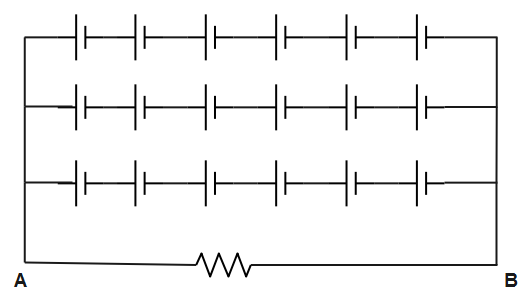
Figure shows grouping of identical cells each of emf $4V$ and internal resistance $1\Omega $. This combination can be replaced by an equivalent cell between A and B having emf $E$ and internal resistance $r$, where
(A). $E=72V,\,r=18\Omega $
(B). $E=24V,\,r=18\Omega $
(C). $E=72V,\,r=2\Omega $
(D). $E=24V,\,r=2\Omega $
Answer
 Verified
533.7k+ views
Hint: Figure shows batteries connected in series and parallel combination. The combination of batteries is similar to the combination of resistances. Therefore, using formula for equivalent emf in series and equivalent resistances in series we can get a combination of batteries purely in parallel combination, we can solve the combination to calculate the equivalent emf and internal resistance in the circuit.
Formulas used:
${{E}_{eq}}={{E}_{1}}+{{E}_{2}}+{{E}_{3}}+--+{{E}_{n}}$
${{r}_{eq}}={{r}_{1}}+{{r}_{2}}+{{r}_{3}}+--+{{r}_{n}}$
$\dfrac{1}{{{r}_{eq}}}=\dfrac{1}{{{r}_{1}}}+\dfrac{1}{{{r}_{2}}}+\dfrac{1}{{{r}_{3}}}+--+\dfrac{1}{{{r}_{n}}}$
Complete answer:
For all elements connected in series, the current passing through them is the same while for all elements connected in parallel the potential drop is the same. Batteries can also be connected in series or parallel combination.
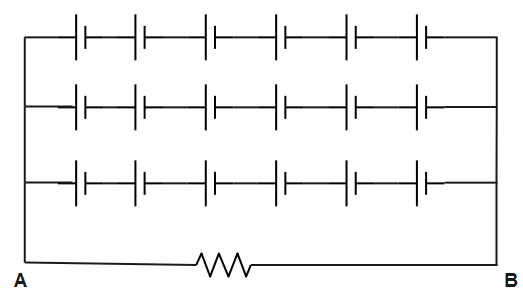
In the above figure, given that each battery has emf $4V$ and their internal resistance is $1\Omega $.
For series combination of batteries, the equivalent emf is given by-
${{E}_{eq}}={{E}_{1}}+{{E}_{2}}+{{E}_{3}}+--+{{E}_{n}}$
Similarly the equivalent internal resistance of batteries connected in series will be-
${{r}_{eq}}={{r}_{1}}+{{r}_{2}}+{{r}_{3}}+--+{{r}_{n}}$
The equivalent emf of batteries connected in series in the figure will be-
${{E}_{eq}}=4\times 6=24V$
The equivalent resistance of batteries connected in series will be-
${{r}_{eq}}=1\times 6=6\Omega $
Therefore, the equivalent resistance of batteries connected in series is $24V$ and internal resistance is $6\Omega $. Hence, the above circuit will be simplified as-
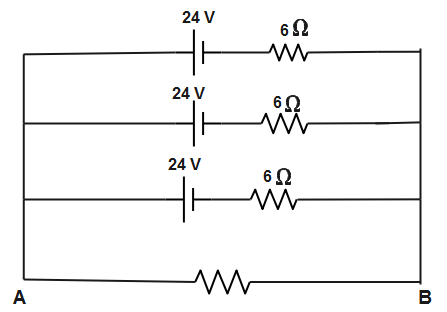
For all batteries connected in parallel, as the voltage is same in parallel, the equivalent emf will be $24V$.
For internal resistances connected in parallel, the formula for equivalent internal resistances is-
$\dfrac{1}{{{r}_{eq}}}=\dfrac{1}{{{r}_{1}}}+\dfrac{1}{{{r}_{2}}}+\dfrac{1}{{{r}_{3}}}+--+\dfrac{1}{{{r}_{n}}}$
Therefore, the equivalent internal resistance will be-
$\begin{align}
& \dfrac{1}{r}=\dfrac{1}{6}+\dfrac{1}{6}+\dfrac{1}{6} \\
& \Rightarrow \dfrac{1}{r}=\dfrac{3}{6} \\
& \therefore r=2\Omega \\
\end{align}$
Therefore, the equivalent internal resistance will be $2\Omega $.
Therefore, the combination of batteries can be replaced by a battery of emf $24V$ having internal resistance $2\Omega $.
Hence, the correct option is (D).
Note:
The emf is the potential developed by a battery. It is always greater than the potential difference. Potential difference is the difference of electric potential between two points in a circuit. Charge always flows from a point of high potential to a point of low potential. Flow of charge is called current.
Formulas used:
${{E}_{eq}}={{E}_{1}}+{{E}_{2}}+{{E}_{3}}+--+{{E}_{n}}$
${{r}_{eq}}={{r}_{1}}+{{r}_{2}}+{{r}_{3}}+--+{{r}_{n}}$
$\dfrac{1}{{{r}_{eq}}}=\dfrac{1}{{{r}_{1}}}+\dfrac{1}{{{r}_{2}}}+\dfrac{1}{{{r}_{3}}}+--+\dfrac{1}{{{r}_{n}}}$
Complete answer:
For all elements connected in series, the current passing through them is the same while for all elements connected in parallel the potential drop is the same. Batteries can also be connected in series or parallel combination.
In the above figure, given that each battery has emf $4V$ and their internal resistance is $1\Omega $.
For series combination of batteries, the equivalent emf is given by-
${{E}_{eq}}={{E}_{1}}+{{E}_{2}}+{{E}_{3}}+--+{{E}_{n}}$
Similarly the equivalent internal resistance of batteries connected in series will be-
${{r}_{eq}}={{r}_{1}}+{{r}_{2}}+{{r}_{3}}+--+{{r}_{n}}$
The equivalent emf of batteries connected in series in the figure will be-
${{E}_{eq}}=4\times 6=24V$
The equivalent resistance of batteries connected in series will be-
${{r}_{eq}}=1\times 6=6\Omega $
Therefore, the equivalent resistance of batteries connected in series is $24V$ and internal resistance is $6\Omega $. Hence, the above circuit will be simplified as-
For all batteries connected in parallel, as the voltage is same in parallel, the equivalent emf will be $24V$.
For internal resistances connected in parallel, the formula for equivalent internal resistances is-
$\dfrac{1}{{{r}_{eq}}}=\dfrac{1}{{{r}_{1}}}+\dfrac{1}{{{r}_{2}}}+\dfrac{1}{{{r}_{3}}}+--+\dfrac{1}{{{r}_{n}}}$
Therefore, the equivalent internal resistance will be-
$\begin{align}
& \dfrac{1}{r}=\dfrac{1}{6}+\dfrac{1}{6}+\dfrac{1}{6} \\
& \Rightarrow \dfrac{1}{r}=\dfrac{3}{6} \\
& \therefore r=2\Omega \\
\end{align}$
Therefore, the equivalent internal resistance will be $2\Omega $.
Therefore, the combination of batteries can be replaced by a battery of emf $24V$ having internal resistance $2\Omega $.
Hence, the correct option is (D).
Note:
The emf is the potential developed by a battery. It is always greater than the potential difference. Potential difference is the difference of electric potential between two points in a circuit. Charge always flows from a point of high potential to a point of low potential. Flow of charge is called current.
Recently Updated Pages
Master Class 11 Computer Science: Engaging Questions & Answers for Success

Master Class 11 Business Studies: Engaging Questions & Answers for Success
Master Class 11 Economics: Engaging Questions & Answers for Success
Master Class 11 English: Engaging Questions & Answers for Success
Master Class 11 Maths: Engaging Questions & Answers for Success
Master Class 11 Biology: Engaging Questions & Answers for Success
Trending doubts
One Metric ton is equal to kg A 10000 B 1000 C 100 class 11 physics CBSE
There are 720 permutations of the digits 1 2 3 4 5 class 11 maths CBSE
Discuss the various forms of bacteria class 11 biology CBSE
Draw a diagram of a plant cell and label at least eight class 11 biology CBSE
State the laws of reflection of light
10 examples of friction in our daily life