




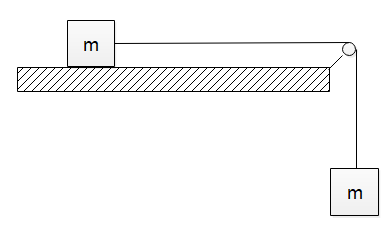
Figure shows two blocks each of masses $ m $ connected by a string passing over a pulley. The horizontal table is smooth. The pulley has a radius $ r $ and moment of inertia $ I $ Find the acceleration of the hanging mass
A) $ a = \dfrac{{mg}}{{2m + \dfrac{1}{{{r^2}}}}} $
B) $ a = \dfrac{{mg}}{{m + \dfrac{1}{{{r^2}}}}} $
C) $ a = \dfrac{{2mg}}{{2m + \dfrac{1}{{{r^2}}}}} $
D) $ a = \dfrac{{mg}}{{m + \dfrac{1}{{{r^2}}}}} $
Answer
 Verified
565.2k+ views
Hint: In this solution, we will first calculate the tension in the string on the left side and below the pulley. Then we will use the relation of torque and angular acceleration to determine the acceleration of the hanging mass.
Formula used: In this solution, we will use the following formula:
Torque of the pulley: $ \tau = F.r = I.\alpha $ where $ F $ is the force on the pulley, $ r $ is the radius of the pulley, $ I $ is the moment of inertia of the rod, and $ \alpha $ is the angular acceleration of the pulley.
Complete step by step answer
In the diagram given to us, the block on the flat surface will move to the right since there is no friction and the string will rotate over the pulley.
Let the tension in the string on the left of the pulley will be $ {T_1} $ and the tension in the string below the pulley be $ {T_2} $ and the acceleration of both the masses be $ a $ . The equation of motion of the top mass will be
$ {T_1} = ma $
And for the lower mass which is falling down will be
$ Mg - {T_2} = Ma $
Hence the force acting on the pulley will be
$ F = {T_2} - {T_1} $
The torque acting on the pulley will be determined from $ \tau = F.r = I.\alpha $ as
$ ({T_2} - {T_1})r = I\alpha $
Now, as $ \alpha = a/r $ , we have
$ ({T_2} - {T_1})r = \dfrac{{Ia}}{r} $
Substituting the values of $ {T_1} $ and $ {T_2} $ , we get
$ mg - 2ma = \dfrac{{Ia}}{{{r^2}}} $
Solving for $ a $ , we get
$ a = \dfrac{{mg}}{{2m + \dfrac{I}{{{r^2}}}}} $ which corresponds to option (A).
Note
Here we must realize that the acceleration of the two blocks will be the same since they are connected by a string. Also, the tension on two sides of the pulley will be unequal since the string will be rotating on the pulley without slipping.
Formula used: In this solution, we will use the following formula:
Torque of the pulley: $ \tau = F.r = I.\alpha $ where $ F $ is the force on the pulley, $ r $ is the radius of the pulley, $ I $ is the moment of inertia of the rod, and $ \alpha $ is the angular acceleration of the pulley.
Complete step by step answer
In the diagram given to us, the block on the flat surface will move to the right since there is no friction and the string will rotate over the pulley.
Let the tension in the string on the left of the pulley will be $ {T_1} $ and the tension in the string below the pulley be $ {T_2} $ and the acceleration of both the masses be $ a $ . The equation of motion of the top mass will be
$ {T_1} = ma $
And for the lower mass which is falling down will be
$ Mg - {T_2} = Ma $
Hence the force acting on the pulley will be
$ F = {T_2} - {T_1} $
The torque acting on the pulley will be determined from $ \tau = F.r = I.\alpha $ as
$ ({T_2} - {T_1})r = I\alpha $
Now, as $ \alpha = a/r $ , we have
$ ({T_2} - {T_1})r = \dfrac{{Ia}}{r} $
Substituting the values of $ {T_1} $ and $ {T_2} $ , we get
$ mg - 2ma = \dfrac{{Ia}}{{{r^2}}} $
Solving for $ a $ , we get
$ a = \dfrac{{mg}}{{2m + \dfrac{I}{{{r^2}}}}} $ which corresponds to option (A).
Note
Here we must realize that the acceleration of the two blocks will be the same since they are connected by a string. Also, the tension on two sides of the pulley will be unequal since the string will be rotating on the pulley without slipping.
Recently Updated Pages
Master Class 11 Computer Science: Engaging Questions & Answers for Success

Master Class 11 Business Studies: Engaging Questions & Answers for Success
Master Class 11 Economics: Engaging Questions & Answers for Success
Master Class 11 English: Engaging Questions & Answers for Success
Master Class 11 Maths: Engaging Questions & Answers for Success
Master Class 11 Biology: Engaging Questions & Answers for Success
Trending doubts
One Metric ton is equal to kg A 10000 B 1000 C 100 class 11 physics CBSE
There are 720 permutations of the digits 1 2 3 4 5 class 11 maths CBSE
Discuss the various forms of bacteria class 11 biology CBSE
Draw a diagram of a plant cell and label at least eight class 11 biology CBSE
State the laws of reflection of light
Explain zero factorial class 11 maths CBSE