




How do you find the angle of elevation of the sun if at 10 am on April 26, 2000, a building 300 feet high casts a shadow 50 feet long?
Answer
 Verified
560.7k+ views
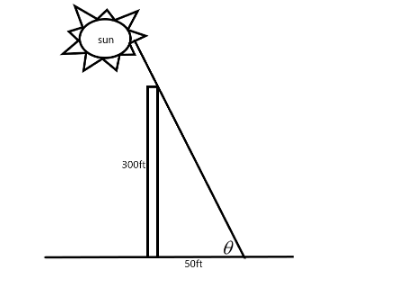
Hint: In this question, we are given the height of the building and the height of its shadow; we have to find the angle of elevation of the sun, that is, the angle between the shadow and the line joining the top of the building with the top of the shadow. Buildings are always perpendicular to the triangle, so the figure obtained is a right-angled triangle. We know that, trigonometric function tells us the relation between the sides of a right triangle and its angles, so we use the appropriate trigonometric function to find out the angle of elevation.
Complete step-by-step answer:
We know that –
$ \tan \theta = \dfrac{{perpendicular}}{{base}} $
In this question, perpendicular is equal to the height of the building, that is, 300 feet and the base is equal to the height of the shadow, that is, 50 feet.
So,
$
\tan \theta = \dfrac{{300}}{{50}} \\
\Rightarrow \tan \theta = 6 \\
\Rightarrow \theta = {\tan ^{ - 1}}6 \\
\Rightarrow \theta = 80.5^\circ \;
$
Hence, the angle of elevation of the sun is $ 80.5^\circ $ .
So, the correct answer is “ $ 80.5^\circ $ ”.
Note: Trigonometric ratios are the ratios of two sides of a right-angled triangle; the sine function is the ratio of the perpendicular and the hypotenuse, cosine function is the ratio of the base and the hypotenuse and the tangent function is the ratio of the perpendicular and the hypotenuse. In this question, we know the measure of the perpendicular and the hypotenuse so we use the tangent function. To get the value of the angle, we use the knowledge of inverse trigonometric functions.
Complete step-by-step answer:
We know that –
$ \tan \theta = \dfrac{{perpendicular}}{{base}} $
In this question, perpendicular is equal to the height of the building, that is, 300 feet and the base is equal to the height of the shadow, that is, 50 feet.
So,
$
\tan \theta = \dfrac{{300}}{{50}} \\
\Rightarrow \tan \theta = 6 \\
\Rightarrow \theta = {\tan ^{ - 1}}6 \\
\Rightarrow \theta = 80.5^\circ \;
$
Hence, the angle of elevation of the sun is $ 80.5^\circ $ .
So, the correct answer is “ $ 80.5^\circ $ ”.
Note: Trigonometric ratios are the ratios of two sides of a right-angled triangle; the sine function is the ratio of the perpendicular and the hypotenuse, cosine function is the ratio of the base and the hypotenuse and the tangent function is the ratio of the perpendicular and the hypotenuse. In this question, we know the measure of the perpendicular and the hypotenuse so we use the tangent function. To get the value of the angle, we use the knowledge of inverse trigonometric functions.
Recently Updated Pages
Master Class 11 Computer Science: Engaging Questions & Answers for Success

Master Class 11 Business Studies: Engaging Questions & Answers for Success
Master Class 11 Economics: Engaging Questions & Answers for Success
Master Class 11 English: Engaging Questions & Answers for Success
Master Class 11 Maths: Engaging Questions & Answers for Success
Master Class 11 Biology: Engaging Questions & Answers for Success
Trending doubts
One Metric ton is equal to kg A 10000 B 1000 C 100 class 11 physics CBSE
There are 720 permutations of the digits 1 2 3 4 5 class 11 maths CBSE
Discuss the various forms of bacteria class 11 biology CBSE
Draw a diagram of a plant cell and label at least eight class 11 biology CBSE
State the laws of reflection of light
Explain zero factorial class 11 maths CBSE