




Find the diagonal of a rectangle whose length is 16 cm and area is 192 sq. cm?
Answer
 Verified
553.2k+ views
Hint: Here we will first find the breadth of the rectangle by using the area of rectangle formula. Then we will draw our rectangle and form a triangle in it. Finally we will use Pythagora's theorem and substitute the values of length and breadth as perpendicular and base to find the diagonal and get the required answer.
Formula Used:
We will use the following formulas:
1. Area of rectangle \[ = l \times b\], where $l$ is the length of the rectangle and $b$ is the breadth of the rectangle
2. Pythagoras Theorem: ${{P}^{2}}+{{B}^{2}}={{H}^{2}}$, where \[P\] is the perpendicular, \[B\] is the base and \[H\] is the hypotenuse of the right angled triangle.
Complete step-by-step answer:
It is given that:
The length of the rectangle \[ = 16\] cm
The Area of the rectangle \[ = 192\] sq. cm
We know that Area of rectangle \[ = l \times b\]
Substituting these values in the above formula, we get
\[ \Rightarrow 192 =16 \times b\]
Dividing both sides by 16, we get
\[ \Rightarrow b = \dfrac{{192}}{{16}}\]
\[ \Rightarrow b = 12\] cm….\[\left( 1 \right)\]
Now, we will draw the rectangle by using the above data.
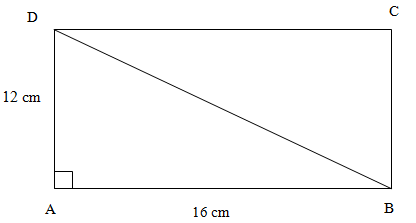
Now we will use Pythagoras theorem to find the length of the diagonal.
In $\vartriangle ABD$,
\[A{B^2} + A{D^2} = B{D^2}\]
Substituting the value from the diagram in above formula, we get
\[ \Rightarrow {\left( {16} \right)^2} + {\left( {12} \right)^2} = B{D^2}\]
Applying the exponent on the terms, we get
\[ \Rightarrow 256 + 144 = B{D^2}\]
Adding the terms, we get
\[ \Rightarrow B{D^2} = 400\]
Taking square root on both sides, we get
\[ \Rightarrow BD = \sqrt{400}\]
\[ \Rightarrow BD = 20 \] cm
So, we get the length of the diagonal as 20 cm.
Note:
Rectangle is a quadrilateral having four sides with four right angles. It is a special case of a parallelogram which has a pair of adjacent sides in a perpendicular angle. Some properties of a rectangle are:
1. It is cyclic as all corners lie on a single circle.
2. It is equiangular as the angles in all corners are equal.
3. It has two lines reflection symmetry and rotational symmetry which are in order 2.
Formula Used:
We will use the following formulas:
1. Area of rectangle \[ = l \times b\], where $l$ is the length of the rectangle and $b$ is the breadth of the rectangle
2. Pythagoras Theorem: ${{P}^{2}}+{{B}^{2}}={{H}^{2}}$, where \[P\] is the perpendicular, \[B\] is the base and \[H\] is the hypotenuse of the right angled triangle.
Complete step-by-step answer:
It is given that:
The length of the rectangle \[ = 16\] cm
The Area of the rectangle \[ = 192\] sq. cm
We know that Area of rectangle \[ = l \times b\]
Substituting these values in the above formula, we get
\[ \Rightarrow 192 =16 \times b\]
Dividing both sides by 16, we get
\[ \Rightarrow b = \dfrac{{192}}{{16}}\]
\[ \Rightarrow b = 12\] cm….\[\left( 1 \right)\]
Now, we will draw the rectangle by using the above data.
Now we will use Pythagoras theorem to find the length of the diagonal.
In $\vartriangle ABD$,
\[A{B^2} + A{D^2} = B{D^2}\]
Substituting the value from the diagram in above formula, we get
\[ \Rightarrow {\left( {16} \right)^2} + {\left( {12} \right)^2} = B{D^2}\]
Applying the exponent on the terms, we get
\[ \Rightarrow 256 + 144 = B{D^2}\]
Adding the terms, we get
\[ \Rightarrow B{D^2} = 400\]
Taking square root on both sides, we get
\[ \Rightarrow BD = \sqrt{400}\]
\[ \Rightarrow BD = 20 \] cm
So, we get the length of the diagonal as 20 cm.
Note:
Rectangle is a quadrilateral having four sides with four right angles. It is a special case of a parallelogram which has a pair of adjacent sides in a perpendicular angle. Some properties of a rectangle are:
1. It is cyclic as all corners lie on a single circle.
2. It is equiangular as the angles in all corners are equal.
3. It has two lines reflection symmetry and rotational symmetry which are in order 2.
Recently Updated Pages
Master Class 9 General Knowledge: Engaging Questions & Answers for Success

Master Class 9 Social Science: Engaging Questions & Answers for Success
Master Class 9 English: Engaging Questions & Answers for Success
Master Class 9 Maths: Engaging Questions & Answers for Success
Master Class 9 Science: Engaging Questions & Answers for Success
Class 9 Question and Answer - Your Ultimate Solutions Guide
Trending doubts
Difference Between Plant Cell and Animal Cell
Fill the blanks with the suitable prepositions 1 The class 9 english CBSE
Who is eligible for RTE class 9 social science CBSE
Which places in India experience sunrise first and class 9 social science CBSE
What is pollution? How many types of pollution? Define it
Name 10 Living and Non living things class 9 biology CBSE