



How do you find the dimensions of the rectangle with the largest area that can be inscribed in a semi – circle of radius r?
Answer
 Verified
552.3k+ views
Hint: Draw a rough diagram of a semi – circle of radius ‘r’ and inscribe a rectangle in it such that one side of the rectangle lies on the diameter of the semi – circle and two vertices lie on its curved boundary. Join the centre of this semi – circle with the two vertices. Assume the length of the rectangle as ‘l’ while breadth as ‘b’. Now, use Pythagoras theorem given as: - \[{{h}^{2}}={{b}^{2}}+{{p}^{2}}\], where h = hypotenuse, b = base and p = perpendicular, to find a relation between r, l and b. Use the formula: - Area = \[l\times b\] to find the area of the rectangle. Now, substitute the value of l, in terms of r and b, in the area relation. Differentiate the area relation with respect to b and equate it equal to 0 and find the value of b in terms of r. Finally, substitute this value of b in Pythagoras relation to get the value of l in terms of r.
Complete step-by-step solution:
Here, we have been provided with a semi – circle of radius r and we have been asked to find the dimensions of the rectangle that will have maximum area when inscribed in this semi – circle.
Now, for the inscribed rectangle to have maximum area, its one side must lie on the diameter and the two vertices on the curved boundary of the semi – circle. So, let us draw a rough diagram of the given situation.
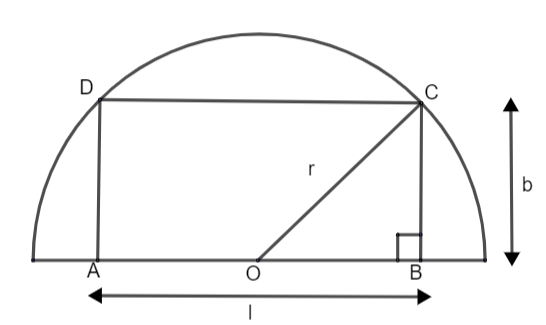
In the above figure, we have assumed l and b as the length and breadth of the rectangle respectively. Length l is divided into two equal parts at centre of the semi – circle. We have joined the centre (O) with vertex C.
Now, clearly we can see that OBC is a right angle triangle. So, applying the Pythagoras theorem given as: - \[{{h}^{2}}={{b}^{2}}+{{p}^{2}}\], where h = hypotenuse, b = base and p = perpendicular, we get,
\[\begin{align}
& \Rightarrow {{r}^{2}}={{b}^{2}}+{{\left( \dfrac{l}{2} \right)}^{2}} \\
& \Rightarrow {{r}^{2}}={{b}^{2}}+\dfrac{{{l}^{2}}}{4} \\
\end{align}\]
\[\Rightarrow 4\left( {{r}^{2}}-{{b}^{2}} \right)={{l}^{2}}\] - (1)
We know that area of a rectangle is the product of its length and breadth, let us denoted the area with A, so we have,
\[\Rightarrow A=l\times b\]
Substituting the value of l from equation (1), we get,
\[\Rightarrow A=\sqrt{4\left( {{r}^{2}}-{{b}^{2}} \right)}\times b\]
On squaring both the sides, we get,
\[\begin{align}
& \Rightarrow {{A}^{2}}=4\left( {{r}^{2}}-{{b}^{2}} \right)\times {{b}^{2}} \\
& \Rightarrow {{A}^{2}}=4\left( {{r}^{2}}{{b}^{2}}-{{b}^{4}} \right) \\
\end{align}\]
Now, for the area to be maximum, its derivative must be 0. Here, in the above relation we have area as a function of b and r is a constant, so differentiating both the sides with respect to the variable b, we get,
\[\begin{align}
& \Rightarrow \dfrac{d\left[ {{A}^{2}} \right]}{db}=\dfrac{d\left[ 4\left( {{r}^{2}}{{b}^{2}}-{{b}^{4}} \right) \right]}{db} \\
& \Rightarrow 2A\dfrac{dA}{db}=4\left[ {{r}^{2}}\times 2b-4{{b}^{3}} \right] \\
& \Rightarrow \dfrac{dA}{db}=\dfrac{2}{A}\left[ 2b{{r}^{2}}-4{{b}^{3}} \right] \\
\end{align}\]
Substituting \[\dfrac{dA}{db}=0\], we get,
\[\begin{align}
& \Rightarrow \dfrac{2}{A}\left[ 2b{{r}^{2}}-4{{b}^{3}} \right]=0 \\
& \Rightarrow 2b{{r}^{2}}-4{{b}^{3}}=0 \\
& \Rightarrow 2{{r}^{2}}-4{{b}^{2}}=0 \\
& \Rightarrow {{r}^{2}}=2{{b}^{2}} \\
& \Rightarrow {{b}^{2}}=\dfrac{{{r}^{2}}}{2} \\
\end{align}\]
Taking square root both the sides, we get,
\[\Rightarrow b=\dfrac{r}{\sqrt{2}}\]
Now, substituting the value of b in equation (1), we get,
\[\Rightarrow {{l}^{2}}=4\left( {{r}^{2}}-\dfrac{{{r}^{2}}}{2} \right)\]
\[\begin{align}
& \Rightarrow {{l}^{2}}=\dfrac{4{{r}^{2}}}{2} \\
& \Rightarrow {{l}^{2}}=2{{r}^{2}} \\
\end{align}\]
Taking square root both the sides, we get,
\[\Rightarrow l=\sqrt{2}r\]
Hence, the dimensions of the rectangle with largest area that can be inscribed in a semi – circle of radius r are \[\sqrt{2}r\times \dfrac{r}{\sqrt{2}}\].
Note: One may note that while differentiating the area relation we have considered radius ‘r’ as a constant because it is already given to us that the semi – circle has radius r and since we are not changing the semi – circle, the value of r will remain the same. Note that we have considered length l on the diameter of the circle, you can also consider base b on the diameter. This will not alter the dimensions.
Complete step-by-step solution:
Here, we have been provided with a semi – circle of radius r and we have been asked to find the dimensions of the rectangle that will have maximum area when inscribed in this semi – circle.
Now, for the inscribed rectangle to have maximum area, its one side must lie on the diameter and the two vertices on the curved boundary of the semi – circle. So, let us draw a rough diagram of the given situation.
In the above figure, we have assumed l and b as the length and breadth of the rectangle respectively. Length l is divided into two equal parts at centre of the semi – circle. We have joined the centre (O) with vertex C.
Now, clearly we can see that OBC is a right angle triangle. So, applying the Pythagoras theorem given as: - \[{{h}^{2}}={{b}^{2}}+{{p}^{2}}\], where h = hypotenuse, b = base and p = perpendicular, we get,
\[\begin{align}
& \Rightarrow {{r}^{2}}={{b}^{2}}+{{\left( \dfrac{l}{2} \right)}^{2}} \\
& \Rightarrow {{r}^{2}}={{b}^{2}}+\dfrac{{{l}^{2}}}{4} \\
\end{align}\]
\[\Rightarrow 4\left( {{r}^{2}}-{{b}^{2}} \right)={{l}^{2}}\] - (1)
We know that area of a rectangle is the product of its length and breadth, let us denoted the area with A, so we have,
\[\Rightarrow A=l\times b\]
Substituting the value of l from equation (1), we get,
\[\Rightarrow A=\sqrt{4\left( {{r}^{2}}-{{b}^{2}} \right)}\times b\]
On squaring both the sides, we get,
\[\begin{align}
& \Rightarrow {{A}^{2}}=4\left( {{r}^{2}}-{{b}^{2}} \right)\times {{b}^{2}} \\
& \Rightarrow {{A}^{2}}=4\left( {{r}^{2}}{{b}^{2}}-{{b}^{4}} \right) \\
\end{align}\]
Now, for the area to be maximum, its derivative must be 0. Here, in the above relation we have area as a function of b and r is a constant, so differentiating both the sides with respect to the variable b, we get,
\[\begin{align}
& \Rightarrow \dfrac{d\left[ {{A}^{2}} \right]}{db}=\dfrac{d\left[ 4\left( {{r}^{2}}{{b}^{2}}-{{b}^{4}} \right) \right]}{db} \\
& \Rightarrow 2A\dfrac{dA}{db}=4\left[ {{r}^{2}}\times 2b-4{{b}^{3}} \right] \\
& \Rightarrow \dfrac{dA}{db}=\dfrac{2}{A}\left[ 2b{{r}^{2}}-4{{b}^{3}} \right] \\
\end{align}\]
Substituting \[\dfrac{dA}{db}=0\], we get,
\[\begin{align}
& \Rightarrow \dfrac{2}{A}\left[ 2b{{r}^{2}}-4{{b}^{3}} \right]=0 \\
& \Rightarrow 2b{{r}^{2}}-4{{b}^{3}}=0 \\
& \Rightarrow 2{{r}^{2}}-4{{b}^{2}}=0 \\
& \Rightarrow {{r}^{2}}=2{{b}^{2}} \\
& \Rightarrow {{b}^{2}}=\dfrac{{{r}^{2}}}{2} \\
\end{align}\]
Taking square root both the sides, we get,
\[\Rightarrow b=\dfrac{r}{\sqrt{2}}\]
Now, substituting the value of b in equation (1), we get,
\[\Rightarrow {{l}^{2}}=4\left( {{r}^{2}}-\dfrac{{{r}^{2}}}{2} \right)\]
\[\begin{align}
& \Rightarrow {{l}^{2}}=\dfrac{4{{r}^{2}}}{2} \\
& \Rightarrow {{l}^{2}}=2{{r}^{2}} \\
\end{align}\]
Taking square root both the sides, we get,
\[\Rightarrow l=\sqrt{2}r\]
Hence, the dimensions of the rectangle with largest area that can be inscribed in a semi – circle of radius r are \[\sqrt{2}r\times \dfrac{r}{\sqrt{2}}\].
Note: One may note that while differentiating the area relation we have considered radius ‘r’ as a constant because it is already given to us that the semi – circle has radius r and since we are not changing the semi – circle, the value of r will remain the same. Note that we have considered length l on the diameter of the circle, you can also consider base b on the diameter. This will not alter the dimensions.
Recently Updated Pages
Master Class 12 Economics: Engaging Questions & Answers for Success

Master Class 12 Physics: Engaging Questions & Answers for Success
Master Class 12 English: Engaging Questions & Answers for Success
Master Class 12 Social Science: Engaging Questions & Answers for Success
Master Class 12 Maths: Engaging Questions & Answers for Success
Master Class 12 Business Studies: Engaging Questions & Answers for Success
Trending doubts
Which are the Top 10 Largest Countries of the World?
What are the major means of transport Explain each class 12 social science CBSE
Draw a labelled sketch of the human eye class 12 physics CBSE
Why cannot DNA pass through cell membranes class 12 biology CBSE
Differentiate between insitu conservation and exsitu class 12 biology CBSE
Draw a neat and well labeled diagram of TS of ovary class 12 biology CBSE