




Find the general solution of the equation $\cos \theta =-\dfrac{1}{2}$ is
A. $\theta =n\pi \pm \dfrac{2\pi }{3},n\in \mathbb{Z}$
B. $\theta =2n\pi \pm \dfrac{2\pi }{3},n\in \mathbb{Z}$
C. $\theta =n\pi \pm \dfrac{\pi }{3},n\in \mathbb{Z}$
D. none of these
Answer
 Verified
517.5k+ views
Hint: We first find the principal value of x for which $\cos \theta =-\dfrac{1}{2}$. In that domain, equal value of the same ratio gives equal angles. We find the angle value for $\theta $. At the end we also find the general solution for the equation $\cos \theta =-\dfrac{1}{2}$.
Complete step by step solution:
It’s given that $\cos \theta =-\dfrac{1}{2}$. The value in fraction is $-\dfrac{1}{2}$. We need to find $\theta $ for which $\cos \theta =-\dfrac{1}{2}$.
We know that in the principal domain or the periodic value of $0\le x\le \pi $ for $\cos x$, if we get $\cos a=\cos b$ where $0\le a,b\le \pi $ then $a=b$.
We have the value of $\cos \left( \dfrac{2\pi }{3} \right)$ as $-\dfrac{1}{2}$. $0<\dfrac{2\pi }{3}<\pi $.
Therefore, \[\cos \theta =-\dfrac{1}{2}=\cos \left( \dfrac{2\pi }{3} \right)\] which gives \[\theta =\dfrac{2\pi }{3}\].
We need to find the general solution then the domain changes to $-\infty \le x\le \infty $. In that case we have to use the formula $x=2n\pi \pm a$ for $\cos \left( x \right)=\cos a$ where $0\le x\le \pi $. For our given problem $\cos \theta =-\dfrac{1}{2}$, the general solution will be $\theta =2n\pi \pm \dfrac{2\pi }{3}$. Here $n\in \mathbb{Z}$.
Note:
We also can show the solutions (primary and general) of the equation $\cos \theta =-\dfrac{1}{2}$ through a graph. We take $y=\cos \theta =-\dfrac{1}{2}$. We got two equations: $y=\cos \theta $ and $y=-\left( \dfrac{1}{2} \right)$. We place them on the graph and find the solutions as their intersecting points.
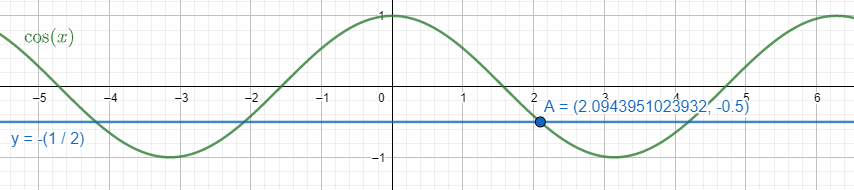
We can see the primary solution in the interval $0\le \theta \le \pi $ is the point A as $\theta =\dfrac{2\pi }{3}$.
All the other intersecting points of the curve and the line are general solutions.
Complete step by step solution:
It’s given that $\cos \theta =-\dfrac{1}{2}$. The value in fraction is $-\dfrac{1}{2}$. We need to find $\theta $ for which $\cos \theta =-\dfrac{1}{2}$.
We know that in the principal domain or the periodic value of $0\le x\le \pi $ for $\cos x$, if we get $\cos a=\cos b$ where $0\le a,b\le \pi $ then $a=b$.
We have the value of $\cos \left( \dfrac{2\pi }{3} \right)$ as $-\dfrac{1}{2}$. $0<\dfrac{2\pi }{3}<\pi $.
Therefore, \[\cos \theta =-\dfrac{1}{2}=\cos \left( \dfrac{2\pi }{3} \right)\] which gives \[\theta =\dfrac{2\pi }{3}\].
We need to find the general solution then the domain changes to $-\infty \le x\le \infty $. In that case we have to use the formula $x=2n\pi \pm a$ for $\cos \left( x \right)=\cos a$ where $0\le x\le \pi $. For our given problem $\cos \theta =-\dfrac{1}{2}$, the general solution will be $\theta =2n\pi \pm \dfrac{2\pi }{3}$. Here $n\in \mathbb{Z}$.
Note:
We also can show the solutions (primary and general) of the equation $\cos \theta =-\dfrac{1}{2}$ through a graph. We take $y=\cos \theta =-\dfrac{1}{2}$. We got two equations: $y=\cos \theta $ and $y=-\left( \dfrac{1}{2} \right)$. We place them on the graph and find the solutions as their intersecting points.
We can see the primary solution in the interval $0\le \theta \le \pi $ is the point A as $\theta =\dfrac{2\pi }{3}$.
All the other intersecting points of the curve and the line are general solutions.
Recently Updated Pages
Master Class 11 Computer Science: Engaging Questions & Answers for Success

Master Class 11 Business Studies: Engaging Questions & Answers for Success
Master Class 11 Economics: Engaging Questions & Answers for Success
Master Class 11 English: Engaging Questions & Answers for Success
Master Class 11 Maths: Engaging Questions & Answers for Success
Master Class 11 Biology: Engaging Questions & Answers for Success
Trending doubts
There are 720 permutations of the digits 1 2 3 4 5 class 11 maths CBSE
Discuss the various forms of bacteria class 11 biology CBSE
Explain zero factorial class 11 maths CBSE
What organs are located on the left side of your body class 11 biology CBSE
Draw a diagram of nephron and explain its structur class 11 biology CBSE
How do I convert ms to kmh Give an example class 11 physics CBSE