




Find the HCF and LCM of $120$ and $144$ by the fundamental theorem of Arithmetic.
Answer
 Verified
525.2k+ views
Hint:Fundamental theorem of Arithmetic states that every composite number can be factored uniquely as a product of primes. HCF is the highest factor common to two given natural numbers. LCM is the smallest multiple common to two given natural numbers. To find HCF and LCM, first we will find prime factorization of the given natural numbers. Then, observe the common prime factors with smallest power to find HCF and observe all prime factors with greatest power to find LCM.
Complete answer:
First we need to find the prime factorization of given numbers $120$ and $144$. These both numbers are even so we can start prime factorization with prime numbers $2$.
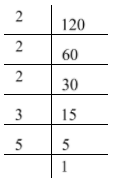
Therefore, $120 = 2 \times 2 \times 2 \times 3 \times 5 = {2^3} \times {3^1} \times {5^1}$
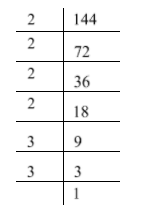
Therefore, $144 = 2 \times 2 \times 2 \times 2 \times 3 \times 3 = {2^4} \times {3^2}$
Now we can see that $2$ and $3$ are common prime factors in the prime factorization of $120$ and
$144$. Also we can see the smallest powers of $2$ and $3$ are $3$ and $1$ respectively.
Therefore, HCF of $120$ and $144$ is the product of ${2^3}$ and ${3^1}$.
That is, HCF of $120$ and $144$ is ${2^3} \times {3^1} = 8 \times 3 = 24$.
Now if we observe prime factorization of both numbers then we can see that there are three prime factors $2,3$ and $5$. Also we can see the greatest powers of $2,3$ and $5$ are $4,2$ and $1$ respectively. Therefore, LCM of $120$ and $144$ is the product of \[{2^4},{3^2}\] and ${5^1}$. That is, LCM of $120$ and $144$ is \[{2^4} \times {3^2} \times {5^1} = 16 \times 9 \times 5 = 720\].
Hence, HCF and LCM of $120$ and $144$ are $24$ and $720$ respectively.
Note:Fundamental theorem of Arithmetic is also known as unique factorization theorem. In this example, the product of two given numbers $120$ and $144$ is $17,280$. If we take a product of HCF and LCM of these two numbers then we will get the same answer. That is, $24 \times 720 = 17280$. Note that the product of given numbers is equivalent to the product of their HCF and LCM. This is the useful property of HCF and LCM.
Complete answer:
First we need to find the prime factorization of given numbers $120$ and $144$. These both numbers are even so we can start prime factorization with prime numbers $2$.
Therefore, $120 = 2 \times 2 \times 2 \times 3 \times 5 = {2^3} \times {3^1} \times {5^1}$
Therefore, $144 = 2 \times 2 \times 2 \times 2 \times 3 \times 3 = {2^4} \times {3^2}$
Now we can see that $2$ and $3$ are common prime factors in the prime factorization of $120$ and
$144$. Also we can see the smallest powers of $2$ and $3$ are $3$ and $1$ respectively.
Therefore, HCF of $120$ and $144$ is the product of ${2^3}$ and ${3^1}$.
That is, HCF of $120$ and $144$ is ${2^3} \times {3^1} = 8 \times 3 = 24$.
Now if we observe prime factorization of both numbers then we can see that there are three prime factors $2,3$ and $5$. Also we can see the greatest powers of $2,3$ and $5$ are $4,2$ and $1$ respectively. Therefore, LCM of $120$ and $144$ is the product of \[{2^4},{3^2}\] and ${5^1}$. That is, LCM of $120$ and $144$ is \[{2^4} \times {3^2} \times {5^1} = 16 \times 9 \times 5 = 720\].
Hence, HCF and LCM of $120$ and $144$ are $24$ and $720$ respectively.
Note:Fundamental theorem of Arithmetic is also known as unique factorization theorem. In this example, the product of two given numbers $120$ and $144$ is $17,280$. If we take a product of HCF and LCM of these two numbers then we will get the same answer. That is, $24 \times 720 = 17280$. Note that the product of given numbers is equivalent to the product of their HCF and LCM. This is the useful property of HCF and LCM.
Recently Updated Pages
Master Class 10 Computer Science: Engaging Questions & Answers for Success

Master Class 10 General Knowledge: Engaging Questions & Answers for Success
Master Class 10 English: Engaging Questions & Answers for Success
Master Class 10 Social Science: Engaging Questions & Answers for Success
Master Class 10 Maths: Engaging Questions & Answers for Success
Master Class 10 Science: Engaging Questions & Answers for Success
Trending doubts
What is the median of the first 10 natural numbers class 10 maths CBSE
Which women's tennis player has 24 Grand Slam singles titles?
Who is the Brand Ambassador of Incredible India?
Why is there a time difference of about 5 hours between class 10 social science CBSE
Write a letter to the principal requesting him to grant class 10 english CBSE
A moving boat is observed from the top of a 150 m high class 10 maths CBSE