



Find the perimeter of a triangle with sides $3{\text{ cm, }}8{\text{ cm}}$ and $6{\text{ cm}}$.
Answer
 Verified
581.1k+ views
Hint: The perimeter of a plane surface is the length of its boundaries. Thus, the perimeter of a triangle is the sum of all of its sides. Add the given sides of the triangle to determine its perimeter.
Complete step-by-step answer:
According to the given question, the sides of the triangle are $3{\text{ cm, }}8{\text{ cm}}$ and $6{\text{ cm}}$.
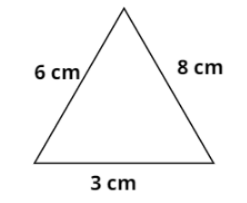
We know that the perimeter of a plane surface is the length of its boundaries.
But since a triangle consists of three sides, its perimeter will be the sum of all of its sides. Therefore using this we will get the perimeter as:
$ \Rightarrow $ Perimeter \[ = 3{\text{ cm }} + 8{\text{ cm }} + {\text{ }}6{\text{ cm}} = 17{\text{ cm}}\]
Thus the perimeter of the triangle is 17 cm.
Additional Information:
If the area of the triangle is asked instead, then we can use the formula:
\[ \Rightarrow {\text{ Area}} = \dfrac{1}{2} \times b \times h\], where $b$ is the base and $h$ is the height of the triangle.
If all the sides of the triangle are known then Heron’s formula can also be used to determine its area. This formula is:
\[ \Rightarrow {\text{ Area}} = \sqrt {s\left( {s - a} \right)\left( {s - b} \right)\left( {s - c} \right)} \], where \[a,{\text{ }}b\] and $c$ are the sides of the triangle and $s$ is the semi-perimeter. So the value of $s$ is $s = \dfrac{{a + b + c}}{2}$.
If the triangle is a right angled triangle instead, then its area can be calculated by the formula:
\[ \Rightarrow {\text{ Area}} = \dfrac{1}{2} \times {\text{base}} \times {\text{perpendicular}}\]
Note: For three lines to form a triangle, the sum of the lengths of any two of them must be greater than the length of the third one. In the above question, the lengths of the sides of the triangle are $3{\text{ cm, }}8{\text{ cm}}$ and $6{\text{ cm}}$ and we can see that:
\[ \Rightarrow 3 + 8 > 6,{\text{ }}3 + 6 > 8\] and $8 + 6 > 3$
Therefore the condition is valid for a triangle.
Complete step-by-step answer:
According to the given question, the sides of the triangle are $3{\text{ cm, }}8{\text{ cm}}$ and $6{\text{ cm}}$.
We know that the perimeter of a plane surface is the length of its boundaries.
But since a triangle consists of three sides, its perimeter will be the sum of all of its sides. Therefore using this we will get the perimeter as:
$ \Rightarrow $ Perimeter \[ = 3{\text{ cm }} + 8{\text{ cm }} + {\text{ }}6{\text{ cm}} = 17{\text{ cm}}\]
Thus the perimeter of the triangle is 17 cm.
Additional Information:
If the area of the triangle is asked instead, then we can use the formula:
\[ \Rightarrow {\text{ Area}} = \dfrac{1}{2} \times b \times h\], where $b$ is the base and $h$ is the height of the triangle.
If all the sides of the triangle are known then Heron’s formula can also be used to determine its area. This formula is:
\[ \Rightarrow {\text{ Area}} = \sqrt {s\left( {s - a} \right)\left( {s - b} \right)\left( {s - c} \right)} \], where \[a,{\text{ }}b\] and $c$ are the sides of the triangle and $s$ is the semi-perimeter. So the value of $s$ is $s = \dfrac{{a + b + c}}{2}$.
If the triangle is a right angled triangle instead, then its area can be calculated by the formula:
\[ \Rightarrow {\text{ Area}} = \dfrac{1}{2} \times {\text{base}} \times {\text{perpendicular}}\]
Note: For three lines to form a triangle, the sum of the lengths of any two of them must be greater than the length of the third one. In the above question, the lengths of the sides of the triangle are $3{\text{ cm, }}8{\text{ cm}}$ and $6{\text{ cm}}$ and we can see that:
\[ \Rightarrow 3 + 8 > 6,{\text{ }}3 + 6 > 8\] and $8 + 6 > 3$
Therefore the condition is valid for a triangle.

Recently Updated Pages
Master Class 8 Social Science: Engaging Questions & Answers for Success

Master Class 8 English: Engaging Questions & Answers for Success
Class 8 Question and Answer - Your Ultimate Solutions Guide
Master Class 8 Maths: Engaging Questions & Answers for Success
Master Class 8 Science: Engaging Questions & Answers for Success
Master Class 9 General Knowledge: Engaging Questions & Answers for Success
Trending doubts
What is BLO What is the full form of BLO class 8 social science CBSE
Citizens of India can vote at the age of A 18 years class 8 social science CBSE
Full form of STD, ISD and PCO
Advantages and disadvantages of science
Right to vote is a AFundamental Right BFundamental class 8 social science CBSE
What are the 12 elements of nature class 8 chemistry CBSE