



How do I find the perimeter of a triangle with vertices \[\left( { - 2,2} \right),\left( {0,4} \right),\left( {1 - ,4} \right)\]?
Answer
 Verified
543.9k+ views
Hint: In the given question, we have been given that there is a triangle whose coordinates of the vertices are given. We have to find the perimeter of the triangle. To find the perimeter of the given triangle, we are going to first find the length of the sides using the distance formula. Then when we have calculated the length of all sides, we are simply going to add them all up and we are going to have our answer.
Complete step by step answer:
We are going to use the distance formula:
Let there be two points \[\left( {{x_1},{y_1}} \right)\] and \[\left( {{x_2},{y_2}} \right)\]. Then the distance between the points is:
\[{d_i} = \sqrt {{{\left( {{y_2} - {y_1}} \right)}^2} + {{\left( {{x_2} - {x_1}} \right)}^2}} \]
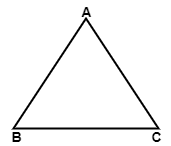
Let the sides being represented by the vertices be \[A\left( { - 2,2} \right),B\left( {0,4} \right),C\left( {1, - 4} \right)\].
First, let us calculate the length of the sides.
\[AB = \sqrt {{{\left( {0 + 2} \right)}^2} + {{\left( {4 - 2} \right)}^2}} = \sqrt {4 + 4} = 2\sqrt 2 \]
\[BC = \sqrt {{{\left( {1 - 0} \right)}^2} + {{\left( { - 4 - 4} \right)}^2}} = \sqrt {65} \]
\[CA = \sqrt {{{\left( {1 + 2} \right)}^2} + {{\left( { - 4 - 2} \right)}^2}} = \sqrt {9 + 36} = 3\sqrt 5 \]
Now, perimeter means sum of all sides.
Hence, \[P = 2\sqrt 2 + \sqrt {65} + 3\sqrt 5 \] units
Note: In the given question, we had to find the perimeter of a triangle whose coordinates were given. The point where the things may go wrong is if we do not pay attention to the sign of the value of the coordinates. To the beginners it might seem that it is not such a big issue, but it totally flips the answer if we make the slightest mistake of a wrong sign. We pay attention to that, write the formula correctly, and follow the procedure, we are good to go.
Complete step by step answer:
We are going to use the distance formula:
Let there be two points \[\left( {{x_1},{y_1}} \right)\] and \[\left( {{x_2},{y_2}} \right)\]. Then the distance between the points is:
\[{d_i} = \sqrt {{{\left( {{y_2} - {y_1}} \right)}^2} + {{\left( {{x_2} - {x_1}} \right)}^2}} \]
Let the sides being represented by the vertices be \[A\left( { - 2,2} \right),B\left( {0,4} \right),C\left( {1, - 4} \right)\].
First, let us calculate the length of the sides.
\[AB = \sqrt {{{\left( {0 + 2} \right)}^2} + {{\left( {4 - 2} \right)}^2}} = \sqrt {4 + 4} = 2\sqrt 2 \]
\[BC = \sqrt {{{\left( {1 - 0} \right)}^2} + {{\left( { - 4 - 4} \right)}^2}} = \sqrt {65} \]
\[CA = \sqrt {{{\left( {1 + 2} \right)}^2} + {{\left( { - 4 - 2} \right)}^2}} = \sqrt {9 + 36} = 3\sqrt 5 \]
Now, perimeter means sum of all sides.
Hence, \[P = 2\sqrt 2 + \sqrt {65} + 3\sqrt 5 \] units
Note: In the given question, we had to find the perimeter of a triangle whose coordinates were given. The point where the things may go wrong is if we do not pay attention to the sign of the value of the coordinates. To the beginners it might seem that it is not such a big issue, but it totally flips the answer if we make the slightest mistake of a wrong sign. We pay attention to that, write the formula correctly, and follow the procedure, we are good to go.

Recently Updated Pages
Master Class 9 General Knowledge: Engaging Questions & Answers for Success

Master Class 9 Social Science: Engaging Questions & Answers for Success
Master Class 9 English: Engaging Questions & Answers for Success
Master Class 9 Maths: Engaging Questions & Answers for Success
Master Class 9 Science: Engaging Questions & Answers for Success
Class 9 Question and Answer - Your Ultimate Solutions Guide
Trending doubts
Difference Between Plant Cell and Animal Cell
Fill the blanks with the suitable prepositions 1 The class 9 english CBSE
Who is eligible for RTE class 9 social science CBSE
Which places in India experience sunrise first and class 9 social science CBSE
What is pollution? How many types of pollution? Define it
Name 10 Living and Non living things class 9 biology CBSE