




Find the value of $\operatorname{cosec} ( - {1410^ \circ })$
Answer
 Verified
591k+ views
Hint: We know that \[{\text{cosec}}\left( { - \theta } \right) = - {\text{cosec}}\theta \]
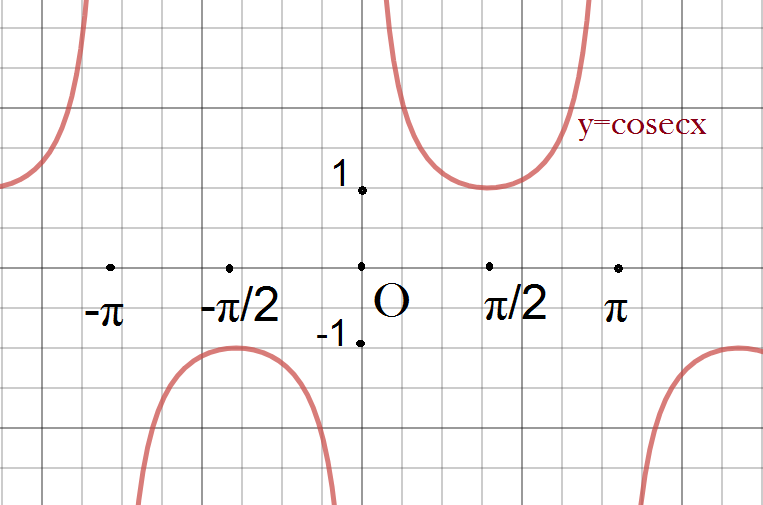
Again, the function \[y = \cos ecx\] has a period of \[2\pi \] or \[360^\circ \], i.e. the value of \[\cos ecx\;\] repeats after an interval of \[2\pi \] or \[360^\circ \].
Therefore write \[1410^\circ \] as \[(4 \times 2\pi - 30^\circ )\] and proceed.
Complete step-by-step answer:
We know that the function \[y = \cos ecx\] has a period of \[2\pi \] or \[360^\circ \], i.e. the value of \[\cos ecx\;\] repeats after an interval of \[2\pi \] or \[360^\circ \].
Therefore,
\[\operatorname{cosec} ( - {1410^ \circ })\]
Using, \[\left[ {{\text{cosec}}\left( { - \theta } \right) = - {\text{cosec}}\theta } \right]\], we get,
\[ = - \operatorname{cosec} ({1410^ \circ }){\text{ }}\]
We can write the above statement as,
\[ = - \operatorname{cosec} \left( {(4 \times {{360}^ \circ }) - {{30}^ \circ }} \right)\]
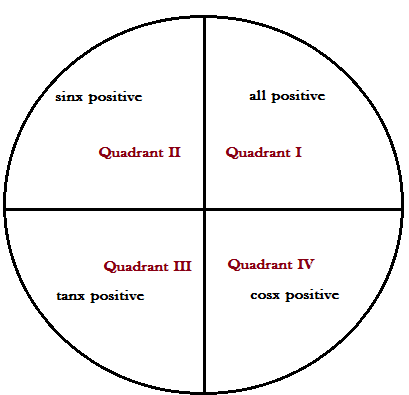
Since \[{\text{141}}{0^ \circ }\] lies in the fourth quadrant, therefore is \[{\text{cosec141}}{0^ \circ }\] negative
\[ = - \left( { - \operatorname{cosec} {{30}^ \circ }} \right){\text{ }}\]
\[ = \operatorname{cosec} {30^ \circ }\]
As, \[\operatorname{cosec} ({30^ \circ }) = 2\], we get,
\[ = 2\]
Hence, the value of $\operatorname{cosec} ( - {1410^ \circ })$ is 2.
Note: Note the following important formulae:
1.$\cos x = \dfrac{1}{{\sec x}}$ , $\sin x = \dfrac{1}{{\cos ecx}}$ , $\tan x = \dfrac{1}{{\cot x}}$
2.${\sin ^2}x + {\cos ^2}x = 1$
3.\[{\sec ^2}x - {\tan ^2}x = 1\]
4.\[{\operatorname{cosec} ^2}x - {\cot ^2}x = 1\]
5.$\sin ( - x) = - \sin x$
6.$\cos ( - x) = \cos x$
7.$\tan ( - x) = - \tan x$
8.$\sin \left( {2n\pi \pm x} \right) = \sin x{\text{ , period 2}}\pi {\text{ or 3}}{60^ \circ }$
9.$\cos \left( {2n\pi \pm x} \right) = \cos x{\text{ , period 2}}\pi {\text{ or 3}}{60^ \circ }$
10.$\tan \left( {n\pi \pm x} \right) = \tan x{\text{ , period }}\pi {\text{ or 18}}{0^ \circ }$
Sign convention:
Also, the trigonometric ratios of the standard angles are given by
Again, the function \[y = \cos ecx\] has a period of \[2\pi \] or \[360^\circ \], i.e. the value of \[\cos ecx\;\] repeats after an interval of \[2\pi \] or \[360^\circ \].
Therefore write \[1410^\circ \] as \[(4 \times 2\pi - 30^\circ )\] and proceed.
Complete step-by-step answer:
We know that the function \[y = \cos ecx\] has a period of \[2\pi \] or \[360^\circ \], i.e. the value of \[\cos ecx\;\] repeats after an interval of \[2\pi \] or \[360^\circ \].
Therefore,
\[\operatorname{cosec} ( - {1410^ \circ })\]
Using, \[\left[ {{\text{cosec}}\left( { - \theta } \right) = - {\text{cosec}}\theta } \right]\], we get,
\[ = - \operatorname{cosec} ({1410^ \circ }){\text{ }}\]
We can write the above statement as,
\[ = - \operatorname{cosec} \left( {(4 \times {{360}^ \circ }) - {{30}^ \circ }} \right)\]
Since \[{\text{141}}{0^ \circ }\] lies in the fourth quadrant, therefore is \[{\text{cosec141}}{0^ \circ }\] negative
\[ = - \left( { - \operatorname{cosec} {{30}^ \circ }} \right){\text{ }}\]
\[ = \operatorname{cosec} {30^ \circ }\]
As, \[\operatorname{cosec} ({30^ \circ }) = 2\], we get,
\[ = 2\]
Hence, the value of $\operatorname{cosec} ( - {1410^ \circ })$ is 2.
Note: Note the following important formulae:
1.$\cos x = \dfrac{1}{{\sec x}}$ , $\sin x = \dfrac{1}{{\cos ecx}}$ , $\tan x = \dfrac{1}{{\cot x}}$
2.${\sin ^2}x + {\cos ^2}x = 1$
3.\[{\sec ^2}x - {\tan ^2}x = 1\]
4.\[{\operatorname{cosec} ^2}x - {\cot ^2}x = 1\]
5.$\sin ( - x) = - \sin x$
6.$\cos ( - x) = \cos x$
7.$\tan ( - x) = - \tan x$
8.$\sin \left( {2n\pi \pm x} \right) = \sin x{\text{ , period 2}}\pi {\text{ or 3}}{60^ \circ }$
9.$\cos \left( {2n\pi \pm x} \right) = \cos x{\text{ , period 2}}\pi {\text{ or 3}}{60^ \circ }$
10.$\tan \left( {n\pi \pm x} \right) = \tan x{\text{ , period }}\pi {\text{ or 18}}{0^ \circ }$
Sign convention:
Also, the trigonometric ratios of the standard angles are given by
| \[0^\circ \] | \[30^\circ \] | \[45^\circ \] | \[60^\circ \] | \[90^\circ \] | |
| \[\operatorname{Sin} x\] | 0 | $\dfrac{1}{2}$ | $\dfrac{1}{{\sqrt 2 }}$ | $\dfrac{{\sqrt 3 }}{2}$ | 1 |
| \[\cos x\] | 1 | $\dfrac{{\sqrt 3 }}{2}$ | $\dfrac{1}{{\sqrt 2 }}$ | $\dfrac{1}{2}$ | 0 |
| \[\tan x\] | 0 | $\dfrac{1}{{\sqrt 3 }}$ | 1 | $\sqrt 3 $ | Undefined |
| \[cotx\] | undefined | $\sqrt 3 $ | 1 | $\dfrac{1}{{\sqrt 3 }}$ | 0 |
| \[\cos ecx\;\] | undefined | 2 | $\sqrt 2 $ | $\dfrac{2}{{\sqrt 3 }}$ | 1 |
| \[\operatorname{Sec} x\] | 1 | $\dfrac{2}{{\sqrt 3 }}$ | $\sqrt 2 $ | 2 | Undefined |
Recently Updated Pages
Master Class 11 Computer Science: Engaging Questions & Answers for Success

Master Class 11 Business Studies: Engaging Questions & Answers for Success
Master Class 11 Economics: Engaging Questions & Answers for Success
Master Class 11 English: Engaging Questions & Answers for Success
Master Class 11 Maths: Engaging Questions & Answers for Success
Master Class 11 Biology: Engaging Questions & Answers for Success
Trending doubts
One Metric ton is equal to kg A 10000 B 1000 C 100 class 11 physics CBSE
There are 720 permutations of the digits 1 2 3 4 5 class 11 maths CBSE
Discuss the various forms of bacteria class 11 biology CBSE
Draw a diagram of a plant cell and label at least eight class 11 biology CBSE
State the laws of reflection of light
Explain zero factorial class 11 maths CBSE