




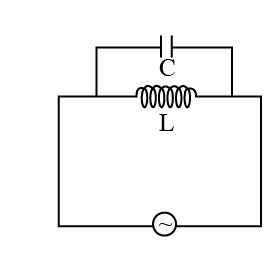
For the circuit shown in the figure the current through the inductor is 1.6 A, while the current through the condenser is 0.4 A, then the current I drawn from the source is,
A. \[2\sqrt 2 \;{\rm{A}}\]
B. \[1.65\;{\rm{A}}\]
C. \[1.2\;{\rm{A}}\]
D. \[2.0\;{\rm{A}}\]
Answer
 Verified
588k+ views
Hint: The above problem can be resolved using the concepts and fundamental relations for the phase difference on the voltage supply as well as the current flow across the given capacitive- Inductive circuit. Moreover, this phase difference will decide the idea of the required current flow from the given source.
Complete step-by-step solution:
Given:
The magnitude of current through the inductor is, \[{I_1} = 1.6\;{\rm{A}}\].
The magnitude of current through the condenser is, \[{I_2} = 0.4\;{\rm{A}}\].
The circuit consisting of capacitor capacitance C and inductor of inductance L is shown in the figure,
Let I be the current drawn from the source
In an L-C circuit, the capacitor possesses a lead of \[90\;^\circ \]in its voltage supply, while the inductor possesses the lag of \[90\;^\circ \] in its voltage supply. This account for the current flow through the inductor will lag by \[180\;^\circ \] with respect to the current flow across the capacitor or the condenser.
Then the magnitude of current drawn from the source is given as,
\[I = {I_1} - {I_2}\]
Substituting the values,
\[\begin{array}{l}
I = {I_1} - {I_2}\\
I = 1.6\;{\rm{A}} - 0.4\;{\rm{A}}\\
I = 1.2\;{\rm{A}}
\end{array}\]
Therefore, the required magnitude of current from the source is 1.2 A and option C is correct.
Note: The problem uses the concepts of phase difference among the voltages, therefore it is important to remember the phase differences for the various kinds of circuits like LC circuit, RL circuit, RLC circuit and many more. Along with this the key concept of the phases of current flow is also to be remembered to resolve the given condition.
Complete step-by-step solution:
Given:
The magnitude of current through the inductor is, \[{I_1} = 1.6\;{\rm{A}}\].
The magnitude of current through the condenser is, \[{I_2} = 0.4\;{\rm{A}}\].
The circuit consisting of capacitor capacitance C and inductor of inductance L is shown in the figure,
Let I be the current drawn from the source
In an L-C circuit, the capacitor possesses a lead of \[90\;^\circ \]in its voltage supply, while the inductor possesses the lag of \[90\;^\circ \] in its voltage supply. This account for the current flow through the inductor will lag by \[180\;^\circ \] with respect to the current flow across the capacitor or the condenser.
Then the magnitude of current drawn from the source is given as,
\[I = {I_1} - {I_2}\]
Substituting the values,
\[\begin{array}{l}
I = {I_1} - {I_2}\\
I = 1.6\;{\rm{A}} - 0.4\;{\rm{A}}\\
I = 1.2\;{\rm{A}}
\end{array}\]
Therefore, the required magnitude of current from the source is 1.2 A and option C is correct.
Note: The problem uses the concepts of phase difference among the voltages, therefore it is important to remember the phase differences for the various kinds of circuits like LC circuit, RL circuit, RLC circuit and many more. Along with this the key concept of the phases of current flow is also to be remembered to resolve the given condition.
Recently Updated Pages
Master Class 10 Computer Science: Engaging Questions & Answers for Success

Master Class 10 General Knowledge: Engaging Questions & Answers for Success
Master Class 10 English: Engaging Questions & Answers for Success
Master Class 10 Social Science: Engaging Questions & Answers for Success
Master Class 10 Maths: Engaging Questions & Answers for Success
Master Class 10 Science: Engaging Questions & Answers for Success
Trending doubts
What is the median of the first 10 natural numbers class 10 maths CBSE
Which women's tennis player has 24 Grand Slam singles titles?
Who is the Brand Ambassador of Incredible India?
Why is there a time difference of about 5 hours between class 10 social science CBSE
Write a letter to the principal requesting him to grant class 10 english CBSE
A moving boat is observed from the top of a 150 m high class 10 maths CBSE