




What is the force applied to the box?
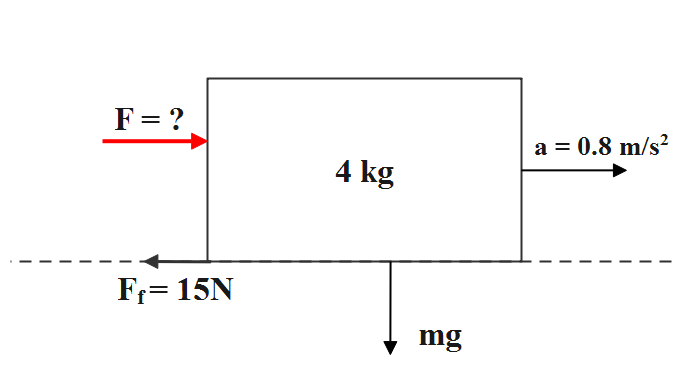
A)$9.1N$
B)$18.2N$
C)$3.6N$
D)$6.2N$
Answer
 Verified
511.8k+ views
Hint: The force which causes a change in velocity and change in velocity creates a force. The SI unit of force is newton (N) and force has both magnitude and direction. There are three newton’s laws of motion and that are newton’s first law, newton’s second law and newton’s third law. Newton’s law of motion stated that acceleration of an object is directly proportional to net force and inversely proportional to mass.
Complete step-by-step solution:
Friction is the force which bears or resists the relative motion of solid surfaces and sliding against each other. There are different types of frictions and that is dry friction, fluid friction, lubricated friction, skin friction and internal friction. Friction is measured in terms of force and unit of friction is newton.
Newton’s law of motion stated that acceleration of an object is directly proportional to net force and inversely proportional to mass
Force=mass$\times $ acceleration
Let consider mass of the block ($m$ )=$4kg$
Acceleration($a$ )=$0.8m{{s}^{-2}}$
The net force acting on the block in the direction of motion is :
$F=ma$
After substitution
$F=4\times 0.8=3.2N$
This is obtained after overcoming the opposing frictional force ($f$ )=$15N$
The total force to be applied is given as below:
${{F}^{1}}=F+f$
After substituting their respective values
${{F}^{1}}=3.2+15=18.2N$
So the force applied to the box is $18.2N$
The correct option is B.
Note: Acceleration depends on the mass and also on the force. The force velocity, acceleration and momentum have both magnitude and a direction. Heavier objects have less acceleration compared to lighter objects. Newton’s second law of motion to relate the motion of the object to the forces involved. Objects with constant masses are used in Newton’s second law.
Complete step-by-step solution:
Friction is the force which bears or resists the relative motion of solid surfaces and sliding against each other. There are different types of frictions and that is dry friction, fluid friction, lubricated friction, skin friction and internal friction. Friction is measured in terms of force and unit of friction is newton.
Newton’s law of motion stated that acceleration of an object is directly proportional to net force and inversely proportional to mass
Force=mass$\times $ acceleration
Let consider mass of the block ($m$ )=$4kg$
Acceleration($a$ )=$0.8m{{s}^{-2}}$
The net force acting on the block in the direction of motion is :
$F=ma$
After substitution
$F=4\times 0.8=3.2N$
This is obtained after overcoming the opposing frictional force ($f$ )=$15N$
The total force to be applied is given as below:
${{F}^{1}}=F+f$
After substituting their respective values
${{F}^{1}}=3.2+15=18.2N$
So the force applied to the box is $18.2N$
The correct option is B.
Note: Acceleration depends on the mass and also on the force. The force velocity, acceleration and momentum have both magnitude and a direction. Heavier objects have less acceleration compared to lighter objects. Newton’s second law of motion to relate the motion of the object to the forces involved. Objects with constant masses are used in Newton’s second law.
Recently Updated Pages
Master Class 11 Computer Science: Engaging Questions & Answers for Success

Master Class 11 Business Studies: Engaging Questions & Answers for Success
Master Class 11 Economics: Engaging Questions & Answers for Success
Master Class 11 English: Engaging Questions & Answers for Success
Master Class 11 Maths: Engaging Questions & Answers for Success
Master Class 11 Biology: Engaging Questions & Answers for Success
Trending doubts
One Metric ton is equal to kg A 10000 B 1000 C 100 class 11 physics CBSE
There are 720 permutations of the digits 1 2 3 4 5 class 11 maths CBSE
Discuss the various forms of bacteria class 11 biology CBSE
Draw a diagram of a plant cell and label at least eight class 11 biology CBSE
State the laws of reflection of light
Explain zero factorial class 11 maths CBSE