




Give IUPAC name of the following compounds :
1.$C{H_3} - C{H_2} - C{H_2} - C{H_2} - O - C{H_2} - C{H_3}$
2.$HO - C{H_2} - C{H_2} - C{H_2} - OH$
3.$CH \equiv C - C{H_2} - CH = C{H_2}$
Answer
 Verified
575.4k+ views
Hint:According to the IUPAC priority order, the preference of the alkene functional group is more than the preference of the alkyne functional group. When there are two alcohol groups then we use ‘diol’ as a suffix for naming.
Complete step by step answer:
$1.)$ In the first part the functional group present in the given compound is an ether which is denoted as $R - O - R'$. In ethers we use ‘Alkoxy Alkane’ for their naming. Here, the carbon chain which is smaller around the oxygen will be named as ‘Alkoxy’ and the carbon chain on the other side which is smaller we use ‘Alkane’.
In the given compound,
$C{H_3} - C{H_2} - C{H_2} - C{H_2} - O - C{H_2} - C{H_3}$
We have ethane carbon chains which are smaller and on the other side of oxygen we have butane which is larger so we will use ‘oxy’ with ethane by removing ‘ane’ of ethane. Therefore, its IUPAC name can be given as:
Ethoxy-Butane.
$2.)$In this part, the compound is
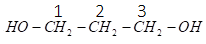
The functional group present in the compound is alcohol that is $ - OH$ and there are two alcohols in the given compound so we will use diol as a suffix for them present at carbon number $1$ and $3$. Also, the carbon chain is of three carbon so we will use propane for it.
Therefore, its IUPAC name is : Propan$ - 1,3 - $diol.
$3.)$In this part, the compound is :
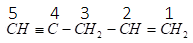
This compound contains alkene as well as alkyne group. So, when there is a tie between alkene and alkyne group then the alkene group is given the more priority for numbering. And for naming we use alphabetical order where we use ‘ene’ suffix for alkene group and ‘yne’ group for alkyne group. Also, the carbon chain here is of five carbons so its word root will be pent.
Hence, its name is : pent$ - 1 - $ene$ - 4 - $yne.
Note:
Always remember that If in a compound there are more than one functional group in that compound then the functional group with the higher priority is named first and the other groups are taken as a substituent.
Complete step by step answer:
$1.)$ In the first part the functional group present in the given compound is an ether which is denoted as $R - O - R'$. In ethers we use ‘Alkoxy Alkane’ for their naming. Here, the carbon chain which is smaller around the oxygen will be named as ‘Alkoxy’ and the carbon chain on the other side which is smaller we use ‘Alkane’.
In the given compound,
$C{H_3} - C{H_2} - C{H_2} - C{H_2} - O - C{H_2} - C{H_3}$
We have ethane carbon chains which are smaller and on the other side of oxygen we have butane which is larger so we will use ‘oxy’ with ethane by removing ‘ane’ of ethane. Therefore, its IUPAC name can be given as:
Ethoxy-Butane.
$2.)$In this part, the compound is
The functional group present in the compound is alcohol that is $ - OH$ and there are two alcohols in the given compound so we will use diol as a suffix for them present at carbon number $1$ and $3$. Also, the carbon chain is of three carbon so we will use propane for it.
Therefore, its IUPAC name is : Propan$ - 1,3 - $diol.
$3.)$In this part, the compound is :
This compound contains alkene as well as alkyne group. So, when there is a tie between alkene and alkyne group then the alkene group is given the more priority for numbering. And for naming we use alphabetical order where we use ‘ene’ suffix for alkene group and ‘yne’ group for alkyne group. Also, the carbon chain here is of five carbons so its word root will be pent.
Hence, its name is : pent$ - 1 - $ene$ - 4 - $yne.
Note:
Always remember that If in a compound there are more than one functional group in that compound then the functional group with the higher priority is named first and the other groups are taken as a substituent.
Recently Updated Pages
Master Class 11 Computer Science: Engaging Questions & Answers for Success

Master Class 11 Business Studies: Engaging Questions & Answers for Success
Master Class 11 Economics: Engaging Questions & Answers for Success
Master Class 11 English: Engaging Questions & Answers for Success
Master Class 11 Maths: Engaging Questions & Answers for Success
Master Class 11 Biology: Engaging Questions & Answers for Success
Trending doubts
One Metric ton is equal to kg A 10000 B 1000 C 100 class 11 physics CBSE
There are 720 permutations of the digits 1 2 3 4 5 class 11 maths CBSE
Discuss the various forms of bacteria class 11 biology CBSE
Draw a diagram of a plant cell and label at least eight class 11 biology CBSE
State the laws of reflection of light
Explain zero factorial class 11 maths CBSE