




Give reasons for this sentence: A mature erythrocyte lacks a nucleus and mitochondria.
Answer
 Verified
573.6k+ views
Hint: Erythrocytes are the small and most numerous blood cells. Mature mammalian Erythrocytes are non nucleated, circular, disc- like, and bio- concave without mitochondria. Mature Erythrocytes are known to have a high capacity to accommodate more hemoglobin hence carry more oxygen molecules.
Complete answer:
A mature erythrocyte lacks nucleus and mitochondria so as to make a place for the accommodation of more hemoglobin and hence more oxygen molecules. Lack of such organelles also provides the peculiar biconcave appearance of RBCs that aids in efficient diffusion. Young mammalian RBCs are nucleated.
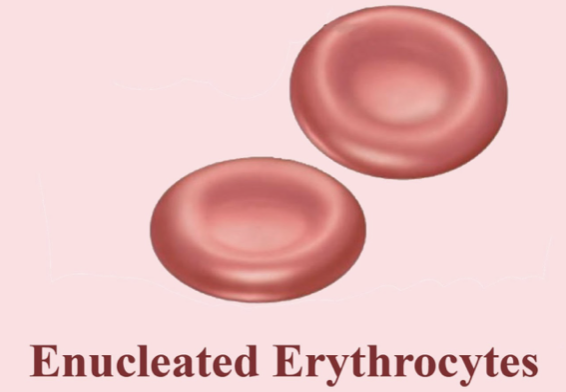
But, as they mature, they lose their nucleus and membrane- bound cell organelles. A mature Erythrocytes consists of a spongy network, known as the stroma. It is enveloped by a limiting plasma membrane.
Additional Information:
- Biochemically Erythrocytes are formed of water, hemoglobin, enzymes, organic constituents, and inorganic constituents.
- The average life-span of Erythrocytes is 129 days. It is estimated that nearly 3 million RBCs die every second. To compensate for this, an equal or still greater number is produced in the bone marrow.
- Normally, the rates of production and destruction of RBCs are mutually balancing. The rate of production of RBCs is determined by the oxygen level in the blood.
Note:
- Worn out corpuscles undergo breakdown in the liver and spleen. During this, the globin part of its hemoglobin gets degraded to amino acids.
- The iron atom of the haem part is stored in the liver in the form of an iron- containing protein called ferritin. It would be used again for the synthesis of hemoglobin or cytochromes.
- Erythrocytes transport respiratory gases. They help in the maintenance of normal blood pH and ionic equilibrium. They help in the formation of bile pigments by the degradation of hemoglobin.
Complete answer:
A mature erythrocyte lacks nucleus and mitochondria so as to make a place for the accommodation of more hemoglobin and hence more oxygen molecules. Lack of such organelles also provides the peculiar biconcave appearance of RBCs that aids in efficient diffusion. Young mammalian RBCs are nucleated.
But, as they mature, they lose their nucleus and membrane- bound cell organelles. A mature Erythrocytes consists of a spongy network, known as the stroma. It is enveloped by a limiting plasma membrane.
Additional Information:
- Biochemically Erythrocytes are formed of water, hemoglobin, enzymes, organic constituents, and inorganic constituents.
- The average life-span of Erythrocytes is 129 days. It is estimated that nearly 3 million RBCs die every second. To compensate for this, an equal or still greater number is produced in the bone marrow.
- Normally, the rates of production and destruction of RBCs are mutually balancing. The rate of production of RBCs is determined by the oxygen level in the blood.
Note:
- Worn out corpuscles undergo breakdown in the liver and spleen. During this, the globin part of its hemoglobin gets degraded to amino acids.
- The iron atom of the haem part is stored in the liver in the form of an iron- containing protein called ferritin. It would be used again for the synthesis of hemoglobin or cytochromes.
- Erythrocytes transport respiratory gases. They help in the maintenance of normal blood pH and ionic equilibrium. They help in the formation of bile pigments by the degradation of hemoglobin.
Recently Updated Pages
Master Class 11 Computer Science: Engaging Questions & Answers for Success

Master Class 11 Business Studies: Engaging Questions & Answers for Success
Master Class 11 Economics: Engaging Questions & Answers for Success
Master Class 11 English: Engaging Questions & Answers for Success
Master Class 11 Maths: Engaging Questions & Answers for Success
Master Class 11 Biology: Engaging Questions & Answers for Success
Trending doubts
One Metric ton is equal to kg A 10000 B 1000 C 100 class 11 physics CBSE
There are 720 permutations of the digits 1 2 3 4 5 class 11 maths CBSE
Discuss the various forms of bacteria class 11 biology CBSE
Draw a diagram of a plant cell and label at least eight class 11 biology CBSE
State the laws of reflection of light
Explain zero factorial class 11 maths CBSE