



Give the IUPAC and the trivial name of ${C_6}{H_6}C{l_6}.$
Answer
 Verified
519.3k+ views
Hint: Trivial name of compounds is a non-systematic approach to name compounds. IUPAC naming is a standardized system of naming compounds which is universally accepted. Trivial name is simpler in comparison to the IUPAC name. In the given compound, the difference in IUPAC and trivial naming occurs while specifying the position of the chlorine atoms.
Complete answer:
Trivial name of compounds is a non-systematic approach to name compounds which is independent of rules. They are usually created based on the sources or properties of a compound. It is a simplified name in comparison to the IUPAC name. IUPAC naming is the internationally accepted standard name for a compound, under the guidelines set by the International Union of Pure and Applied Chemistry.
The trivial name of ${C_6}{H_6}C{l_6}$ is Benzene Hexachloride, while the IUPAC name is $1,2,3,4,5,6 - {\text{hexachlorocyclohexane}}{\text{.}}$
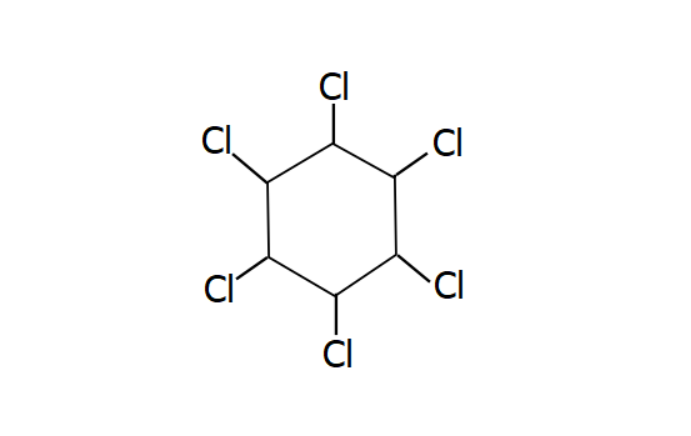
${C_6}{H_6}C{l_6}$ is an organic compound which has six Chlorine atoms attached to a six-Carbon ring, in which each Carbon atom is bonded to a Hydrogen atom. It has several different names such as Lindane, Gammallin, Gamaxene et cetera. One of the preparation methods of this compound is by photochlorination, where Benzene is chlorinated in the presence of sunlight. The structure of Benzene Hexachloride is as follows:
Note:
Since Hexachlorocyclohexane or ${C_6}{H_6}C{l_6}$ is polyhalogenated, stereochemistry plays a big role in the structure of it. There are nine stereoisomers of Hexachlorocyclohexane, out of which eight are diastereomers and the last one has two enantiomers. This compound has applications as an agricultural insecticide and in treatment of lice.
Complete answer:
Trivial name of compounds is a non-systematic approach to name compounds which is independent of rules. They are usually created based on the sources or properties of a compound. It is a simplified name in comparison to the IUPAC name. IUPAC naming is the internationally accepted standard name for a compound, under the guidelines set by the International Union of Pure and Applied Chemistry.
The trivial name of ${C_6}{H_6}C{l_6}$ is Benzene Hexachloride, while the IUPAC name is $1,2,3,4,5,6 - {\text{hexachlorocyclohexane}}{\text{.}}$
${C_6}{H_6}C{l_6}$ is an organic compound which has six Chlorine atoms attached to a six-Carbon ring, in which each Carbon atom is bonded to a Hydrogen atom. It has several different names such as Lindane, Gammallin, Gamaxene et cetera. One of the preparation methods of this compound is by photochlorination, where Benzene is chlorinated in the presence of sunlight. The structure of Benzene Hexachloride is as follows:
Note:
Since Hexachlorocyclohexane or ${C_6}{H_6}C{l_6}$ is polyhalogenated, stereochemistry plays a big role in the structure of it. There are nine stereoisomers of Hexachlorocyclohexane, out of which eight are diastereomers and the last one has two enantiomers. This compound has applications as an agricultural insecticide and in treatment of lice.
Recently Updated Pages
Master Class 12 Economics: Engaging Questions & Answers for Success

Master Class 12 Physics: Engaging Questions & Answers for Success
Master Class 12 English: Engaging Questions & Answers for Success
Master Class 12 Social Science: Engaging Questions & Answers for Success
Master Class 12 Maths: Engaging Questions & Answers for Success
Master Class 12 Business Studies: Engaging Questions & Answers for Success
Trending doubts
Which are the Top 10 Largest Countries of the World?
What are the major means of transport Explain each class 12 social science CBSE
Draw a labelled sketch of the human eye class 12 physics CBSE
What is a transformer Explain the principle construction class 12 physics CBSE
Why cannot DNA pass through cell membranes class 12 biology CBSE
Differentiate between insitu conservation and exsitu class 12 biology CBSE