




What will happen if the deer is missing in the food chain given below:
Grass → Deer → tiger
(a) The population of tigers increases
(b) The population of grass increases
(c) Tiger will start eating grass
(d) The population of tigers decreases and the population of grass increases.
Answer
 Verified
584.7k+ views
Hint:Each organism is dependent on another organism for survival and food availability in an ecosystem.
Complete answer:In a grazing food chain, the grass is being eaten by the deer and the tiger will eat the deer. If the deer goes missing from the food chain then the population of grass will increase rapidly as there’s no herbivore in that food chain to keep a check. At the same time, the tiger population will decrease due to lack of food.
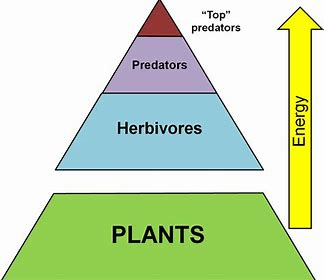
Additional information:The various steps in a food chain are known as the trophic levels and there is a constant flow of energy between them. The organisms which carry out the photosynthesis constitute the producers of an ecosystem. E.g., include plants, algae and bacteria.
Consumers are organisms which eat or devour other organisms. There are divided into 3 types:
Primary consumers are those who eat products like plants, algae and bacteria. They are also known as herbivores
Secondary consumers are those who kill and eat the herbivores. These are known as carnivores.
Tertiary consumers kill and devour the secondary consumers.
So, the correct answer is ‘The population of tigers decreases and the population of grass increases’
Note:1. In an ecosystem, various food chains are interconnected and they form a network known as the food web.
2. Food chains are very important in maintaining the ecosystem homeostasis.
3. The number of trophic levels in the food chain is restricted to 5 or 6 because a large amount of energy is lost at each trophic level. It is seen that around 90% of energy is lost when transferred from one trophic level to another.
Complete answer:In a grazing food chain, the grass is being eaten by the deer and the tiger will eat the deer. If the deer goes missing from the food chain then the population of grass will increase rapidly as there’s no herbivore in that food chain to keep a check. At the same time, the tiger population will decrease due to lack of food.
Additional information:The various steps in a food chain are known as the trophic levels and there is a constant flow of energy between them. The organisms which carry out the photosynthesis constitute the producers of an ecosystem. E.g., include plants, algae and bacteria.
Consumers are organisms which eat or devour other organisms. There are divided into 3 types:
Primary consumers are those who eat products like plants, algae and bacteria. They are also known as herbivores
Secondary consumers are those who kill and eat the herbivores. These are known as carnivores.
Tertiary consumers kill and devour the secondary consumers.
So, the correct answer is ‘The population of tigers decreases and the population of grass increases’
Note:1. In an ecosystem, various food chains are interconnected and they form a network known as the food web.
2. Food chains are very important in maintaining the ecosystem homeostasis.
3. The number of trophic levels in the food chain is restricted to 5 or 6 because a large amount of energy is lost at each trophic level. It is seen that around 90% of energy is lost when transferred from one trophic level to another.
Recently Updated Pages
Master Class 10 Computer Science: Engaging Questions & Answers for Success

Master Class 10 General Knowledge: Engaging Questions & Answers for Success
Master Class 10 English: Engaging Questions & Answers for Success
Master Class 10 Social Science: Engaging Questions & Answers for Success
Master Class 10 Maths: Engaging Questions & Answers for Success
Master Class 10 Science: Engaging Questions & Answers for Success
Trending doubts
What is the median of the first 10 natural numbers class 10 maths CBSE
Which women's tennis player has 24 Grand Slam singles titles?
Who is the Brand Ambassador of Incredible India?
Why is there a time difference of about 5 hours between class 10 social science CBSE
Write a letter to the principal requesting him to grant class 10 english CBSE
A moving boat is observed from the top of a 150 m high class 10 maths CBSE