




How do you graph $\ln (|x|)$?
Answer
 Verified
546k+ views
Hint: First we will understand the base by using the rule ${\log _e}x = \ln x$.
Then we will evaluate the x-intercept and the y-intercept and then accordingly mark points. Then we will finally plot the graph.
Complete step by step answer:
We will first start by using the properties of logarithms to graph $f(x) = \ln (|x|)$. Now here, the function $\ln (|x|)$ is a logarithmic function with base $e$ which is an irrational number and has the value $2.17828$.
Now, the x-intercept, or we can say the point where the graph crosses the x-axis of the graph, is $(1,0)$. The y-axis is a vertical asymptote of the graph or in other words, the graph approaches the y-axis but does not touch it.
Now we will plot the graph.
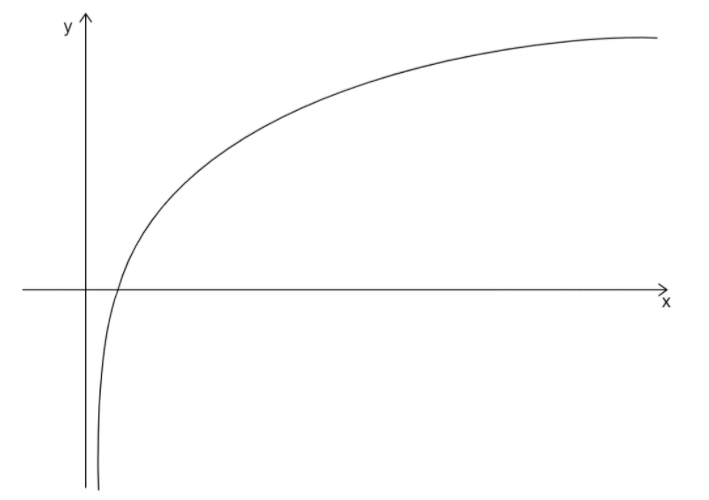
Additional Information: A logarithm is the power to which a number must be raised in order to get some other number. Example: ${\log _a}b$ here, a is the base and b is the argument. Exponent is a symbol written above and to the right of a mathematical expression to indicate the operation of raising to a power. The symbol of the exponential symbol is $e$ and has the value $2.17828$. Remember that $\ln a$ and $\log a$ are two different terms. In $\ln a$ the base is e and in $\log a$ the base is $10$. While rewriting an exponential equation in log form or a log equation in exponential form, it is helpful to remember that the base of exponent.
Note: Remember the logarithmic property precisely which is ${\log _e}x = \ln x$.
While comparing the terms, be cautious. After the application of property when you get the final answer, tress back the problem and see if it returns the same values. Evaluate the base and the argument carefully. Also, remember that ${\ln _e}e = 1$.
Then we will evaluate the x-intercept and the y-intercept and then accordingly mark points. Then we will finally plot the graph.
Complete step by step answer:
We will first start by using the properties of logarithms to graph $f(x) = \ln (|x|)$. Now here, the function $\ln (|x|)$ is a logarithmic function with base $e$ which is an irrational number and has the value $2.17828$.
Now, the x-intercept, or we can say the point where the graph crosses the x-axis of the graph, is $(1,0)$. The y-axis is a vertical asymptote of the graph or in other words, the graph approaches the y-axis but does not touch it.
Now we will plot the graph.
Additional Information: A logarithm is the power to which a number must be raised in order to get some other number. Example: ${\log _a}b$ here, a is the base and b is the argument. Exponent is a symbol written above and to the right of a mathematical expression to indicate the operation of raising to a power. The symbol of the exponential symbol is $e$ and has the value $2.17828$. Remember that $\ln a$ and $\log a$ are two different terms. In $\ln a$ the base is e and in $\log a$ the base is $10$. While rewriting an exponential equation in log form or a log equation in exponential form, it is helpful to remember that the base of exponent.
Note: Remember the logarithmic property precisely which is ${\log _e}x = \ln x$.
While comparing the terms, be cautious. After the application of property when you get the final answer, tress back the problem and see if it returns the same values. Evaluate the base and the argument carefully. Also, remember that ${\ln _e}e = 1$.
Recently Updated Pages
Master Class 11 Computer Science: Engaging Questions & Answers for Success

Master Class 11 Business Studies: Engaging Questions & Answers for Success
Master Class 11 Economics: Engaging Questions & Answers for Success
Master Class 11 English: Engaging Questions & Answers for Success
Master Class 11 Maths: Engaging Questions & Answers for Success
Master Class 11 Biology: Engaging Questions & Answers for Success
Trending doubts
One Metric ton is equal to kg A 10000 B 1000 C 100 class 11 physics CBSE
There are 720 permutations of the digits 1 2 3 4 5 class 11 maths CBSE
Discuss the various forms of bacteria class 11 biology CBSE
Draw a diagram of a plant cell and label at least eight class 11 biology CBSE
State the laws of reflection of light
Explain zero factorial class 11 maths CBSE