




How do you solve and graph x – 3 > 7?
Answer
 Verified
554.4k+ views
Hint: Rearrange the terms by taking the constant terms to the R.H.S. and leaving the terms containing the variable x to the L.H.S. Now, simplify the R.H.S. by simple addition or subtraction, whichever needed to get a particular numerical value. Leave the inequality sign as it is. Draw a line x = 10 and consider the suitable part of the graph according to the simplified inequality obtained.
Complete step-by-step solution:
Here, we have been provided with the inequality x – 3 > 7 and we are asked to solve it and draw the graph.
Now, rearranging the given inequality by taking the constant terms to the R.H.S. and leaving the terms containing the variable x in the L.H.S., we get,
\[\begin{align}
& \Rightarrow x-3>7 \\
& \Rightarrow x>7+3 \\
\end{align}\]
\[\Rightarrow x>10\] - (1)
Here, as you can see, the direction of the inequality sign does not change. This is because the direction of inequality sign only changes when we multiply or divide both the sides with a negative number or take reciprocal on both the sides.
Now, let us draw the graph of inequality obtained in (1). To do this first we have to remove the inequality sign and replace it with ‘=’ sign and draw the required line, so we have,
\[\Rightarrow x=10\]
Drawing the line x = 10, we get,
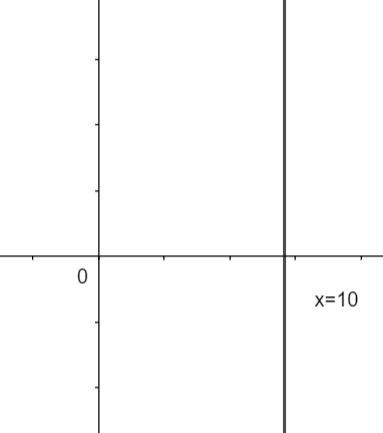
Now, considering equation (1), i.e., x > 10, here we can clearly see that we have to select that part of the graph in which x will be greater than 10. So, in the above graph we have to select the right side of the graph x = 10. Therefore, we have,
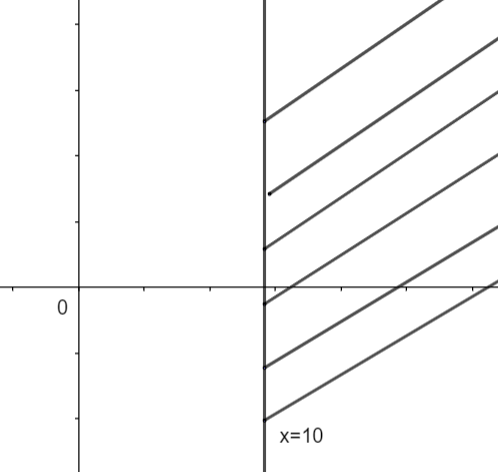
So, the above graph represents the graphical solution of our inequality.
Note: One may note that there are not many differences in solving and graphing an inequality and an equality. We need the help of equality while drawing the graph. One thing you can note is we do not have to consider the value x = 10 in our graph, so it will be better to use the dashed line instead of a solid line, however we have used a solid line. Always remember the rules of reversing the direction of inequality. The direction is only reversed when we take reciprocal or divide and multiply both the sides with a negative number.
Complete step-by-step solution:
Here, we have been provided with the inequality x – 3 > 7 and we are asked to solve it and draw the graph.
Now, rearranging the given inequality by taking the constant terms to the R.H.S. and leaving the terms containing the variable x in the L.H.S., we get,
\[\begin{align}
& \Rightarrow x-3>7 \\
& \Rightarrow x>7+3 \\
\end{align}\]
\[\Rightarrow x>10\] - (1)
Here, as you can see, the direction of the inequality sign does not change. This is because the direction of inequality sign only changes when we multiply or divide both the sides with a negative number or take reciprocal on both the sides.
Now, let us draw the graph of inequality obtained in (1). To do this first we have to remove the inequality sign and replace it with ‘=’ sign and draw the required line, so we have,
\[\Rightarrow x=10\]
Drawing the line x = 10, we get,
Now, considering equation (1), i.e., x > 10, here we can clearly see that we have to select that part of the graph in which x will be greater than 10. So, in the above graph we have to select the right side of the graph x = 10. Therefore, we have,
So, the above graph represents the graphical solution of our inequality.
Note: One may note that there are not many differences in solving and graphing an inequality and an equality. We need the help of equality while drawing the graph. One thing you can note is we do not have to consider the value x = 10 in our graph, so it will be better to use the dashed line instead of a solid line, however we have used a solid line. Always remember the rules of reversing the direction of inequality. The direction is only reversed when we take reciprocal or divide and multiply both the sides with a negative number.
Recently Updated Pages
Master Class 11 Computer Science: Engaging Questions & Answers for Success

Master Class 11 Business Studies: Engaging Questions & Answers for Success
Master Class 11 Economics: Engaging Questions & Answers for Success
Master Class 11 English: Engaging Questions & Answers for Success
Master Class 11 Maths: Engaging Questions & Answers for Success
Master Class 11 Biology: Engaging Questions & Answers for Success
Trending doubts
One Metric ton is equal to kg A 10000 B 1000 C 100 class 11 physics CBSE
There are 720 permutations of the digits 1 2 3 4 5 class 11 maths CBSE
Discuss the various forms of bacteria class 11 biology CBSE
Draw a diagram of a plant cell and label at least eight class 11 biology CBSE
State the laws of reflection of light
Explain zero factorial class 11 maths CBSE