




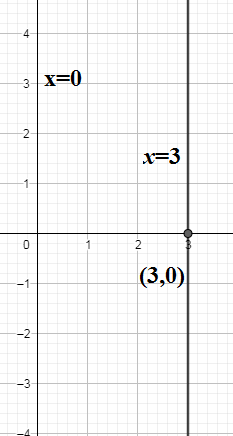
How would you graph the line $x=3$? \[\]
Answer
 Verified
563.7k+ views
Hint: We recall the definition of $x$ and $y-$ coordinate of the point. We use the fact that that the locus of all points equidistant from a line will be a line parallel to the original line and deduce that $x=3$ is a line parallel to $y-$ axis at a distance 3 from $y-$ axis passing through point $\left( 3,0 \right)$.\[\]
Complete step by step answer:
We know that all points in plane are represented as the ordered pair $\left( a,b \right)$ where $\left| a \right|$ is the distance from $y-$axis (called as abscissa or $x-$coordinate) and $\left| b \right|$ is the distance of the point from the $y-$axis (called as ordinate or $y-$coordinate).
We are given the line $x=3$ in the question. Here $x=3$ means all the points on the line $x=3$the $x-$coordinate of the points will remain same irrespective of the $y-$ordinate which means $x=3$ is the locus points of the type $\left( 3,b \right)$ where $b\in R$. \[\]
We know that locus of all points equidistant from a line will be a line parallel to the original line. Since $x-$coordinate which is also the distance $\left( \left| 3 \right|=3 \right)$ from $y-$axis is constant, all the points from $y-$axis will be equidistant. So the distance between $y-$axis and $x=3$ is constant and hence $x=3$is line parallel to $y-$axis . So the line $x=3$ will also pass through $\left( 3,0 \right)$ where it will cut $x-$axis for the value $y=0$ in $\left( 3,b \right)$.
Note:
We know that the general equation of line is $ax+by+c=0$ and the line parallel to it is given by $ax=by+k=0,k\ne c$. Since the equation of the $y-$axis is $x=0$ line parallel to it will be $x=k,k\ne 0$. We can alternatively find the slope of the line $ax+by+c=0$ as $\dfrac{-a}{b}$ from $0\cdot y+1\cdot x-3=0$ as $\dfrac{-1}{0}=\infty $ that is undefined and we know that a lien with undefined slope is perpendicular to $x-$axis and we get point $\left( 3,0 \right)$ to draw the perpendicular line.
Complete step by step answer:
We know that all points in plane are represented as the ordered pair $\left( a,b \right)$ where $\left| a \right|$ is the distance from $y-$axis (called as abscissa or $x-$coordinate) and $\left| b \right|$ is the distance of the point from the $y-$axis (called as ordinate or $y-$coordinate).
We are given the line $x=3$ in the question. Here $x=3$ means all the points on the line $x=3$the $x-$coordinate of the points will remain same irrespective of the $y-$ordinate which means $x=3$ is the locus points of the type $\left( 3,b \right)$ where $b\in R$. \[\]
We know that locus of all points equidistant from a line will be a line parallel to the original line. Since $x-$coordinate which is also the distance $\left( \left| 3 \right|=3 \right)$ from $y-$axis is constant, all the points from $y-$axis will be equidistant. So the distance between $y-$axis and $x=3$ is constant and hence $x=3$is line parallel to $y-$axis . So the line $x=3$ will also pass through $\left( 3,0 \right)$ where it will cut $x-$axis for the value $y=0$ in $\left( 3,b \right)$.
Note:
We know that the general equation of line is $ax+by+c=0$ and the line parallel to it is given by $ax=by+k=0,k\ne c$. Since the equation of the $y-$axis is $x=0$ line parallel to it will be $x=k,k\ne 0$. We can alternatively find the slope of the line $ax+by+c=0$ as $\dfrac{-a}{b}$ from $0\cdot y+1\cdot x-3=0$ as $\dfrac{-1}{0}=\infty $ that is undefined and we know that a lien with undefined slope is perpendicular to $x-$axis and we get point $\left( 3,0 \right)$ to draw the perpendicular line.
Recently Updated Pages
Master Class 11 Computer Science: Engaging Questions & Answers for Success

Master Class 11 Business Studies: Engaging Questions & Answers for Success
Master Class 11 Economics: Engaging Questions & Answers for Success
Master Class 11 English: Engaging Questions & Answers for Success
Master Class 11 Maths: Engaging Questions & Answers for Success
Master Class 11 Biology: Engaging Questions & Answers for Success
Trending doubts
There are 720 permutations of the digits 1 2 3 4 5 class 11 maths CBSE
Discuss the various forms of bacteria class 11 biology CBSE
Draw a diagram of a plant cell and label at least eight class 11 biology CBSE
Explain zero factorial class 11 maths CBSE
What organs are located on the left side of your body class 11 biology CBSE
Draw a diagram of nephron and explain its structur class 11 biology CBSE