




(i) Calculate the work done when $F=\left( 5\hat{i}+3\hat{j}+2\hat{k} \right)N$ and $S=\left( 3\hat{i}-\hat{j}+2\hat{k} \right)m$ acting in the same direction.
(ii) Show with the help of a vector diagram that the work-done is a scalar product of force and displacement.
Answer
 Verified
582.6k+ views
Hint: A scalar product can be defined as the product of two vector quantities which results in a scalar. Force is a vector quantity and displacement is also a vector quantity. Work done can be defined as the dot product or scalar product of the force and the displacement.
Complete step-by-step solution
The force on the object is given as, $F=\left( 5\hat{i}+3\hat{j}+2\hat{k} \right)N$
The distance covered by the object is, $S=\left( 3\hat{i}-\hat{j}+2\hat{k} \right)m$
The work done on an object on which a force is acting and moves by a distance can be given by the dot product of the force and the distance. Simply, we can define that work done by a force can be defined as the product of the force in the direction of movement of the object and the distance covered by the object.
Work done is,
$\begin{align}
&\Rightarrow W=\vec{F}.\vec{S}=\left( 5\hat{i}+3\hat{j}+2\hat{k} \right).\left( 3\hat{i}-\hat{j}+2\hat{k} \right) \\
& \Rightarrow W=15-3+4 \\
& \Rightarrow W=16J \\
\end{align}$
So, the work done is 16 joules. The force and the displacement are vector quantities, while the work done is a scalar quantity.
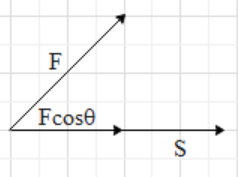
Find the component of the force F in the direction of the displacement. The component of the force is $F\cos \theta $, where $\theta $ is the angle between the force and the displacement. Then multiply the component of a force and the displacement to find the work done.
$W=FS\cos \theta $
Note: A scalar quantity can be defined as a quantity which has only magnitude, not direction. A vector quantity can be defined as the quantity which has both the direction and the magnitude. We have the force and displacement as a vector quantity. But the work done found from the force and the displacement is a scalar quantity.
Complete step-by-step solution
The force on the object is given as, $F=\left( 5\hat{i}+3\hat{j}+2\hat{k} \right)N$
The distance covered by the object is, $S=\left( 3\hat{i}-\hat{j}+2\hat{k} \right)m$
The work done on an object on which a force is acting and moves by a distance can be given by the dot product of the force and the distance. Simply, we can define that work done by a force can be defined as the product of the force in the direction of movement of the object and the distance covered by the object.
Work done is,
$\begin{align}
&\Rightarrow W=\vec{F}.\vec{S}=\left( 5\hat{i}+3\hat{j}+2\hat{k} \right).\left( 3\hat{i}-\hat{j}+2\hat{k} \right) \\
& \Rightarrow W=15-3+4 \\
& \Rightarrow W=16J \\
\end{align}$
So, the work done is 16 joules. The force and the displacement are vector quantities, while the work done is a scalar quantity.
Find the component of the force F in the direction of the displacement. The component of the force is $F\cos \theta $, where $\theta $ is the angle between the force and the displacement. Then multiply the component of a force and the displacement to find the work done.
$W=FS\cos \theta $
Note: A scalar quantity can be defined as a quantity which has only magnitude, not direction. A vector quantity can be defined as the quantity which has both the direction and the magnitude. We have the force and displacement as a vector quantity. But the work done found from the force and the displacement is a scalar quantity.
Recently Updated Pages
Master Class 11 Computer Science: Engaging Questions & Answers for Success

Master Class 11 Business Studies: Engaging Questions & Answers for Success
Master Class 11 Economics: Engaging Questions & Answers for Success
Master Class 11 English: Engaging Questions & Answers for Success
Master Class 11 Maths: Engaging Questions & Answers for Success
Master Class 11 Biology: Engaging Questions & Answers for Success
Trending doubts
One Metric ton is equal to kg A 10000 B 1000 C 100 class 11 physics CBSE
There are 720 permutations of the digits 1 2 3 4 5 class 11 maths CBSE
Discuss the various forms of bacteria class 11 biology CBSE
Draw a diagram of a plant cell and label at least eight class 11 biology CBSE
State the laws of reflection of light
Explain zero factorial class 11 maths CBSE