



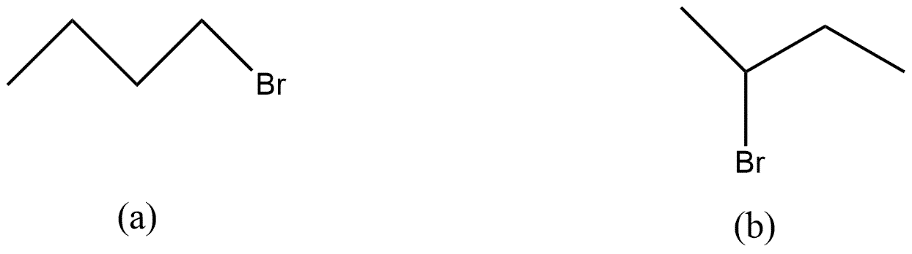
(i) Which alkyl halide from the following pair is chiral and undergoes faster $S{{N}_{1}}$ reaction?
(ii) Out of $S{{N}_{1}}$and $S{{N}_{2}}$, which reaction occurs with
(a) inversion of configuration?
(b) racemisation?
Answer
 Verified
522.9k+ views
Hint: Alkyl halide also known by the name haloalkanes or halogenoalkanes which are generally those chemical compounds which are often derived from alkanes which contain one or more halogens. These are formed by the replacement of hydrogen atoms in an aliphatic hydrocarbon by any halogen atom.
Complete answer:
Nucleophiles generally take part in the nucleophilic substitution reactions and during this reaction nucleophile becomes attracted towards a partial or full positive charge rather than this neutral nucleophilic reactions with solvents like water is known by the name solvolysis. Nucleophilic substitution reaction is generally of two types known by the name $S{{N}_{1}}$and $S{{N}_{2}}$i.e. unimolecular nucleophilic substitution and bimolecular nucleophilic substitution.
The secondary alkyl halide given in the option b i.e. 2-bromobutane is chiral in nature and can undergo $S{{N}_{1}}$ reaction at faster rate. Chiral carbon atom is defined as that carbon atom which contains four different groups attached with itself.
Whereas in option 1 primary alkyl halide i.e. 1-bromobutane is given which is achiral in nature and this will undergo $S{{N}_{2}}$ reaction at faster rate.
Thus from this we can conclude that $S{{N}_{2}}$ reaction i.e. compound a gives inversion of configuration while $S{{N}_{1}}$ reaction i.e. compound b gives racemization.
Note:
Retention refers to that phase of the molecule in which the molecular composition is preserved throughout the reaction whereas inversion refers to that mechanism in which the structure of the molecules is changed during the reaction.
Complete answer:
Nucleophiles generally take part in the nucleophilic substitution reactions and during this reaction nucleophile becomes attracted towards a partial or full positive charge rather than this neutral nucleophilic reactions with solvents like water is known by the name solvolysis. Nucleophilic substitution reaction is generally of two types known by the name $S{{N}_{1}}$and $S{{N}_{2}}$i.e. unimolecular nucleophilic substitution and bimolecular nucleophilic substitution.
The secondary alkyl halide given in the option b i.e. 2-bromobutane is chiral in nature and can undergo $S{{N}_{1}}$ reaction at faster rate. Chiral carbon atom is defined as that carbon atom which contains four different groups attached with itself.
Whereas in option 1 primary alkyl halide i.e. 1-bromobutane is given which is achiral in nature and this will undergo $S{{N}_{2}}$ reaction at faster rate.
Thus from this we can conclude that $S{{N}_{2}}$ reaction i.e. compound a gives inversion of configuration while $S{{N}_{1}}$ reaction i.e. compound b gives racemization.
Note:
Retention refers to that phase of the molecule in which the molecular composition is preserved throughout the reaction whereas inversion refers to that mechanism in which the structure of the molecules is changed during the reaction.
Recently Updated Pages
Master Class 11 Computer Science: Engaging Questions & Answers for Success

Master Class 11 Business Studies: Engaging Questions & Answers for Success
Master Class 11 Economics: Engaging Questions & Answers for Success
Master Class 11 English: Engaging Questions & Answers for Success
Master Class 11 Maths: Engaging Questions & Answers for Success
Master Class 11 Biology: Engaging Questions & Answers for Success
Trending doubts
One Metric ton is equal to kg A 10000 B 1000 C 100 class 11 physics CBSE
There are 720 permutations of the digits 1 2 3 4 5 class 11 maths CBSE
Discuss the various forms of bacteria class 11 biology CBSE
Draw a diagram of a plant cell and label at least eight class 11 biology CBSE
State the laws of reflection of light
Explain zero factorial class 11 maths CBSE