




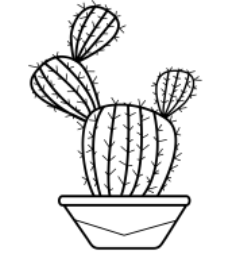
Identify the plant in the diagram and write any two morphological features.
Answer
 Verified
579.3k+ views
Hint: Morphology is the external appearance of an organism. Phytomorphology is the branch of science which deals with the study of the physical form and external structure of plants. This is different from plant anatomy, which is the study of the internal structure of plants. Plant morphology is useful in outer identification or visual identification.
Complete answer:
The above diagram is that of a Cactus. It belongs to the family Cactaceae of the kingdom Plantae. The name is derived from a Latin word which means a spiny plant.
- Most cacti live in habitats subject to drought and those conditions are often termed as Xerophytic.
- Many species strive in extremely dry environments, even being found in the Atacama Desert( considered as one of the driest places on earth).
- They have adapted profoundly to conserve water.
- Almost all species are succulents that means they have thickened, fleshy parts that are adapted to retain water.
- The stem is the only part of most cacti where this process takes place. Most species of cacti are devoid of leaves, pertaining to spines, which are highly modified leaves.
- Spines help in preventing water loss by reducing airflow.
Two morphological features include-
- As already discussed, they possess leafless spiny stems that acts as a defender against herbivores and retains water.
- Presence of Areolas- These are present only in cactus. They are the structure through which the spines emerge.
Note: Cactus have adapted special modifications for water retention such as:
- They have no leaves but instead, they have the presence of spines which are modified leaves.
- They have succulent stems.
- They have roots but they only penetrate up to a short distance.
- They perform the C3 cycle in order to reduce the effect of photosynthesis.
Complete answer:
The above diagram is that of a Cactus. It belongs to the family Cactaceae of the kingdom Plantae. The name is derived from a Latin word which means a spiny plant.
- Most cacti live in habitats subject to drought and those conditions are often termed as Xerophytic.
- Many species strive in extremely dry environments, even being found in the Atacama Desert( considered as one of the driest places on earth).
- They have adapted profoundly to conserve water.
- Almost all species are succulents that means they have thickened, fleshy parts that are adapted to retain water.
- The stem is the only part of most cacti where this process takes place. Most species of cacti are devoid of leaves, pertaining to spines, which are highly modified leaves.
- Spines help in preventing water loss by reducing airflow.
Two morphological features include-
- As already discussed, they possess leafless spiny stems that acts as a defender against herbivores and retains water.
- Presence of Areolas- These are present only in cactus. They are the structure through which the spines emerge.
Note: Cactus have adapted special modifications for water retention such as:
- They have no leaves but instead, they have the presence of spines which are modified leaves.
- They have succulent stems.
- They have roots but they only penetrate up to a short distance.
- They perform the C3 cycle in order to reduce the effect of photosynthesis.
Recently Updated Pages
Master Class 11 Computer Science: Engaging Questions & Answers for Success

Master Class 11 Business Studies: Engaging Questions & Answers for Success
Master Class 11 Economics: Engaging Questions & Answers for Success
Master Class 11 English: Engaging Questions & Answers for Success
Master Class 11 Maths: Engaging Questions & Answers for Success
Master Class 11 Biology: Engaging Questions & Answers for Success
Trending doubts
One Metric ton is equal to kg A 10000 B 1000 C 100 class 11 physics CBSE
There are 720 permutations of the digits 1 2 3 4 5 class 11 maths CBSE
Discuss the various forms of bacteria class 11 biology CBSE
Draw a diagram of a plant cell and label at least eight class 11 biology CBSE
State the laws of reflection of light
10 examples of friction in our daily life