




Identify the type of nutrition in Amoeba.
Answer
 Verified
518.7k+ views
Hint: Amoeba is a unicellular organism. It has the ability to alter its shape to any extent in order to engulf its food particles. Instead, Amoeba does not form a single taxonomic group, they are found in all major eukaryotic organisms.
Complete Explanation:
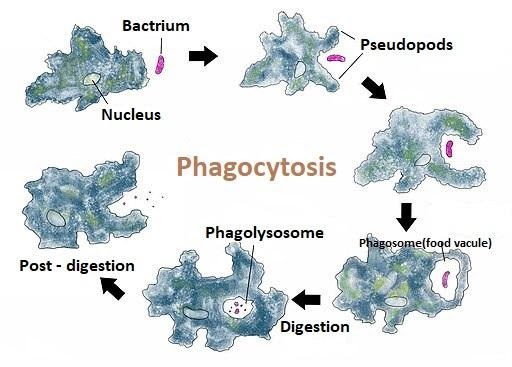
Amoeba is an important Protozoa which is found in freshwater. It feeds on microscopic water-based plants and animals. Holozoic nutrition is the mode of nutrition in ameba. And the process by which it obtains food is called phagocytosis. Phagocytosis means engulfing the entire food by just accommodating by the predator shape and taking inside.
There are five steps in the food mechanism in Amoeba- ingestion, digestion, absorption, assimilation and excretion.
Intake is the process of taking food in the body. Amoeba is a single-cell animal so it has no mouth to put food in. Amoeba consumes food by forming pseudopodia. It encircles it. If the food is fully surrounded, it is absorbed into the food sac, known as the food shelter.
Digestion- digestion is the process of breaking large and insoluble molecules in small and water-soluble molecules. In Amoeba, several digestive enzymes react into the food and break down the food into simpler ones.
Absorption—the digested food is then absorbed by a diffusion process in the cytoplasm. The food remains in the vacuole while it is ungrown.
Assimilation- during this step the food absorbed by the cytoplasm is used to obtain energy, growth and repair. This process of utilizing food for obtaining energy is called assimilation.
Egestion- If enough food is collected in the food vacuole, ruptured cell membrane throws it out of the body. Egestion is called the process of removing undigested food from the body.
Note:
Nutrition as we discussed above, are holozoic phagocytic. Amoeba has its own way of engulfing food. Food vacuoles are mostly lipid content and glycolipid content. For other habitats in Amoeba like reproduction it is reproduced by asexual mode. Specially binary fission. Binary fission is the type of reproduction in which the Amoeba cuts its halves and those halves develop into new individuals. It has a high rate of reproduction ability.
Complete Explanation:
Amoeba is an important Protozoa which is found in freshwater. It feeds on microscopic water-based plants and animals. Holozoic nutrition is the mode of nutrition in ameba. And the process by which it obtains food is called phagocytosis. Phagocytosis means engulfing the entire food by just accommodating by the predator shape and taking inside.
There are five steps in the food mechanism in Amoeba- ingestion, digestion, absorption, assimilation and excretion.
Intake is the process of taking food in the body. Amoeba is a single-cell animal so it has no mouth to put food in. Amoeba consumes food by forming pseudopodia. It encircles it. If the food is fully surrounded, it is absorbed into the food sac, known as the food shelter.
Digestion- digestion is the process of breaking large and insoluble molecules in small and water-soluble molecules. In Amoeba, several digestive enzymes react into the food and break down the food into simpler ones.
Absorption—the digested food is then absorbed by a diffusion process in the cytoplasm. The food remains in the vacuole while it is ungrown.
Assimilation- during this step the food absorbed by the cytoplasm is used to obtain energy, growth and repair. This process of utilizing food for obtaining energy is called assimilation.
Egestion- If enough food is collected in the food vacuole, ruptured cell membrane throws it out of the body. Egestion is called the process of removing undigested food from the body.
Note:
Nutrition as we discussed above, are holozoic phagocytic. Amoeba has its own way of engulfing food. Food vacuoles are mostly lipid content and glycolipid content. For other habitats in Amoeba like reproduction it is reproduced by asexual mode. Specially binary fission. Binary fission is the type of reproduction in which the Amoeba cuts its halves and those halves develop into new individuals. It has a high rate of reproduction ability.
Recently Updated Pages
Master Class 11 Computer Science: Engaging Questions & Answers for Success

Master Class 11 Business Studies: Engaging Questions & Answers for Success
Master Class 11 Economics: Engaging Questions & Answers for Success
Master Class 11 English: Engaging Questions & Answers for Success
Master Class 11 Maths: Engaging Questions & Answers for Success
Master Class 11 Biology: Engaging Questions & Answers for Success
Trending doubts
One Metric ton is equal to kg A 10000 B 1000 C 100 class 11 physics CBSE
There are 720 permutations of the digits 1 2 3 4 5 class 11 maths CBSE
Discuss the various forms of bacteria class 11 biology CBSE
Draw a diagram of a plant cell and label at least eight class 11 biology CBSE
State the laws of reflection of light
Explain zero factorial class 11 maths CBSE