




If A (1, 2), B (4, 3) and C (6, 6) are the vertices of parallelogram ABCD, then find the co- ordinates of the fourth vertex?
Answer
 Verified
552k+ views
Hint:In order to find the fourth vertex, first we need to find the mid-point of line AC and then we find the mid-point of line BD. Later equating both the solved mid-point by the property of parallelogram that the diagonals of the parallelogram bisect each other we get the required solution.
Complete step by step solution:
We have given a parallelogram ABCD in which the coordinates of the vertices given are If A (1, 2), B (4,3) and C (6, 6);
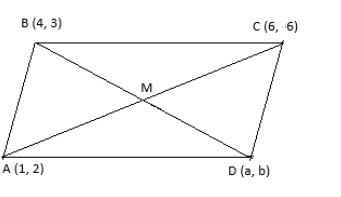
Let the fourth vertex of the given parallelogram ABCD be D(a, b).
Let M be the midpoint of the intersection of diagonals of the parallelogram ABCD. Since ABCD is a parallelogram and we know that the diagonals of the parallelogram bisect each other.
Now,
Coordinates of midpoint of a line PQ is given by;
\[\Rightarrow mid-po\operatorname{int}=\left(
\dfrac{{{x}_{1}}+{{x}_{2}}}{2},\dfrac{{{y}_{1}}+{{y}_{2}}}{2} \right)\]
Where \[\left( {{x}_{1}},{{y}_{1}} \right)\] are the coordinates of the point P and \[\left( {{x}_{2}},{{y}_{2}}
\right)\] are the coordinates of the point Q.
Now,
The coordinates of the midpoint, M of the line AC will be,
Coordinates of point A = (1,2)
Coordinates of point C = (6,-6)
\[\Rightarrow M=\left( \dfrac{1+6}{2},\dfrac{2+6}{2} \right)=\left( \dfrac{7}{2},4 \right)\]
\[\Rightarrow M=\left( \dfrac{7}{2},4 \right)\]----- (1)
Therefore, the coordinate of midpoint, M of line AC is \[\left( \dfrac{7}{2},4 \right)\]
Now,
The coordinates of the midpoint, M of the line BD will be,
Coordinates of point B = (4, 3)
Coordinates of point D = (a,b)
\[\Rightarrow M=\left( \dfrac{4+a}{2},\dfrac{3+b}{2} \right)\]----- (2)
Therefore, the coordinate of the midpoint, M of line BD is \[\left( \dfrac{4+a}{2},\dfrac{3+b}{2} \right)\].
On comparing equation (1) and equation (2), we get
\[\Rightarrow M=\left( \dfrac{4+a}{2},\dfrac{3+b}{2} \right)=\left( \dfrac{7}{2},4 \right)\]
Now, equating the individual coordinates to find the unknown value,
\[\Rightarrow \dfrac{4+a}{2}=\dfrac{7}{2}\]
Multiplying both the sides of the equation by 2, we get
\[\Rightarrow 4+a=7\]
On simplifying,
\[\Rightarrow a=3\]
Similarly,
\[\Rightarrow \dfrac{3+b}{2}=4\]
Multiplying both the sides of the equation by 2, we get
\[\Rightarrow 3+b=8\]
On simplifying,
\[\Rightarrow b=5\]
Hence the coordinates of the vertex D (a, b) is (3, 5).
\[\therefore \ coordinates\ ofD=\left( 3,\ 5 \right)\]
Note: In order to solve these types of questions, students should always remember the formula of the midpoint of any line given. Coordinates of midpoint of a line PQ is given by;
\[\Rightarrow mid-po\operatorname{int}=\left(\dfrac{{{x}_{1}}+{{x}_{2}}}{2},\dfrac{{{y}_{1}}+{{y}_{2}}}{2} \right)\]
Where \[\left( {{x}_{1}},{{y}_{1}} \right)\] are the coordinates of the point P and \[\left({{x}_{2}},{{y}_{2}} \right)\] are the coordinates of the point Q.
Complete step by step solution:
We have given a parallelogram ABCD in which the coordinates of the vertices given are If A (1, 2), B (4,3) and C (6, 6);
Let the fourth vertex of the given parallelogram ABCD be D(a, b).
Let M be the midpoint of the intersection of diagonals of the parallelogram ABCD. Since ABCD is a parallelogram and we know that the diagonals of the parallelogram bisect each other.
Now,
Coordinates of midpoint of a line PQ is given by;
\[\Rightarrow mid-po\operatorname{int}=\left(
\dfrac{{{x}_{1}}+{{x}_{2}}}{2},\dfrac{{{y}_{1}}+{{y}_{2}}}{2} \right)\]
Where \[\left( {{x}_{1}},{{y}_{1}} \right)\] are the coordinates of the point P and \[\left( {{x}_{2}},{{y}_{2}}
\right)\] are the coordinates of the point Q.
Now,
The coordinates of the midpoint, M of the line AC will be,
Coordinates of point A = (1,2)
Coordinates of point C = (6,-6)
\[\Rightarrow M=\left( \dfrac{1+6}{2},\dfrac{2+6}{2} \right)=\left( \dfrac{7}{2},4 \right)\]
\[\Rightarrow M=\left( \dfrac{7}{2},4 \right)\]----- (1)
Therefore, the coordinate of midpoint, M of line AC is \[\left( \dfrac{7}{2},4 \right)\]
Now,
The coordinates of the midpoint, M of the line BD will be,
Coordinates of point B = (4, 3)
Coordinates of point D = (a,b)
\[\Rightarrow M=\left( \dfrac{4+a}{2},\dfrac{3+b}{2} \right)\]----- (2)
Therefore, the coordinate of the midpoint, M of line BD is \[\left( \dfrac{4+a}{2},\dfrac{3+b}{2} \right)\].
On comparing equation (1) and equation (2), we get
\[\Rightarrow M=\left( \dfrac{4+a}{2},\dfrac{3+b}{2} \right)=\left( \dfrac{7}{2},4 \right)\]
Now, equating the individual coordinates to find the unknown value,
\[\Rightarrow \dfrac{4+a}{2}=\dfrac{7}{2}\]
Multiplying both the sides of the equation by 2, we get
\[\Rightarrow 4+a=7\]
On simplifying,
\[\Rightarrow a=3\]
Similarly,
\[\Rightarrow \dfrac{3+b}{2}=4\]
Multiplying both the sides of the equation by 2, we get
\[\Rightarrow 3+b=8\]
On simplifying,
\[\Rightarrow b=5\]
Hence the coordinates of the vertex D (a, b) is (3, 5).
\[\therefore \ coordinates\ ofD=\left( 3,\ 5 \right)\]
Note: In order to solve these types of questions, students should always remember the formula of the midpoint of any line given. Coordinates of midpoint of a line PQ is given by;
\[\Rightarrow mid-po\operatorname{int}=\left(\dfrac{{{x}_{1}}+{{x}_{2}}}{2},\dfrac{{{y}_{1}}+{{y}_{2}}}{2} \right)\]
Where \[\left( {{x}_{1}},{{y}_{1}} \right)\] are the coordinates of the point P and \[\left({{x}_{2}},{{y}_{2}} \right)\] are the coordinates of the point Q.
Recently Updated Pages
Master Class 11 Computer Science: Engaging Questions & Answers for Success

Master Class 11 Business Studies: Engaging Questions & Answers for Success
Master Class 11 Economics: Engaging Questions & Answers for Success
Master Class 11 English: Engaging Questions & Answers for Success
Master Class 11 Maths: Engaging Questions & Answers for Success
Master Class 11 Biology: Engaging Questions & Answers for Success
Trending doubts
One Metric ton is equal to kg A 10000 B 1000 C 100 class 11 physics CBSE
There are 720 permutations of the digits 1 2 3 4 5 class 11 maths CBSE
Discuss the various forms of bacteria class 11 biology CBSE
Draw a diagram of a plant cell and label at least eight class 11 biology CBSE
State the laws of reflection of light
Explain zero factorial class 11 maths CBSE