




If \[{\text{a = 13,b = 12,c = 5}}\]in \[\vartriangle {\text{ABC}}\]where a, b, c are the sides of a triangle, then the value of
\[{\text{sin}}\dfrac{A}{2} = \]
\[\begin{gathered}
\left( a \right){\text{ }}\dfrac{1}{{\sqrt 5 }} \\
\left( b \right){\text{ }}\dfrac{2}{3} \\
\left( c \right){\text{ }}\sqrt {\dfrac{{32}}{{35}}} \\
\left( d \right){\text{ }}\dfrac{1}{{\sqrt 2 }} \\
\end{gathered} \]
Answer
 Verified
624k+ views
Hint- Try to figure out whether the triangular sides formulated above forms a right angled triangle or not.
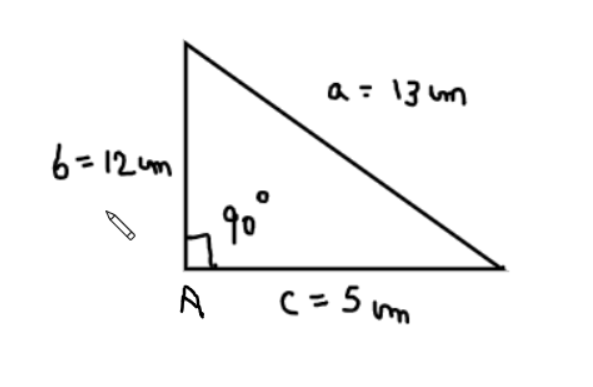
In the above figure we can see that $\vartriangle {\text{ABC}}$has the sides ${\text{a = 13,b = 12 and c = 5}}$
Now if we try to apply Pythagoras theorem which states that if ${\text{hypotenuse}}{{\text{s}}^2} = {\text{perpendicular}}{{\text{r}}^2} + {\text{bas}}{{\text{e}}^2}$then the triangle will be a right angle triangle.
Thus clearly ${{\text{a}}^2} = {{\text{b}}^2} + {{\text{c}}^2}$that is ${\text{1}}{{\text{3}}^2} = {12^2} + {5^2}$or ${\text{169 = 144 + 25}}$
Hence we can say that the above triangle is a right angle triangle and from the above figure it is clear that it is right angled at A that is$\angle {\text{A = 90}}$.
Let’s discuss why it is right angled at A only and not B or C?
Because $\angle {\text{A}}$is the opposite angle to the greatest side of the triangle and Pythagoras theorem is also applicable.
Hence ${\text{sin}}\dfrac{A}{2} = \sin \dfrac{{90}}{2} = \sin 45 = \dfrac{1}{{\sqrt 2 }}$
Hence option (d) is the correct option.
Note-If a triangle is found obeying the Pythagoras theorem then the angle which is always opposite to the greatest side is 90 degree or in other words if a triangle is obeying Pythagoras theorem than it is right angled at the angle which is exactly opposite to the greatest side in that triangle.
In the above figure we can see that $\vartriangle {\text{ABC}}$has the sides ${\text{a = 13,b = 12 and c = 5}}$
Now if we try to apply Pythagoras theorem which states that if ${\text{hypotenuse}}{{\text{s}}^2} = {\text{perpendicular}}{{\text{r}}^2} + {\text{bas}}{{\text{e}}^2}$then the triangle will be a right angle triangle.
Thus clearly ${{\text{a}}^2} = {{\text{b}}^2} + {{\text{c}}^2}$that is ${\text{1}}{{\text{3}}^2} = {12^2} + {5^2}$or ${\text{169 = 144 + 25}}$
Hence we can say that the above triangle is a right angle triangle and from the above figure it is clear that it is right angled at A that is$\angle {\text{A = 90}}$.
Let’s discuss why it is right angled at A only and not B or C?
Because $\angle {\text{A}}$is the opposite angle to the greatest side of the triangle and Pythagoras theorem is also applicable.
Hence ${\text{sin}}\dfrac{A}{2} = \sin \dfrac{{90}}{2} = \sin 45 = \dfrac{1}{{\sqrt 2 }}$
Hence option (d) is the correct option.
Note-If a triangle is found obeying the Pythagoras theorem then the angle which is always opposite to the greatest side is 90 degree or in other words if a triangle is obeying Pythagoras theorem than it is right angled at the angle which is exactly opposite to the greatest side in that triangle.
Recently Updated Pages
Master Class 10 Computer Science: Engaging Questions & Answers for Success

Master Class 10 General Knowledge: Engaging Questions & Answers for Success
Master Class 10 English: Engaging Questions & Answers for Success
Master Class 10 Social Science: Engaging Questions & Answers for Success
Master Class 10 Maths: Engaging Questions & Answers for Success
Master Class 10 Science: Engaging Questions & Answers for Success
Trending doubts
What is the median of the first 10 natural numbers class 10 maths CBSE
Which women's tennis player has 24 Grand Slam singles titles?
Who is the Brand Ambassador of Incredible India?
Why is there a time difference of about 5 hours between class 10 social science CBSE
Write a letter to the principal requesting him to grant class 10 english CBSE
State and prove converse of BPT Basic Proportionality class 10 maths CBSE