




If one chamber has a ${{\psi }_{w}}$ of -2000 kPa and the other -1000kPa, which is the chamber that has the higher $\psi $ ?
Answer
 Verified
565.5k+ views
Hint: Water potential is an actual measurement of the potential energy in water or the difference in potential energy between a given water sample and pure water (at atmospheric pressure and suitable temperature).
Complete step-by-step answer:
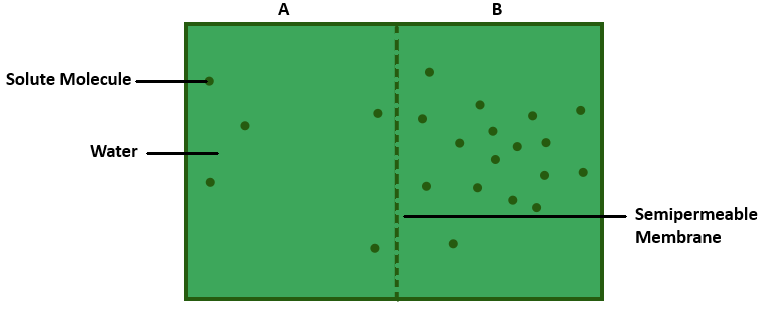
Water potential totally depends on the number or concentration of water molecules. More the number of water molecules in a system, higher will be the water potential. Hence, pure water has the highest water potential. By convention water potential of pure water has been fixed as zero. This means that the water potential of any solution will always be negative or less than zero. It is represented by ${{\psi }_{w}}$ , and the value of ${{\psi }_{w}}$ is measured in bars, pascals or atmosphere. Water always moves from the area of high water potential or high energy to the area of low water potential or low energy, i.e., from less negative potential (-1000kPa) to more negative potential (-2000kPa). The movement of a substance from an area of higher free energy to an area of lower free energy is called diffusion and when it occurs through a semipermeable membrane, it is called osmosis. The chamber having Pressure potential of -1000kPa has a higher water potential. A solution that has a higher water potential is called a dilute solution
So, in the above example chamber, A has higher water potential or higher $\psi $.
Note: If two systems having water are in contact, more random movement of water molecules in the system having higher water potential or more energy will result in their net movement towards the system with low energy or low water potential.
Complete step-by-step answer:
Water potential totally depends on the number or concentration of water molecules. More the number of water molecules in a system, higher will be the water potential. Hence, pure water has the highest water potential. By convention water potential of pure water has been fixed as zero. This means that the water potential of any solution will always be negative or less than zero. It is represented by ${{\psi }_{w}}$ , and the value of ${{\psi }_{w}}$ is measured in bars, pascals or atmosphere. Water always moves from the area of high water potential or high energy to the area of low water potential or low energy, i.e., from less negative potential (-1000kPa) to more negative potential (-2000kPa). The movement of a substance from an area of higher free energy to an area of lower free energy is called diffusion and when it occurs through a semipermeable membrane, it is called osmosis. The chamber having Pressure potential of -1000kPa has a higher water potential. A solution that has a higher water potential is called a dilute solution
So, in the above example chamber, A has higher water potential or higher $\psi $.
Note: If two systems having water are in contact, more random movement of water molecules in the system having higher water potential or more energy will result in their net movement towards the system with low energy or low water potential.
Recently Updated Pages
Master Class 11 Computer Science: Engaging Questions & Answers for Success

Master Class 11 Business Studies: Engaging Questions & Answers for Success
Master Class 11 Economics: Engaging Questions & Answers for Success
Master Class 11 English: Engaging Questions & Answers for Success
Master Class 11 Maths: Engaging Questions & Answers for Success
Master Class 11 Biology: Engaging Questions & Answers for Success
Trending doubts
One Metric ton is equal to kg A 10000 B 1000 C 100 class 11 physics CBSE
There are 720 permutations of the digits 1 2 3 4 5 class 11 maths CBSE
Discuss the various forms of bacteria class 11 biology CBSE
Draw a diagram of a plant cell and label at least eight class 11 biology CBSE
State the laws of reflection of light
Explain zero factorial class 11 maths CBSE