




If points (1, 0), (0, 1) and (x, 8) are collinear, then the value of x is
(a) 5
(b) -6
(c) 6
(d) -7
Answer
 Verified
590.4k+ views
Hint: To solve this question we will use the fact that three points are said to be collinear if the area of triangle formed using these three points is zero. Area of triangle, \[\Delta =\dfrac{1}{2}\left| \begin{matrix}
1 & 1 & 1 \\
{{x}_{1}} & {{x}_{2}} & {{x}_{3}} \\
{{y}_{1}} & {{y}_{2}} & {{y}_{3}} \\
\end{matrix} \right|\]. This way we can easily determine the value of x. To get started, first assume the given points from the question as \[\left( {{x}_{1}},{{y}_{1}} \right)=\left( 1,0 \right)\], \[\left( {{x}_{2}},{{y}_{2}} \right)=\left( 0,1 \right)\], \[\left( {{x}_{3}},{{y}_{3}} \right)=\left( x,8 \right)\] . Now, substitute these properly in the determinant and equate it to 0 to find the value of x.
Complete step-by-step solution:
Given that point (1, 0), (0, 1) and (x, 8) are collinear.
We know the fact that when three points are collinear, it means they lie on the same line. Such a set of points cannot form a triangle where all three points must lie on different lines. So, the area of the triangle formed using these three points will be zero.
Area of triangle, \[\Delta =\dfrac{1}{2}\left| \begin{matrix}
1 & 1 & 1 \\
{{x}_{1}} & {{x}_{2}} & {{x}_{3}} \\
{{y}_{1}} & {{y}_{2}} & {{y}_{3}} \\
\end{matrix} \right|\], where, \[\left( {{x}_{1}},{{y}_{1}} \right)=\left( 1,0 \right)\], \[\left( {{x}_{2}},{{y}_{2}} \right)=\left( 0,1 \right)\], \[\left( {{x}_{3}},{{y}_{3}} \right)=\left( x,8 \right)\].
Given that points are collinear \[\Rightarrow \Delta =0\].
Substituting the value in \[\Delta \] we get;
\[\Rightarrow \Delta =\dfrac{1}{2}\left| \begin{matrix}
1 & 1 & 1 \\
1 & 0 & x \\
0 & 1 & 8 \\
\end{matrix} \right|=0\]
Opening the determinant along first column we get;
\[\begin{align}
& \Rightarrow \dfrac{1}{2}\left| \begin{matrix}
1 & 1 & 1 \\
1 & 0 & x \\
0 & 1 & 8 \\
\end{matrix} \right|=0 \\
& \Rightarrow \dfrac{1}{2}\left[ 1\left( -x \right)-1\left( 8-0 \right)+1\left( 1-0 \right) \right]=0 \\
& \Rightarrow \dfrac{1}{2}\left( -x-7 \right)=0 \\
& \Rightarrow -x=7 \\
& \Rightarrow x=-7 \\
\end{align}\]
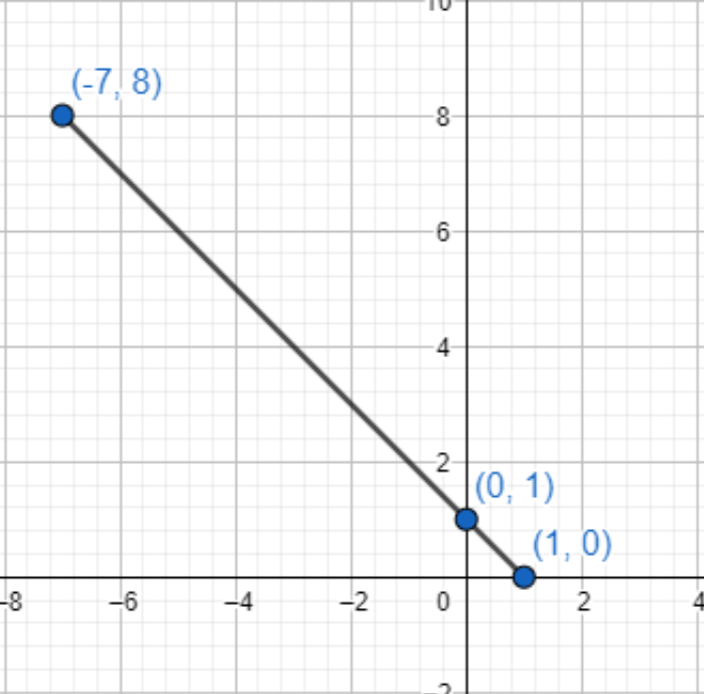
Hence the value of x for which the points (1, 0), (0, 1), and (x, 8) are collinear is -7, which is an option (d).
We can also plot the points and understand that they are collinear as shown below,
Note: Another way to solve this question is opening the determinant directly without using the area of triangle in determinant form.
We can directly use, \[\dfrac{1}{2}\left[ {{x}_{1}}\left( {{y}_{2}}-{{y}_{3}} \right)+{{x}_{2}}\left( {{y}_{3}}-{{y}_{1}} \right)+{{x}_{3}}\left( {{y}_{1}}-{{y}_{2}} \right) \right]\] = 0, and substitute value of \[\left( {{x}_{1}},{{y}_{1}} \right),\left( {{x}_{2}},{{y}_{2}} \right)\] and \[\left( {{x}_{3}},{{y}_{3}} \right)\] directly to get the answer. The answer anyway would be the same.
1 & 1 & 1 \\
{{x}_{1}} & {{x}_{2}} & {{x}_{3}} \\
{{y}_{1}} & {{y}_{2}} & {{y}_{3}} \\
\end{matrix} \right|\]. This way we can easily determine the value of x. To get started, first assume the given points from the question as \[\left( {{x}_{1}},{{y}_{1}} \right)=\left( 1,0 \right)\], \[\left( {{x}_{2}},{{y}_{2}} \right)=\left( 0,1 \right)\], \[\left( {{x}_{3}},{{y}_{3}} \right)=\left( x,8 \right)\] . Now, substitute these properly in the determinant and equate it to 0 to find the value of x.
Complete step-by-step solution:
Given that point (1, 0), (0, 1) and (x, 8) are collinear.
We know the fact that when three points are collinear, it means they lie on the same line. Such a set of points cannot form a triangle where all three points must lie on different lines. So, the area of the triangle formed using these three points will be zero.
Area of triangle, \[\Delta =\dfrac{1}{2}\left| \begin{matrix}
1 & 1 & 1 \\
{{x}_{1}} & {{x}_{2}} & {{x}_{3}} \\
{{y}_{1}} & {{y}_{2}} & {{y}_{3}} \\
\end{matrix} \right|\], where, \[\left( {{x}_{1}},{{y}_{1}} \right)=\left( 1,0 \right)\], \[\left( {{x}_{2}},{{y}_{2}} \right)=\left( 0,1 \right)\], \[\left( {{x}_{3}},{{y}_{3}} \right)=\left( x,8 \right)\].
Given that points are collinear \[\Rightarrow \Delta =0\].
Substituting the value in \[\Delta \] we get;
\[\Rightarrow \Delta =\dfrac{1}{2}\left| \begin{matrix}
1 & 1 & 1 \\
1 & 0 & x \\
0 & 1 & 8 \\
\end{matrix} \right|=0\]
Opening the determinant along first column we get;
\[\begin{align}
& \Rightarrow \dfrac{1}{2}\left| \begin{matrix}
1 & 1 & 1 \\
1 & 0 & x \\
0 & 1 & 8 \\
\end{matrix} \right|=0 \\
& \Rightarrow \dfrac{1}{2}\left[ 1\left( -x \right)-1\left( 8-0 \right)+1\left( 1-0 \right) \right]=0 \\
& \Rightarrow \dfrac{1}{2}\left( -x-7 \right)=0 \\
& \Rightarrow -x=7 \\
& \Rightarrow x=-7 \\
\end{align}\]
Hence the value of x for which the points (1, 0), (0, 1), and (x, 8) are collinear is -7, which is an option (d).
We can also plot the points and understand that they are collinear as shown below,
Note: Another way to solve this question is opening the determinant directly without using the area of triangle in determinant form.
We can directly use, \[\dfrac{1}{2}\left[ {{x}_{1}}\left( {{y}_{2}}-{{y}_{3}} \right)+{{x}_{2}}\left( {{y}_{3}}-{{y}_{1}} \right)+{{x}_{3}}\left( {{y}_{1}}-{{y}_{2}} \right) \right]\] = 0, and substitute value of \[\left( {{x}_{1}},{{y}_{1}} \right),\left( {{x}_{2}},{{y}_{2}} \right)\] and \[\left( {{x}_{3}},{{y}_{3}} \right)\] directly to get the answer. The answer anyway would be the same.
Recently Updated Pages
Master Class 11 Computer Science: Engaging Questions & Answers for Success

Master Class 11 Business Studies: Engaging Questions & Answers for Success
Master Class 11 Economics: Engaging Questions & Answers for Success
Master Class 11 English: Engaging Questions & Answers for Success
Master Class 11 Maths: Engaging Questions & Answers for Success
Master Class 11 Biology: Engaging Questions & Answers for Success
Trending doubts
One Metric ton is equal to kg A 10000 B 1000 C 100 class 11 physics CBSE
There are 720 permutations of the digits 1 2 3 4 5 class 11 maths CBSE
Discuss the various forms of bacteria class 11 biology CBSE
Draw a diagram of a plant cell and label at least eight class 11 biology CBSE
State the laws of reflection of light
10 examples of friction in our daily life