




If the normal at any point P on the ellipse $\dfrac{{{x^2}}}{{{a^2}}} + \dfrac{{{y^2}}}{{{b^2}}} = 1$ meets the axes in G and g respectively, then the ratio \[PG:Pg\] is equal to
A. $a:b$
B. ${a^2}:{b^2}$
C. $b:a$
D. ${b^2}:{a^2}$
Answer
 Verified
539.7k+ views
Hint: In this question, we need to determine the ratio of \[PG:Pg\] such that the normal at any point P on the ellipse $\dfrac{{{x^2}}}{{{a^2}}} + \dfrac{{{y^2}}}{{{b^2}}} = 1$ meets the axes in G and g respectively. For this, we use the equation of the normal to the given ellipse.
First, we are going to find the coordinates of g and G and then we are going to find the distance from the point on the normal and then we are going to find the ratio for which is asked in the question and then simplify it to get the answer.
Formula Used: $ax\sec \theta - yb{\text{cosec}}\theta = {a^2} - {b^2}$
Complete step by step answer:
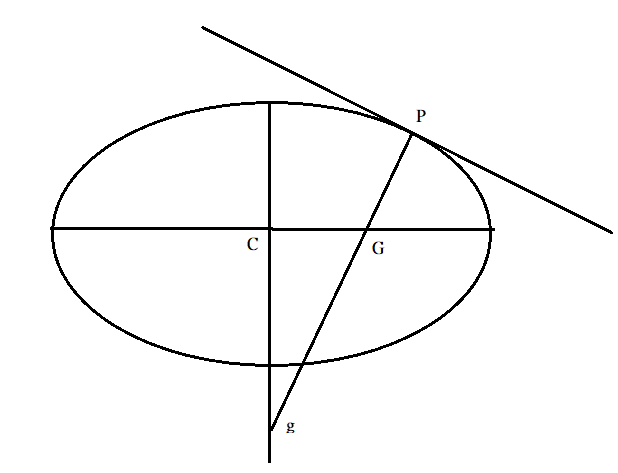
Let \[P \equiv \left( {a{\text{ }}cos{\text{ }}\theta {\text{ }},{\text{ }}b{\text{ }}sin{\text{ }}\theta } \right)\]
The equation of the normal to the given ellipse at P is given by $ax\sec \theta - yb{\text{cosec}}\theta = {a^2} - {b^2}$
Therefore,
$G \equiv \left( {\left( {a - \dfrac{{{b^2}}}{a}} \right)\cos \theta ,0} \right)$ and $g \equiv \left( {0,\left( {b - \dfrac{{{a^2}}}{b}} \right)\sin \theta } \right)$
Thus,
\[
PG = \sqrt {\left( {\dfrac{{{b^4}}}{{{a^2}}}{{\cos }^2}\theta + {b^2}{{\sin }^2}\theta } \right)} \\
= \dfrac{b}{a}\sqrt {\left( {{b^2}{{\cos }^2}\theta + {a^2}{{\sin }^2}\theta } \right)} \\
\]
Also,
\[
Pg = \sqrt {\left( {{a^2}{{\cos }^2}\theta + \dfrac{{{a^4}}}{{{b^2}}}{{\sin }^2}\theta } \right)} \\
= \dfrac{a}{b}\sqrt {\left( {{b^2}{{\cos }^2}\theta + {a^2}{{\sin }^2}\theta } \right)} \\
\]
Now, dividing PG and Pg values, we get
$
\dfrac{{PG}}{{Pg}} = \dfrac{{\dfrac{b}{a}\sqrt {\left( {{b^2}{{\cos }^2}\theta + {a^2}{{\sin }^2}\theta } \right)} }}{{\dfrac{a}{b}\sqrt {\left( {{b^2}{{\cos }^2}\theta + {a^2}{{\sin }^2}\theta } \right)} }} \\
= \dfrac{{{b^2}}}{{{a^2}}} \\
$
Therefore, if the normal at any point P on the ellipse $\dfrac{{{x^2}}}{{{a^2}}} + \dfrac{{{y^2}}}{{{b^2}}} = 1$ meets the axes in G and g respectively, then the ratio PG : Pg is equal to \[\dfrac{{{b^2}}}{{{a^2}}}\].
So, the correct answer is Option D.
Note: There might be confusion in the points of G and g. Normal is defined as the line passing through the point of contact which is perpendicular to the tangent.
An ellipse is defined as the plane curve surrounding two focal points such that for all the points on the curve, the sum of the two distances to the focal points is a constant.
The equation of the standard ellipse centered at the origin with the width 2a and the height 2b is given by
$\dfrac{{{x^2}}}{{{a^2}}} + \dfrac{{{y^2}}}{{{b^2}}} = 1$
If the equation of the ellipse is
$\dfrac{{{x^2}}}{{{a^2}}} + \dfrac{{{y^2}}}{{{b^2}}} = 1$
Then, the point form equation of the normal at point (${x_1},{y_1}$) is $y - {y_1} = \dfrac{{{y_1}{a^2}}}{{{x_1}{b^2}}}(x - {x_1}),{x_1} \ne 0$
First, we are going to find the coordinates of g and G and then we are going to find the distance from the point on the normal and then we are going to find the ratio for which is asked in the question and then simplify it to get the answer.
Formula Used: $ax\sec \theta - yb{\text{cosec}}\theta = {a^2} - {b^2}$
Complete step by step answer:
Let \[P \equiv \left( {a{\text{ }}cos{\text{ }}\theta {\text{ }},{\text{ }}b{\text{ }}sin{\text{ }}\theta } \right)\]
The equation of the normal to the given ellipse at P is given by $ax\sec \theta - yb{\text{cosec}}\theta = {a^2} - {b^2}$
Therefore,
$G \equiv \left( {\left( {a - \dfrac{{{b^2}}}{a}} \right)\cos \theta ,0} \right)$ and $g \equiv \left( {0,\left( {b - \dfrac{{{a^2}}}{b}} \right)\sin \theta } \right)$
Thus,
\[
PG = \sqrt {\left( {\dfrac{{{b^4}}}{{{a^2}}}{{\cos }^2}\theta + {b^2}{{\sin }^2}\theta } \right)} \\
= \dfrac{b}{a}\sqrt {\left( {{b^2}{{\cos }^2}\theta + {a^2}{{\sin }^2}\theta } \right)} \\
\]
Also,
\[
Pg = \sqrt {\left( {{a^2}{{\cos }^2}\theta + \dfrac{{{a^4}}}{{{b^2}}}{{\sin }^2}\theta } \right)} \\
= \dfrac{a}{b}\sqrt {\left( {{b^2}{{\cos }^2}\theta + {a^2}{{\sin }^2}\theta } \right)} \\
\]
Now, dividing PG and Pg values, we get
$
\dfrac{{PG}}{{Pg}} = \dfrac{{\dfrac{b}{a}\sqrt {\left( {{b^2}{{\cos }^2}\theta + {a^2}{{\sin }^2}\theta } \right)} }}{{\dfrac{a}{b}\sqrt {\left( {{b^2}{{\cos }^2}\theta + {a^2}{{\sin }^2}\theta } \right)} }} \\
= \dfrac{{{b^2}}}{{{a^2}}} \\
$
Therefore, if the normal at any point P on the ellipse $\dfrac{{{x^2}}}{{{a^2}}} + \dfrac{{{y^2}}}{{{b^2}}} = 1$ meets the axes in G and g respectively, then the ratio PG : Pg is equal to \[\dfrac{{{b^2}}}{{{a^2}}}\].
So, the correct answer is Option D.
Note: There might be confusion in the points of G and g. Normal is defined as the line passing through the point of contact which is perpendicular to the tangent.
An ellipse is defined as the plane curve surrounding two focal points such that for all the points on the curve, the sum of the two distances to the focal points is a constant.
The equation of the standard ellipse centered at the origin with the width 2a and the height 2b is given by
$\dfrac{{{x^2}}}{{{a^2}}} + \dfrac{{{y^2}}}{{{b^2}}} = 1$
If the equation of the ellipse is
$\dfrac{{{x^2}}}{{{a^2}}} + \dfrac{{{y^2}}}{{{b^2}}} = 1$
Then, the point form equation of the normal at point (${x_1},{y_1}$) is $y - {y_1} = \dfrac{{{y_1}{a^2}}}{{{x_1}{b^2}}}(x - {x_1}),{x_1} \ne 0$
Recently Updated Pages
Master Class 11 Computer Science: Engaging Questions & Answers for Success

Master Class 11 Business Studies: Engaging Questions & Answers for Success
Master Class 11 Economics: Engaging Questions & Answers for Success
Master Class 11 English: Engaging Questions & Answers for Success
Master Class 11 Maths: Engaging Questions & Answers for Success
Master Class 11 Biology: Engaging Questions & Answers for Success
Trending doubts
One Metric ton is equal to kg A 10000 B 1000 C 100 class 11 physics CBSE
There are 720 permutations of the digits 1 2 3 4 5 class 11 maths CBSE
Discuss the various forms of bacteria class 11 biology CBSE
Draw a diagram of a plant cell and label at least eight class 11 biology CBSE
State the laws of reflection of light
Explain zero factorial class 11 maths CBSE